
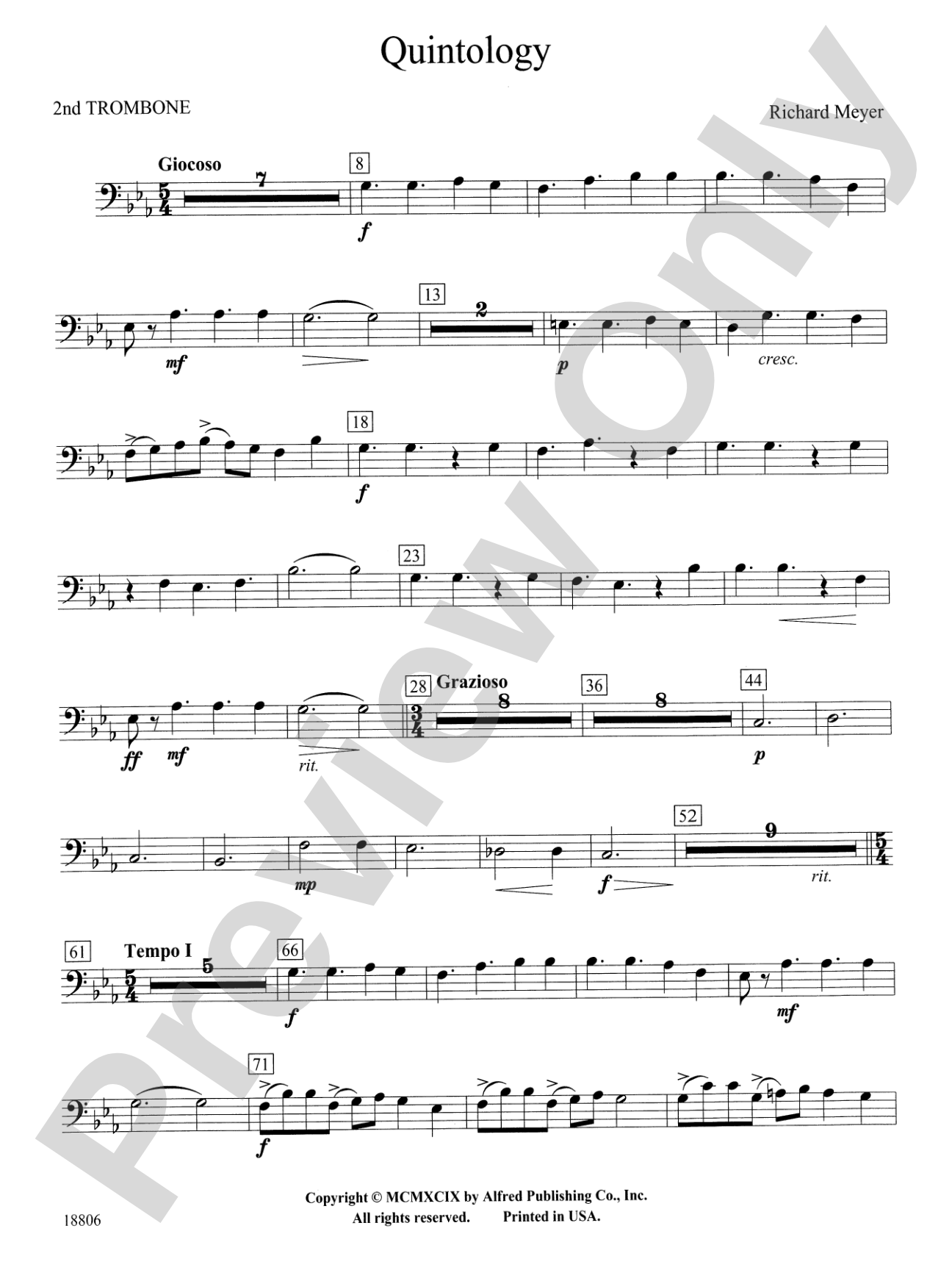

Quintology: 2nd Trombone
By Richard Meyer
Grade: 2 (Medium Easy)
Item: 00-PC-0000284_TN2
$3.00
Pickup currently not available
Description
The name says it all! Leave it to the ever-crafty Richard Meyer to base an entire piece on the number five. Its "quintological" features include utilizing a five-part form, including perfect fiffhs, pentatonic scales, 5/4 time, 2/4 + 3/4 time and much more. This piece is all things five! Program Quintology on your next concert and your band will have five times the fun! This title is available in MakeMusic Cloud.


Don't just read it, hear it, play along with it, and watch your students grow with it. In MakeMusic Cloud, Quintology: 2nd Trombone comes alive with professional accompaniment, adjustable tempo, and built-in practice tools that turn solo practice into real progress.
Open in the Player
Jump straight in and assign it today.
Start Your Free Trial
Open this title and explore the full library in minutes.
Sample Audio
1
Audio File
--:--
0:00
0:00
Sample Video
No sample videos found.
Additional Details
Series:
Young Symphonic
Publisher:
Alfred Music
Page Count:
268
SKU:
00-PC-0000284_TN2
More about this title
About the Composer: Richard Meyer

Richard Meyer brings three decades of classroom experience to his work as a composer and educator. He spent 22 years building the string program at Oak Avenue Intermediate School in Temple City, California, expanding it from 29 students to 200, and directed the Pasadena Youth Symphony Orchestra for 16 years, taking ensembles on international tours to Vienna, Australia, and Canada. Beyond the podium, Meyer created the "Giving Bach" program in 2009, which uses interactive concerts to reach students with special needs and underserved communities throughout Southern California, earning national recognition for the model.
As a composer, Meyer has become one of the most published voices in music education, with nearly 200 works and arrangements in print. He spent 16 years as string editor for Alfred Publishing and co-authored foundational method books including the String Explorer Series and Sight-read It for Strings. Meyer remains active as a guest conductor and clinician, having presented at the A.S.T.A. National Conference, the Texas Orchestra Directors' Association Conference, and string workshops at Ohio State University.
Why we love this
Meyer's structural ingenuity here is genuinely clever without feeling gimmicky. He commits fully to the "five" concept across harmonic language, rhythmic texture, and formal design, creating a piece that rewards careful listening and keeps young ensembles engaged with its variety. It's the kind of concept-driven work that makes students understand how compositional ideas can shape an entire piece from the ground up.
What to expect
Quintology feels inventive and playful, built on interlocking harmonic and rhythmic ideas that create momentum without heaviness. The pentatonic writing gives it an open, accessible quality, while the meter changes and perfect fifths add enough sophistication to keep the piece interesting throughout.
Who it's for
This is an ideal piece for concert band directors working with Grade 2 ensembles who want to expose students to mixed meter and pentatonic writing without overwhelming them. The clever conceptual architecture makes it engaging for both young musicians and audiences, and it works equally well in concert and festival contexts.
How to get the most out of it
- Establish the pentatonic scale patterns early in sectionals so students recognize the harmonic environment. This foundation makes rhythm changes feel less disorienting.
- Approach the meter shifts (5/4, 2/4 + 3/4) by conducting through the larger pulse rather than subdividing. Let students feel how these meters still create forward motion.
- Highlight the perfect fifth intervals in the harmonic structure during rehearsal. Meyer uses them as a unifying thread, and bringing awareness to this device deepens ensemble cohesion.
How to use it
Use Quintology as a feature piece on a concert celebrating contemporary band music or compositional craft. Its conceptual clarity and Grade 2 accessibility make it a strong opener or closer that engages both young musicians and family audiences.
Skills your students will build
- Reading and performing in 5/4 and mixed meter (2/4 + 3/4)
- Identifying and performing pentatonic scale patterns
- Hearing and balancing perfect fifth harmonies
- Executing a five-part formal structure
- Maintaining ensemble cohesion through meter changes