
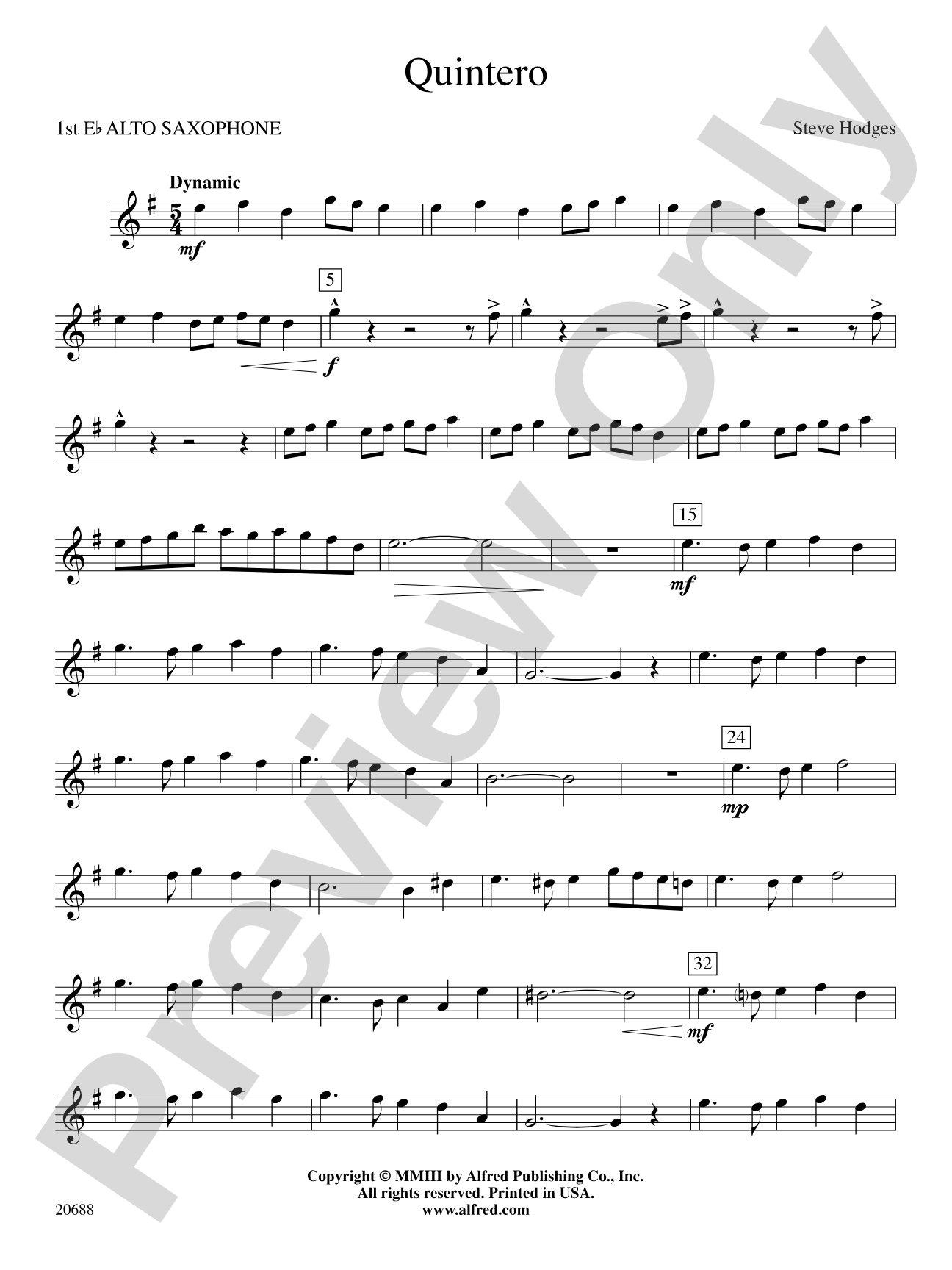

Quintero: E-flat Alto Saxophone
By Steve Hodges
Grade: 2 (Medium Easy)
Item: 00-PC-0000435_AX1
$3.00
Pickup currently not available
Description
This exciting new piece from Steve Hodges begins with a chorale-type introduction that leads to a dynamic opening statement by the low brass. The main theme is legato to contrast with the busy percussion section. A secondary theme, introduced by the woodwinds, is followed by the return of the introduction with development. The second theme is then repeated by the woodwinds in a light, jazzy style. This leads to a powerful conclusion where the percussion section drives the full ensemble to a rousing finish.


Don't just read it, hear it, play along with it, and watch your students grow with it. In MakeMusic Cloud, Quintero: E-flat Alto Saxophone comes alive with professional accompaniment, adjustable tempo, and built-in practice tools that turn solo practice into real progress.
Open in the Player
Jump straight in and assign it today.
Start Your Free Trial
Open this title and explore the full library in minutes.
Sample Audio
1
Audio File
--:--
0:00
0:00
Sample Video
No sample videos found.
Additional Details
Series:
Young Symphonic
Publisher:
Alfred Music
Page Count:
270
SKU:
00-PC-0000435_AX1
More about this title
About the Composer: Steve Hodges

Steve Hodges holds degrees from Western Oregon University (Bachelor of Science) and Central Washington University (Master of Music Education). He spent four decades in public school music education, directing bands, choirs, and chamber ensembles across all performance levels before retiring from classroom teaching.
Since 1986, Hodges has composed and published more than 120 concert band works through Alfred Music, along with choral arrangements issued by Staff Music and Shawnee Press. His music has been performed internationally at festivals and state conventions, and he has received commissions from honor bands and school programs throughout the United States and Canada. His compositions have also been licensed by major television networks including TBS and ESPN. Hodges is an ASCAP member and currently lives in The Dalles, Oregon, where he remains active in community music alongside his wife, Teddie.
Why we love this
Quintero delivers exactly what a Grade 2 program needs: engaging musical substance without overwhelming players. The structure (chorale intro, strong brass statement, legato melody against rhythmic accompaniment, secondary theme, and development) teaches directors how to build architecture into accessible writing, and students experience a complete musical journey in one rehearsal-friendly package. It's a piece that sounds impressive in performance but respects the technical reality of developing ensembles.
What to expect
Quintero opens with quiet dignity, then shifts into energetic momentum. The interplay between lyrical brass lines and rhythmic activity creates forward motion, while the woodwind sections add freshness and lift. The final push is triumphant and satisfying, leaving both performers and audiences with a sense of accomplishment.
Who it's for
Grade 2 concert bands ready to program a piece that combines musical credibility with accessibility. Directors seeking repertoire that develops ensemble balance, phrasing, and form without excessive technical demands will find a reliable choice here.
How to get the most out of it
- Shape the chorale introduction with consistent phrase direction and allow silence to breathe between the opening statement and the dynamic brass entrance. This contrast anchors the form for both players and listeners.
- Balance the legato main theme against the busy percussion; the theme should sing clearly above the accompaniment without the rhythm section receding into the background. This teaches ensemble blend at its core.
- Bring out the secondary woodwind theme with clarity and lightness when it returns in the jazzy style. Use this section to explore articulation and rhythmic precision without sacrificing the flowing character.
- Build the final section deliberately. The percussion drives the conclusion, but the full ensemble should sound unified and powerful rather than scattered. Take time in rehearsal to lock the ensemble with the percussion pulse.
How to use it
This works as a strong concert opener or mid-program piece that establishes the band's musicality early. Its clarity of structure and accessible difficulty make it ideal for festival or contest contexts where you want to showcase ensemble fundamentals. It also pairs well in a program with either more challenging repertoire (it prepares the ear for musical development) or lighter fare (it provides substance without demanding extended technical focus).
Skills your students will build
- Balancing melody against accompaniment in ensemble settings
- Shaping long-lined legato phrases across phrase boundaries
- Responding to dynamic contrasts between calm introductions and energetic sections
- Executing rhythmic precision in busier accompaniment passages
- Understanding formal structure (introduction, theme, secondary theme, development, return, conclusion)
- Listening for and matching articulation styles (traditional, jazzy) within the same piece