
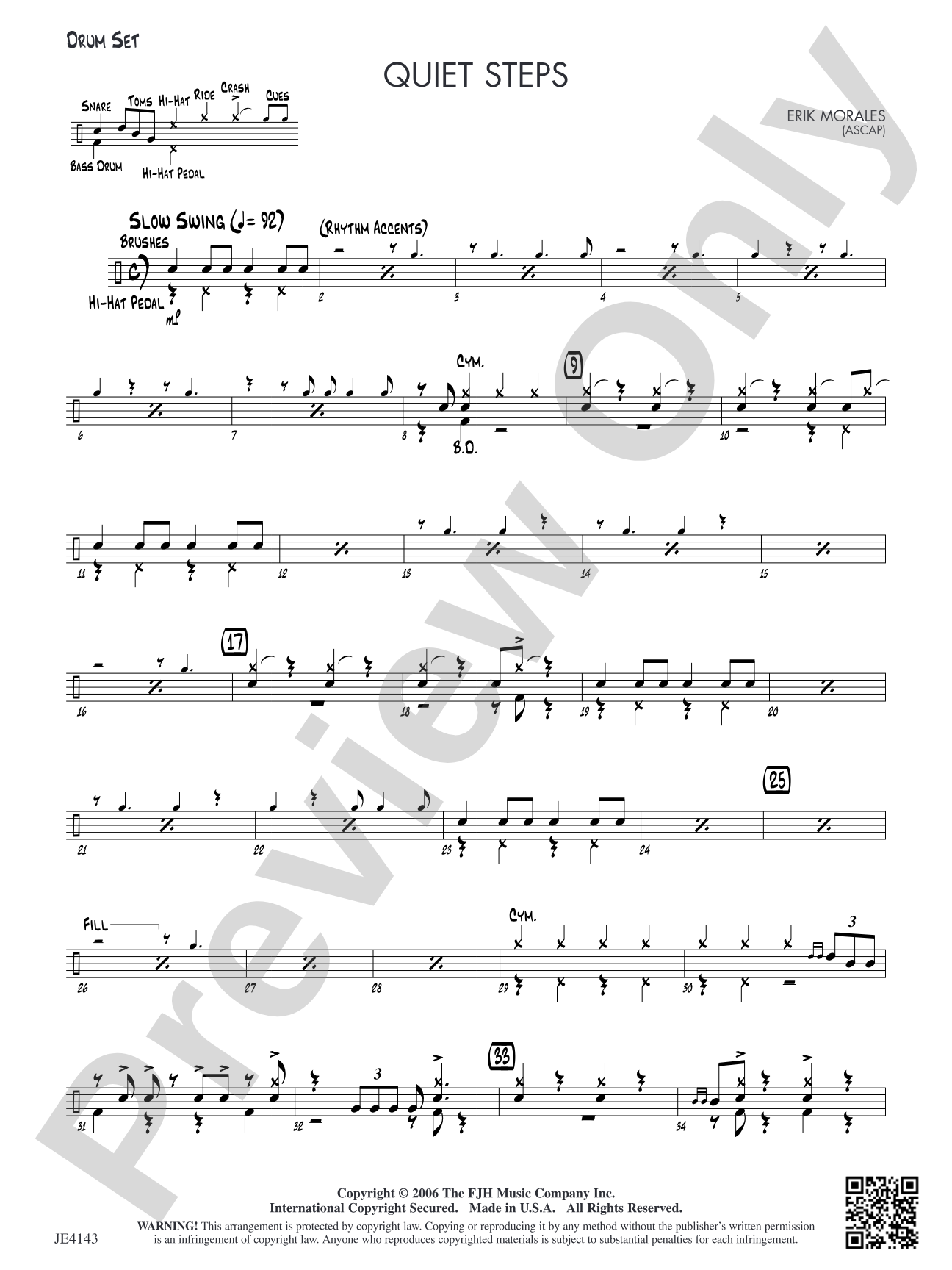

Quiet Steps: Drum Set
By Erik Morales
Grade: 2
Item: 98-PC-DJE4143_DS
$7.00
Pickup currently not available
Description
Inspired by John Coltrane's Giant Steps, this slow swing ballad features a simple melody over a fairly complex chord structure (voiced for rhythm section if not playing changes). Evoking images of dark, smoky jazz clubs of the '50s, a warm flugelhorn (opt.) solo adds to the mystique and charm. Beautiful ensemble writing within the framework of a mature-sounding yet technically approachable ballad.


Quiet Steps: Drum Set isn't in MakeMusic Cloud just yet...but it could be. Let us know you'd like to see it, and you'll help shape what comes next. In the meantime, start a free trial and dive into thousands of interactive titles your students can play along with today.
Request This Title
Tell us you want it.
Start Your Free Trial
Explore everything that's ready to play right now.
Sample Audio
1
Audio File
--:--
0:00
0:00
Sample Video
No sample videos found.
Additional Details
Series:
FJH Developing Jazz Ensemble
Publisher:
The FJH Music Company, Inc.
SKU:
98-PC-DJE4143_DS
More about this title
About the Composer: Erik Morales

Erik Morales began composing shortly after high school in south Florida, when a former band director asked him to arrange music for the marching band in 1985. That early opportunity launched a prolific career spanning classical, jazz, and commercial genres; his published works now exceed 150 titles across wind, orchestral, jazz, and chamber settings, and his compositions have been performed internationally and commissioned regularly by schools and organizations.
A native of New York City (born December 10, 1966), Morales studied composition at Florida International University and earned his bachelor's degree from the University of Louisiana, Lafayette in 1989. His contributions to the trumpet repertoire have earned particular recognition, including first-place performances at the National Trumpet Competitions and premieres at the International Trumpet Guild conference. In 2016, he was inducted into the Louisiana Association for Jazz Education's Hall of Fame. His compositional approach consistently balances artistic substance with pedagogical accessibility, making sophisticated musical ideas available to developing ensembles.
Why we love this
Morales captures the essence of classic '50s jazz without demanding virtuosic chops from young players. The chord structure (inspired by Giant Steps) provides genuine harmonic interest for rhythm section musicians and offers soloists real changes to navigate, while the straightforward melody keeps the piece accessible and vocalist-friendly for the full ensemble.
What to expect
Quiet Steps evokes the intimate atmosphere of a dimly lit jazz room, where a single voice speaks over softly comped changes. The melody unfolds with the unhurried grace of a late-night set, and the optional flugelhorn solo adds a contemplative warmth that lingers like cigarette smoke in still air.
Who it's for
Jazz ensemble directors seeking material that develops musicianship without excessive technical barriers. This works equally well for developing ensembles building maturity through ballad interpretation and for more advanced groups exploring mature harmonic concepts within an approachable framework.
How to get the most out of it
- Shape the ballad with careful attention to dynamic contour; the warm character emerges through subtle swells and releases rather than dramatic dynamic shifts.
- If using the optional flugelhorn solo, balance it intimately against the ensemble backdrop so it remains the focal point without overwhelming the texture.
- Lock the rhythm section on the harmonic progression early in rehearsal; once that foundation is secure, soloists and the ensemble melody will sit naturally on top.
- Emphasize the swing feel throughout, even at a relaxed tempo; straight eighths will flatten the ballad's intended mood.
How to use it
Program this as an emotional centerpiece in a jazz concert, placing it alongside uptempo selections to showcase the ensemble's dynamic range and maturity. It also pairs beautifully with standards and other ballads, demonstrating how contemporary composition can honor the tradition of the form.
Skills your students will build
- Interpreting swing feel at slow tempos
- Reading and executing chord changes (rhythm section)
- Balancing a solo voice against ensemble texture
- Shaping long-form melodic lines with limited harmonic movement
- Accompanying ensemble writing within jazz voicings