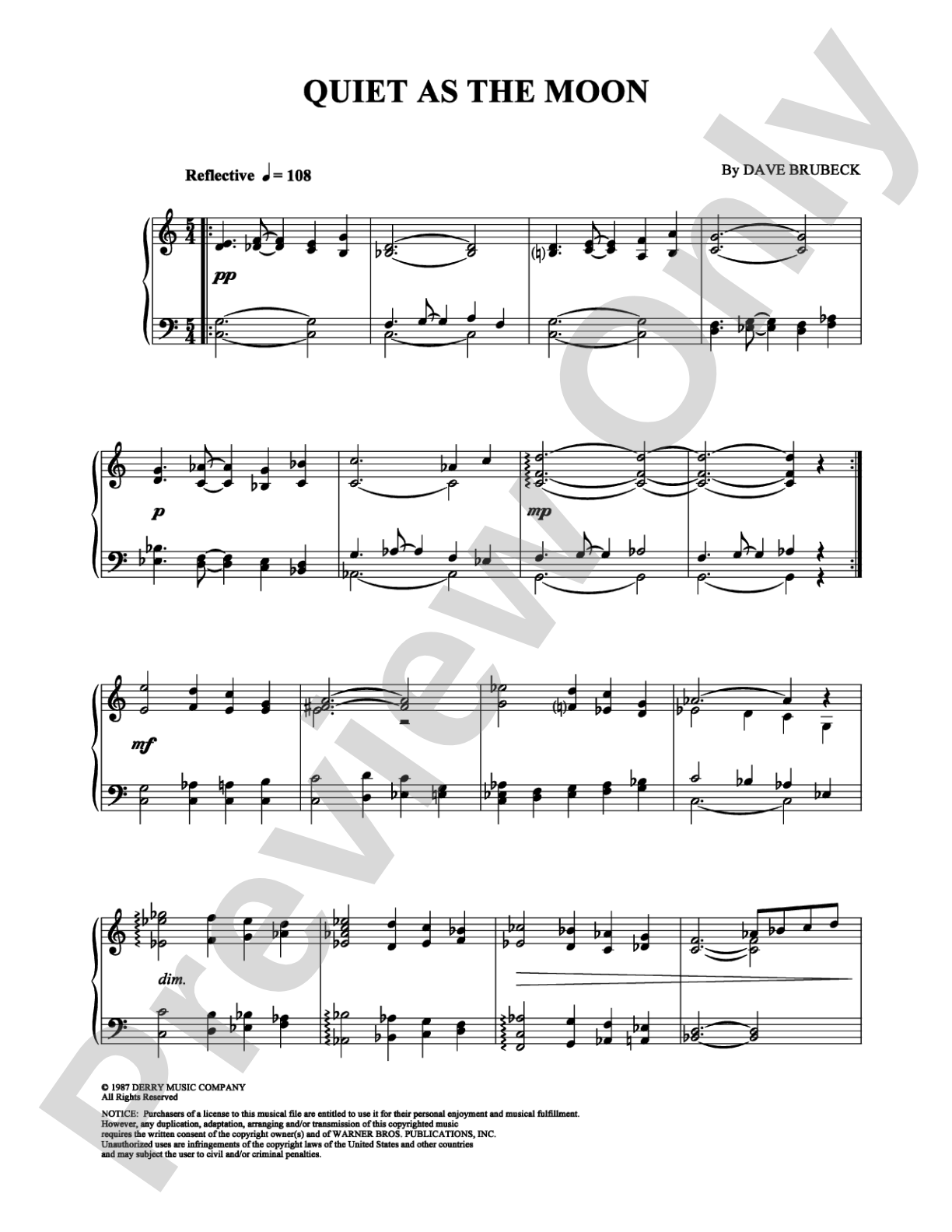
Quiet As The Moon: Piano Digital Sheet Music

Quiet As The Moon: Piano Digital Sheet Music

Dave Brubeck

Item: 00-PS-0000751

Digital Download
$3.99
Description

Quiet As The Moon: Piano Digital Sheet Music isn't in MakeMusic Cloud just yet...but it could be. Let us know you'd like to see it, and you'll help shape what comes next. In the meantime, start a free trial and dive into thousands of interactive titles your students can play along with today.

Sample Audio
No sample audio found.
Sample Video
Additional Details
SKU: 00-PS-0000751

More about this title

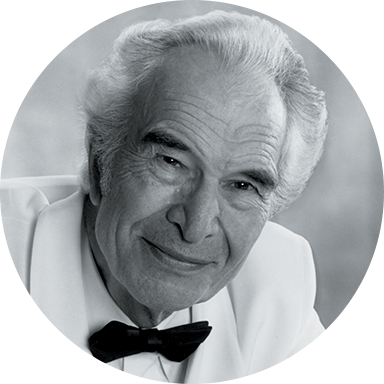
About the Artist: Dave Brubeck

Dave Brubeck

Dave Brubeck stands as one of jazz's most consequential figures, equally accomplished as an improviser and a disciplined composer. His compositions span choral works, hymns, orchestral pieces, chamber music, and large-scale works for chorus and orchestra, all written in full notation. Beyond his landmark recordings including the culturally historic album Time Out and the signature piece "Take Five," Brubeck studied composition with Darius Milhaud at Mills College following World War II service. Milhaud's influence shaped Brubeck's distinctive approach of integrating jazz language with classical compositional techniques.

Throughout his career, Brubeck advanced music on and off the stage. He broke racial barriers in mid-twentieth-century America through his performances and recordings, and his sacred music including To Hope!, Pange Lingua Variations, and the oratorios The Voice of the Holy Spirit and Beloved Son have been performed and recorded by major orchestras and choirs worldwide. His honors include the Presidential Medal of the Arts, Grammy Lifetime Achievement Award, election to the American Classical Music Hall of Fame in 2003, and recognition from the London Symphony Orchestra.

Why we love this

Brubeck's piano writing balances the spontaneity of jazz with the clarity of composed form, making this piece rewarding for pianists who want to engage with modern jazz vocabulary without sacrificing structure. As a composer trained in both classical and jazz languages, he creates pieces that honor both traditions, offering students and teachers genuine crossover repertoire that doesn't feel watered down or overly simplified.

What to expect

A contemplative piece with subtle harmonic movement and the quietness its title promises. The piece conveys the stillness and clarity of moonlight, unfolding with the restraint of a master composer who trusts space and silence as much as notes.

Who it's for

Pianists with solid classical technique who are ready to explore jazz composition and harmonic language. Intermediate to advanced students will find the piece accessible yet sophisticated, offering a meaningful introduction to Brubeck's aesthetic without requiring extensive jazz training.

How to get the most out of it

  • Approach the harmonic language with the same precision you'd give a classical score; Brubeck's notated harmonies are deliberate, not suggestions for improvisation.
  • Listen to recordings of Brubeck's own playing to absorb his touch and phrasing; his interpretation of his own work reveals nuances that notation alone cannot capture.
  • Balance reflective passages with the underlying rhythmic clarity that defines Brubeck's compositional voice; resist the temptation to rush quiet sections.
  • Pay attention to the interplay between melody and accompaniment; Brubeck often shifts the musical weight unexpectedly, and these transitions shape the piece's emotional arc.

How to use it

Pair this with other jazz-influenced classical pieces in a concert exploring the intersection of vernacular and concert music traditions. It works equally well as a solo recital piece for pianists developing interpretive maturity, or as an adjudication selection that demonstrates both technical control and expressive depth.

Skills your students will build

  • Reading and interpreting Brubeck's jazz-inflected harmonic language within a notated score
  • Balancing rhythmic precision with expressive phrasing in a modern jazz composition
  • Understanding how classical compositional form interacts with jazz vocabulary and vocabulary
  • Developing touch and pedaling technique for creating subtle tonal gradations in intimate passages

You May Also Like