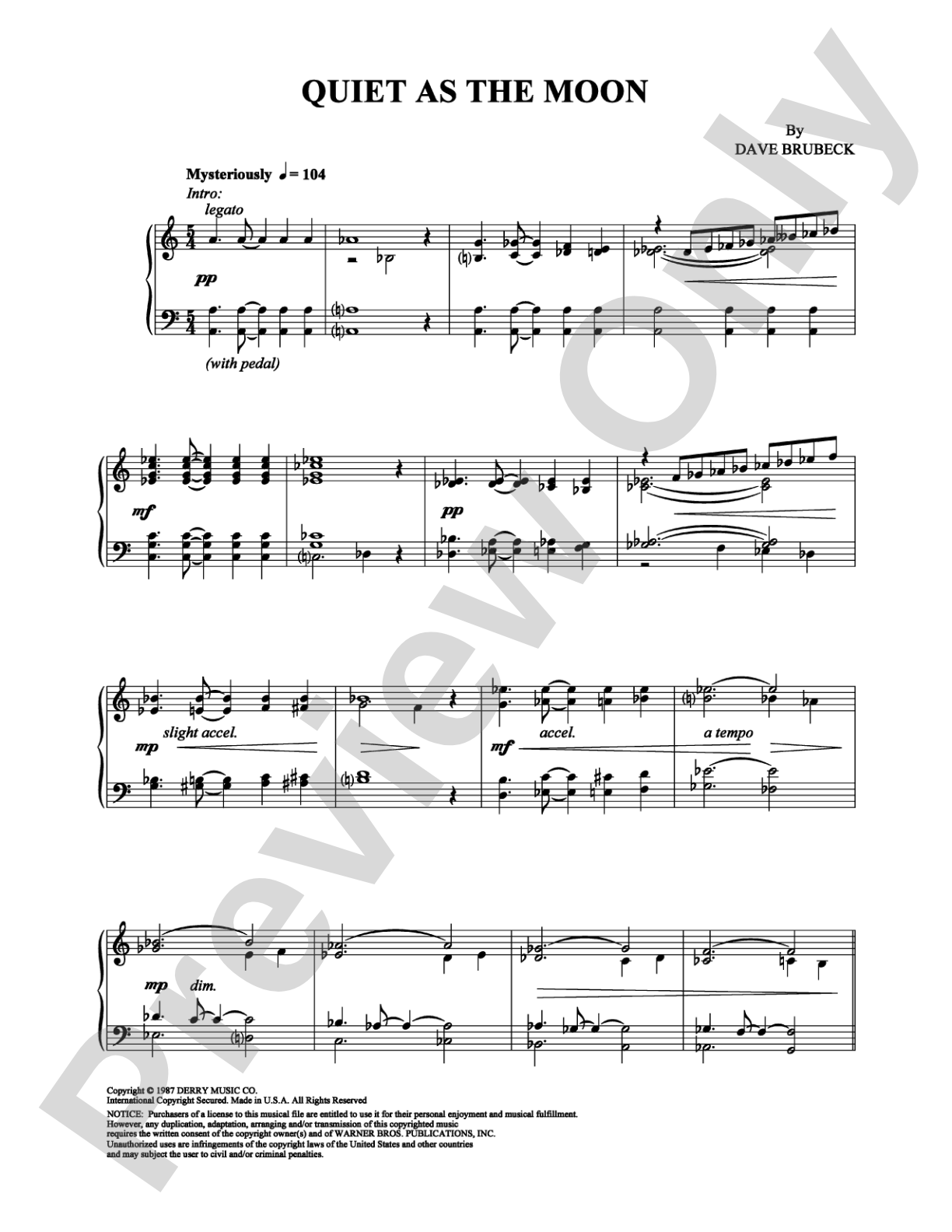
Quiet As The Moon: Piano Digital Sheet Music

Quiet As The Moon: Piano Digital Sheet Music

Dave Brubeck

Item: 00-PS-0000750

Digital Download
$3.99
Description

Quiet As The Moon: Piano Digital Sheet Music isn't in MakeMusic Cloud just yet...but it could be. Let us know you'd like to see it, and you'll help shape what comes next. In the meantime, start a free trial and dive into thousands of interactive titles your students can play along with today.

Sample Audio
No sample audio found.
Sample Video
Additional Details
SKU: 00-PS-0000750

More about this title

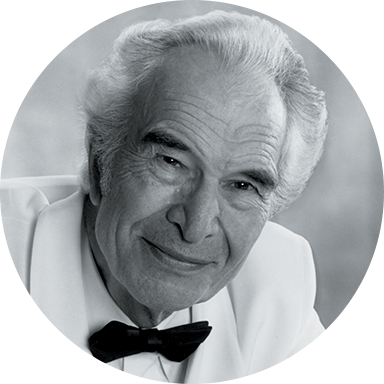
About the Artist: Dave Brubeck

Dave Brubeck

Dave Brubeck stands as one of jazz's most consequential figures, equally at home improvising at the keyboard and crafting fully notated compositions across multiple genres. His body of work spans choral pieces, hymns, orchestral works, chamber music, ballet suites, and large-scale pieces for chorus and orchestra, all informed by his studies with Darius Milhaud at Mills College following World War II. Milhaud's influence encouraged Brubeck to weave jazz language into classical forms, a synthesis that defined his artistic vision.

Beyond his groundbreaking recordings, including "Time Out," the first jazz album to sell over a million copies, Brubeck used his prominence to challenge racial segregation in mid-twentieth-century America. His sacred works including "To Hope!" and the oratorios "The Voice of the Holy Spirit" and "Beloved Son" have been performed and recorded worldwide. The honors accumulated throughout his lifetime included the Presidential Medal of the Arts, a Grammy Lifetime Achievement Award, and induction into the American Classical Music Hall of Fame in 2003.

Why we love this

Brubeck's piano compositions merge the immediacy of jazz with the rigor of classical writing, giving pianists genuine interpretive choices within a fully notated score. This piece reflects his gift for writing melody that feels both fresh and singable, with the harmonic language that made his small group recordings so compelling. Programming a Brubeck original connects your students to a composer who shaped American music while maintaining artistic integrity across jazz and concert music.

What to expect

The title evokes contemplation and gentleness, with a quietness that feels intentional rather than tentative. Brubeck's harmonic language creates subtle sophistication, moving with an ease that masks careful compositional craft.

Who it's for

This piece suits intermediate to advanced pianists who want to explore jazz-inflected composition from one of the genre's most respected voices. It works equally well for students drawn to contemporary classical contexts and those studying jazz standards and originals.

How to get the most out of it

  • Let the melody breathe with natural phrasing rather than mechanical evenness; Brubeck's compositions reward expressive rubato within the written time signature.
  • Pay close attention to Brubeck's harmonic language and voice leading in the left hand, which often contains the compositional logic that supports the melody.
  • Approach this as a complete thought rather than a display of technique; the piece's strength lies in its directness and emotional clarity, not in virtuosic flourish.

How to use it

This piece fits naturally into a recital celebrating American composers or into a program exploring the intersection of jazz and contemporary classical music. Its modest scope makes it a strong choice for student recitals or salon concerts where intimate, character-driven music creates the right atmosphere.

Skills your students will build

  • Interpreting jazz harmonies and voice leading in a notated context
  • Balancing melodic clarity with harmonic sophistication
  • Shaping phrasing and rubato within a jazz-informed harmonic framework
  • Understanding Brubeck's compositional voice and aesthetic

You May Also Like