
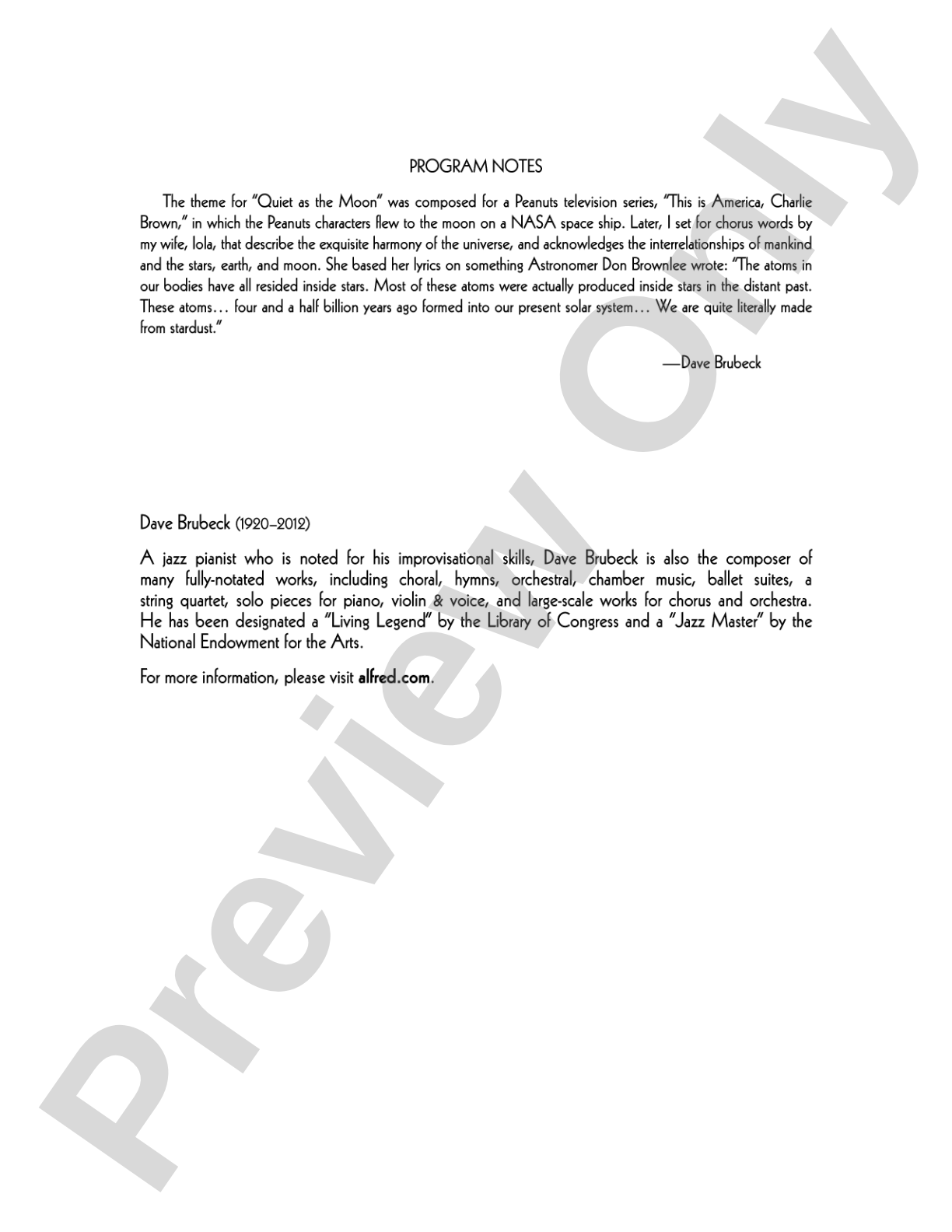
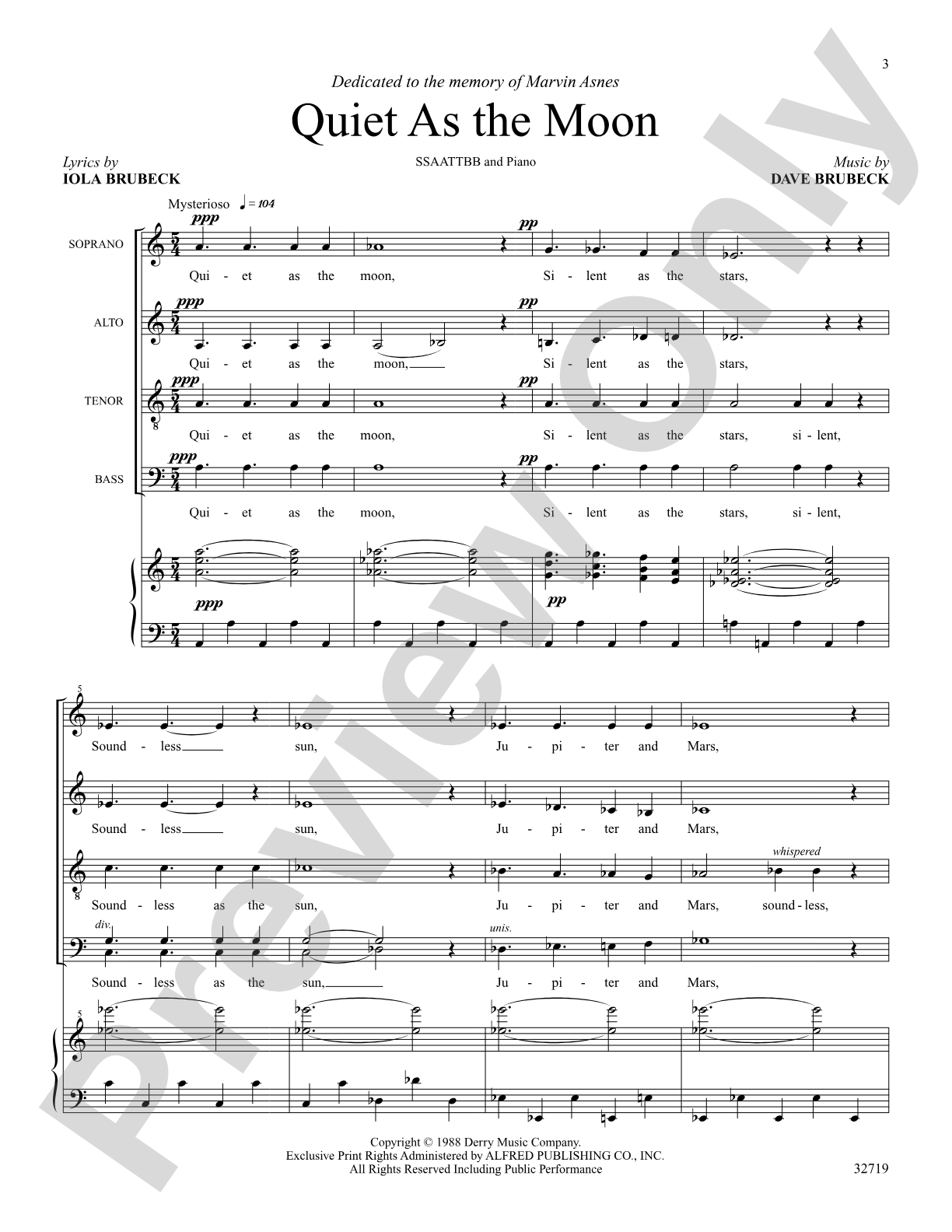
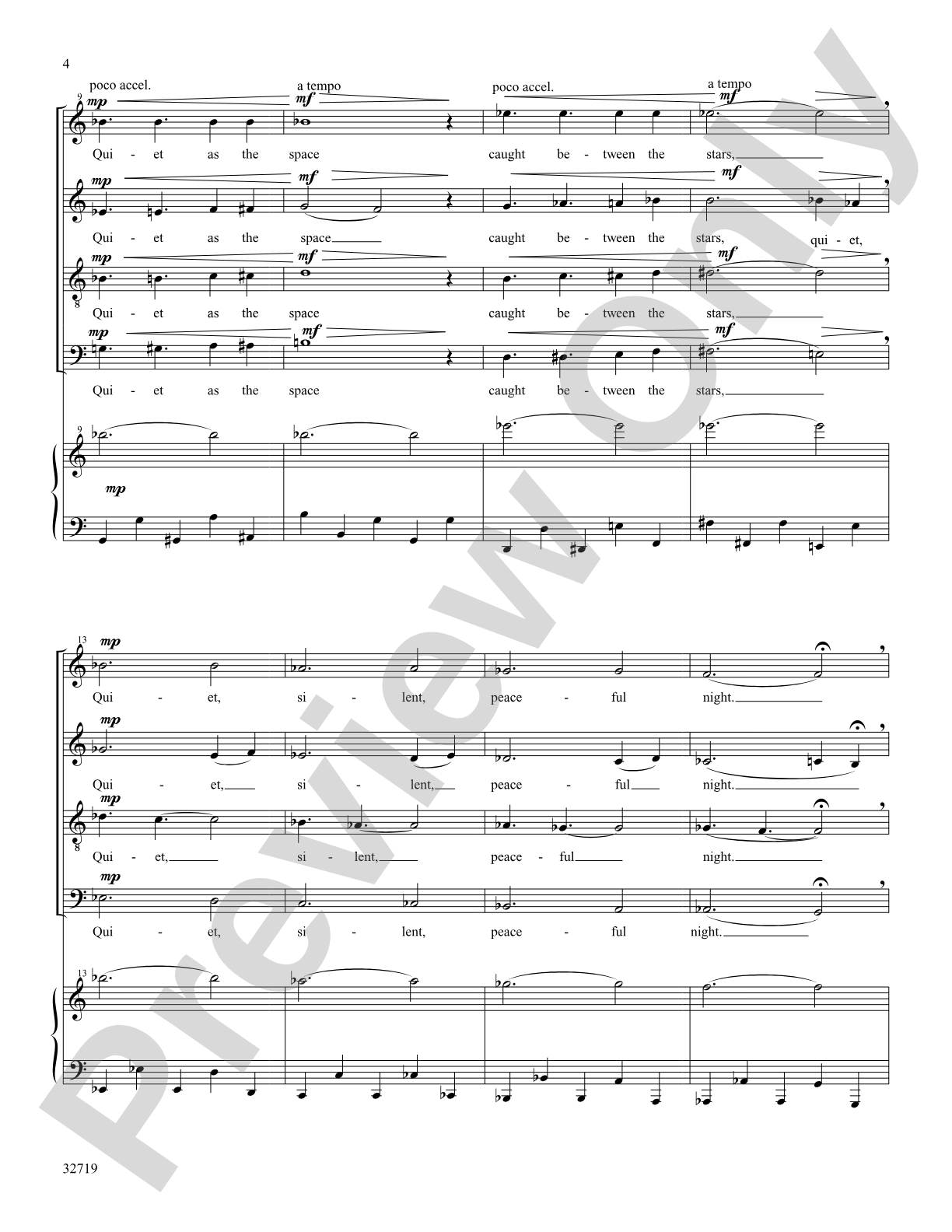

Quiet As the Moon: SSAATTBB Choral Octavo
Music by Dave Brubeck, lyrics by Iola Brubeck
Item: 00-PO-0004394
$2.95
Minimum order quantity: 20 copies
Pickup currently not available
Related Items
Quiet As the Moon: SSAATTBB Choral Octavo |
$2.95
|
View |
Description


Quiet As the Moon: SSAATTBB Choral Octavo isn't in MakeMusic Cloud just yet...but it could be. Let us know you'd like to see it, and you'll help shape what comes next. In the meantime, start a free trial and dive into thousands of interactive titles your students can play along with today.
Request This Title
Tell us you want it.
Start Your Free Trial
Explore everything that's ready to play right now.
Sample Audio
No sample audio found.
Sample Video
No sample videos found.
Additional Details
Series:
Lawson-Gould: The Dave Brubeck Series
Publisher:
Alfred Music
Page Count:
16
SKU:
00-PO-0004394
More about this title
About the Composer: Dave Brubeck
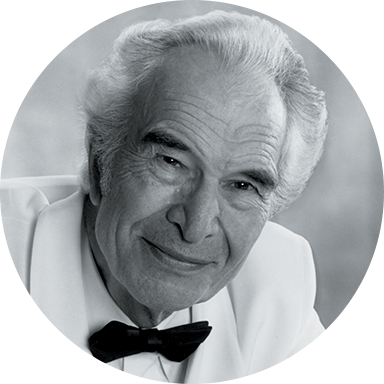
Dave Brubeck built his reputation as a jazz pianist through innovative improvisation, but his compositional ambitions extended far beyond the jazz idiom. He created a substantial body of formally notated works spanning choral pieces, hymns, orchestral compositions, chamber music, and large-scale works for chorus and orchestra. His studies with Darius Milhaud at Mills College after World War II shaped his approach to blending jazz language with classical forms, a fusion that defined much of his output.
Brubeck's cultural impact transcended music. He helped dismantle racial barriers in mid-20th-century American music and achieved unprecedented commercial success with "Time Out," the first jazz album to sell over a million copies. His choral and orchestral works, including the mass "To Hope!" and oratorios like "The Voice of the Holy Spirit" and "Beloved Son," have been performed and recorded internationally by major ensembles. Throughout his career, he received numerous honors including the Presidential Medal of the Arts, a Grammy Lifetime Achievement Award, and induction into the American Classical Music Hall of Fame in 2003.
Why we love this
Brubeck's choral writing brings the sophistication and harmonic richness of his jazz compositions into a format accessible to any skilled choir. The eight-part texture allows for the kind of intricate voice leading and unexpected harmonic movement that made his instrumental works so distinctive, giving singers a genuine engagement with serious compositional thinking rather than conventional pop arrangements.
What to expect
The piece carries a contemplative, introspective quality suggested by its title, with the harmonic sophistication of Brubeck's jazz vocabulary translated into sustained choral sonorities. The eight-part texture creates an enveloping, rich sound world that feels both modern in its harmonies and timeless in its restraint.
Who it's for
Choirs with solid sight-reading skills and the ability to manage complex harmonic material benefit most from this piece. High school treble or mixed choirs with strong fundamentals, college choirs, and professional chamber choirs can all find rewarding challenges in Brubeck's eight-part writing.
How to get the most out of it
- Balance the eight voices so no single part dominates; the SSAATTBB texture is designed to create harmonic density, not to highlight soloistic lines.
- Pay attention to how Brubeck uses silence and rests within phrases. His jazz sensibility includes space as a compositional tool, so resist the urge to fill every moment with sound.
- Approach the harmonic language with the same flexibility you would a jazz standard. Brubeck's chord movements may feel less traditional than hymn-style writing; let the singers feel the logic of how each sonority flows into the next.
- Rehearse the piece sectionally by voice part first, especially with the divided sopranos, altos, tenors, and basses. Once the individual lines are secure, the full harmonic picture will emerge more easily in combined rehearsals.
How to use it
This works well as a concert closer or centerpiece for a program focused on 20th-century American composers. Its serious but accessible character makes it suitable for a concert that bridges classical and jazz traditions, and at 16 pages, it commands attention without dominating an entire program.
Skills your students will build
- Reading and sustaining eight-part mixed voicing with independent melodic lines
- Navigating non-diatonic harmony and jazz-influenced chord progressions
- Balancing blend across divided voice parts while maintaining clarity
- Responding to compositional subtlety in phrasing and articulation rather than relying on text stress alone