
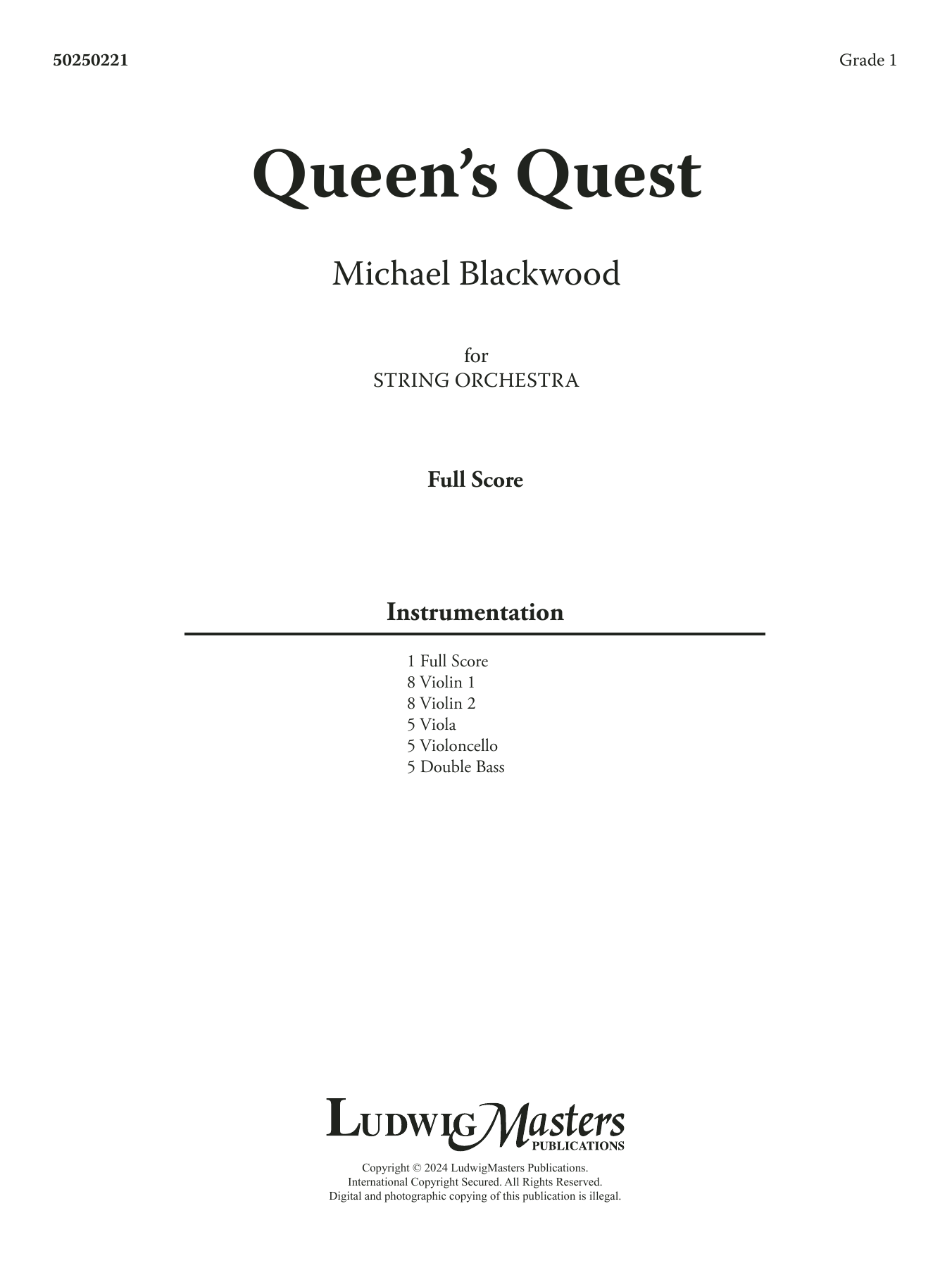

Queen's Quest: String Orchestra Conductor Score & Parts
By Michael Blackwood
Item: 35-PK01498815
$40.00
Pickup currently not available
Buy Extra Parts (Digital PDF Download)
| Product | Price | Quantity |
|---|---|---|
| Queen's Quest - Full Score | $6.00 | |
| Queen's Quest - Violin 1 | $2.50 | |
| Queen's Quest - Violin 2 | $2.50 | |
| Queen's Quest - Viola | $2.50 | |
| Queen's Quest - Violoncello | $2.50 | |
| Queen's Quest - Double Bass | $2.50 |
Parts Added to Cart!
Description
QUEEN'S QUEST depicts an intense chase through the kingdom as our titular queen seeks to help her citizens in times of trouble! Your students will love playing the intense staccato rhythms and the powerful E Dorian mode on the D and A strings. Your basses will get some practice solidifying their shifting skills to 3rd position, along with your cellos getting to stretch their legato melody skills. If your students want to play something fast, this is a great choice for your beginners. Let them shine and join the Queen's Quest!


Queen's Quest: String Orchestra Conductor Score & Parts isn't in MakeMusic Cloud just yet...but it could be. Let us know you'd like to see it, and you'll help shape what comes next. In the meantime, start a free trial and dive into thousands of interactive titles your students can play along with today.
Request This Title
Tell us you want it.
Start Your Free Trial
Explore everything that's ready to play right now.
Sample Audio
No sample audio found.
Sample Video
No sample videos found.
Additional Details
Publisher:
Hal Leonard
SKU:
35-PK01498815
More about this title
Why we love this
Queen's Quest delivers genuine energy without sacrificing musicianship. The writing gives every section a moment to shine while keeping rhythmic demands accessible enough that beginners can execute the staccato articulations cleanly and feel the propulsive drive from measure one.
What to expect
A kingdom in motion. The relentless forward energy and bright E Dorian sonority create urgency and purpose, as if the orchestra itself is racing to answer a call. There's nobility in the melody alongside the breathless chase underneath.
Who it's for
String orchestras with developing players who are ready to tackle faster tempos and sustained technical demands. The piece rewards groups that have solid intonation fundamentals and can manage independent rhythmic patterns across multiple parts.
How to get the most out of it
- Establish the staccato texture early in rehearsals by isolating rhythmic patterns in small groups. Once the attack and release are consistent, layer in the other parts so the ensemble locks together.
- Work the E Dorian melodies separately from the accompaniment figures. Students often rush modal passages, so anchor the tempo with the bass line and have soloists count through long phrases.
- Map out the bass shifts to 3rd position before full ensemble rehearsal. These transitions define the piece's momentum, so clarity here prevents the tempo from dragging when players hunt for their positions.
How to use it
This works well as an opener or closer on a concert where you want to set an exciting pace. It pairs naturally with slower, lyrical pieces and gives audiences a visceral sense of ensemble precision without requiring the rehearsal time that longer concerto works demand.
Skills your students will build
- Staccato articulation in fast scalar passages
- Playing in E Dorian mode with secure intonation on D and A strings
- Bass shifts to 3rd position with clean transitions
- Legato melodic playing with sustained tone and phrasing
- Reading and executing rhythmic patterns that sit across multiple parts
- Maintaining tempo and ensemble cohesion in music driven by rhythmic momentum