
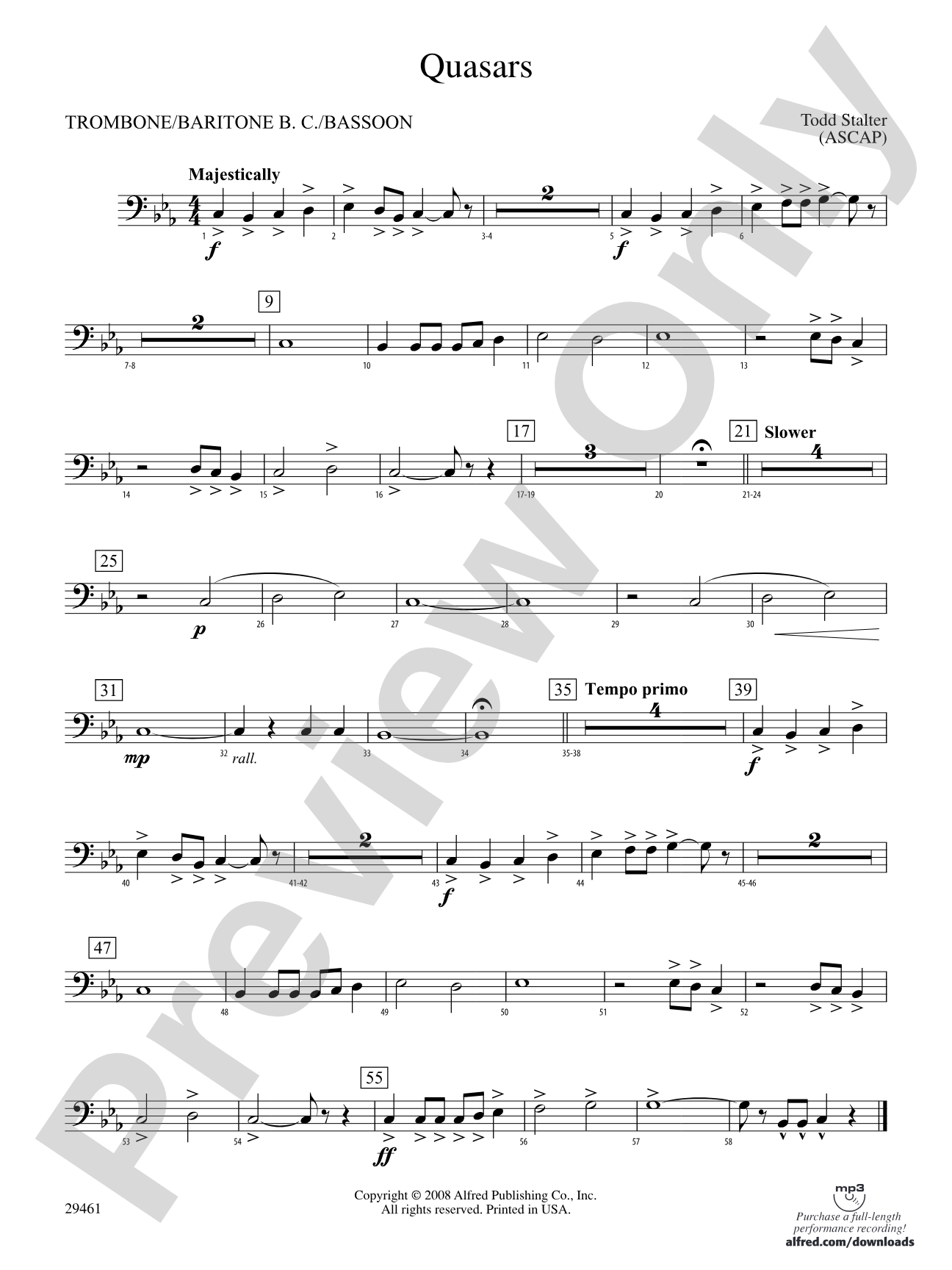

Quasars: 1st Trombone
By Todd Stalter
Grade: 1 (Very Easy)
Item: 00-PC-0001418_TN1
$3.00
Pickup currently not available
Description
Quasars are the brightest observable objects in the universe, created by super-massive black holes in the centers of galaxies. This piece attempts to musically portray the awe of the vastness of our universe, and the reflective middle section explores the wonder each of us has when viewing the nighttime sky. (2:25) This title is available in MakeMusic Cloud.


Don't just read it, hear it, play along with it, and watch your students grow with it. In MakeMusic Cloud, Quasars: 1st Trombone comes alive with professional accompaniment, adjustable tempo, and built-in practice tools that turn solo practice into real progress.
Open in the Player
Jump straight in and assign it today.
Start Your Free Trial
Open this title and explore the full library in minutes.
Sample Audio
1
Audio File
--:--
0:00
0:00
Sample Video
No sample videos found.
Additional Details
Series:
Alfred Debut Series
Publisher:
Alfred Music
Page Count:
122
SKU:
00-PC-0001418_TN1
More about this title
About the Composer: Todd Stalter

Todd Stalter spent 34 years as Director of Bands at Eureka High School in Illinois, where he built a program recognized statewide for consistent musical achievement. His marching band captured 16 Class 1A state championships, his concert band earned Superior ratings at state competitions, and his ensembles performed at Orchestra Hall in Chicago and Walt Disney World, along with festival championships at the Cotton and Liberty Bowls. He was inducted into the Illinois State Marching Band Championships Hall of Fame.
As a conductor, Stalter has led All-State bands in Georgia and Delaware and serves actively as an adjudicator and clinician for solo, ensemble, and large group evaluation. His compositions for band and string orchestra are performed internationally and appear on state contest and festival lists across the United States, with several works included in the "Teaching Music Through Performance in Band" series published by GIA. He holds degrees from Illinois State University in Music Education and Trumpet Performance.
Why we love this
Stalter captures cosmic wonder without requiring advanced technical facility, making this an ideal opener for groups building confidence early in the season. The programmatic arc from awe to introspection gives students a genuine emotional journey to explore, and the Grade 1 writing never sacrifices musical substance for simplicity. Programming this alongside other pieces creates immediate contrast and shows an audience that accessibility and artistic intention aren't mutually exclusive.
What to expect
The opening radiates outward like light from a distant source, building gradually in texture and intensity as the ensemble grows. The middle section becomes intimate and wondering, inviting listeners to share in that personal moment of gazing upward, before the music opens back to the cosmos with renewed resonance.
Who it's for
This work is designed for early-year concert bands and developing ensembles that benefit from accessible scoring without sacrificing musicianship. It works equally well for first-year students encountering concert band repertoire and for experienced groups wanting a crowd-pleasing standard that requires focused rehearsal rather than technical virtuosity.
How to get the most out of it
- Shape the opening section with gradual dynamic growth rather than abrupt changes; the sense of vastness builds through accumulation of texture and volume
- Balance the middle reflective section carefully so that its quieter passages don't disappear, but let it breathe without rushing the harmonic changes
- Use the recorded accompaniment available in MakeMusic Cloud to solidify ensemble entrances and maintain tempo stability across full sections
- Emphasize clarity of articulation in the parts that represent the celestial imagery; precision contributes to the sense of brightness and distance
How to use it
Open a spring concert with this piece to establish an ambitious, imaginative tone for the evening. It pairs effectively with more challenging works later in the program, showing range and demonstrating that your ensemble can handle both the technical and the artistic.
Skills your students will build
- Shaping long phrases with dynamic control
- Balancing texture across multiple instrumental lines
- Interpreting programmatic intent through careful articulation and phrasing
- Ensemble blend and sustained tone production