
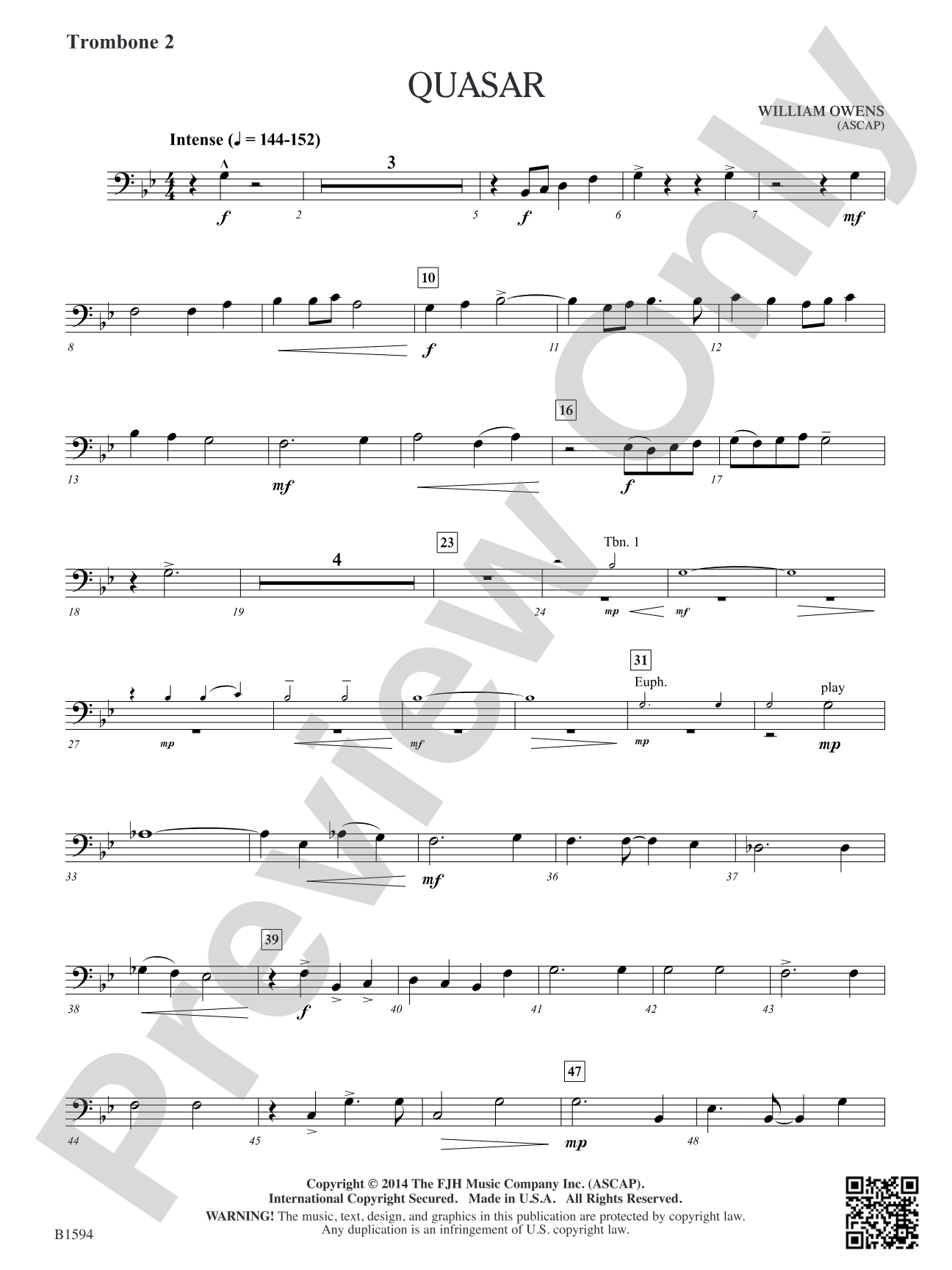

Quasar: Trombone 2
By William Owens
Grade: 2.5
Item: 98-PC-DB1594_TN2
$7.00
Pickup currently not available
Description
This thrilling and adrenaline-charged work depicts a “quasar,” the most intense source of light in the universe. The boisterous opening and brisk tempo portrays the speed of light itself while sudden bursts of sound mix with lingering dissonant clusters to characterize unpredictable discharges of light and radiation. A serene, slow section offers a glimpse into a distant universe before the music becomes more powerful, driving to a fiery finish. Outstanding!


Don't just read it, hear it, play along with it, and watch your students grow with it. In MakeMusic Cloud, Quasar: Trombone 2 comes alive with professional accompaniment, adjustable tempo, and built-in practice tools that turn solo practice into real progress.
Open in the Player
Jump straight in and assign it today.
Start Your Free Trial
Open this title and explore the full library in minutes.
Sample Audio
1
Audio File
--:--
0:00
0:00
Sample Video
No sample videos found.
Additional Details
Series:
FJH Young Band
Publisher:
The FJH Music Company, Inc.
SKU:
98-PC-DB1594_TN2
More about this title
About the Composer: William Owens
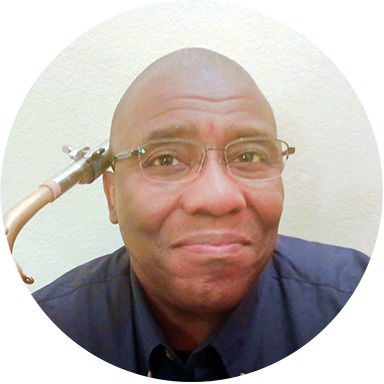
William Owens has spent three decades shaping young musicians as both educator and composer. A 1985 graduate of VanderCook College of Music, he has built a prolific catalog of over 300 works for concert band, string orchestra, and chamber ensembles since 1993, earning recognition through commissions from major organizations including the American Bandmasters Association and Phi Beta Mu International.
Owens' compositional voice is rooted in practical musicianship and accessibility for developing ensembles. His works appear on required music lists across North America and have become teaching standards in band programs nationwide. He has served the Texas music education community actively through professional affiliations including ASCAP and the Texas Music Educators Association, and retired in 2014 after 30 years as a band director in Texas.
Why we love this
Owens captures the raw energy of astrophysical phenomena without demanding virtuosic technique, making this a programmatic work that actually works for intermediate bands. The pacing of the dramatic arc—from that arresting opening through the contemplative middle section to the climactic finale—keeps both players and audiences engaged, and the contest/festival designation means it carries weight as a competitive selection without overwhelming musicians still building technical foundation.
What to expect
Quasar pulses with cosmic urgency. The violent opening—boisterous and driven by relentless tempo—evokes the violent discharge of radiation, while carefully placed dissonant clusters and sudden bursts create an unsettling, unpredictable character. The serene passage transports listeners to a distant, peaceful universe before the final section builds to an overwhelming, fiery conclusion that mirrors the quasar's ultimate intensity.
Who it's for
This work suits concert bands at the Grade 2.5 level who have solid fundamentals and are ready for pieces with sophisticated programmatic intent. Directors seeking repertoire that engages students intellectually while remaining technically accessible will find this a strong addition to festival or contest programs.
How to get the most out of it
- Establish the tempo clearly from the downbeat so the opening's sense of speed and intensity lands immediately; this piece depends on rhythmic precision and forward momentum to convey its astronomical imagery.
- Balance the dissonant cluster passages carefully during rehearsal so they sound intentional and striking rather than muddy; isolate these moments and have sections practice their individual lines before combining.
- Shape the serene middle section with genuine stillness; students should feel the contrast as a real departure, not just a slower tempo, so work on dynamic control and sustained tone production in this section.
- Use the conductor parts to clarify gesture during sudden shifts in texture and intensity; these transitions define the piece's character, so make sure your conducting clearly communicates the shift to the ensemble.
How to use it
This programmatic work makes a compelling opening or closing selection for a concert that explores science and natural phenomena, or it serves as an effective festival entry that demonstrates a band's ability to balance technical precision with expressive storytelling. The dramatic trajectory and distinct sections work well when paired with contrasting lyrical pieces.
Skills your students will build
- Sustaining consistent tempo through rhythmic complexity and rapid articulation
- Dynamic control in dissonant cluster passages
- Balance and blend when multiple voices carry independent melodic material simultaneously
- Expressive interpretation of programmatic music and sectional contrasts
- Ensemble precision during sudden textural and intensity shifts