Quanta Qualia Sheet Music Preview

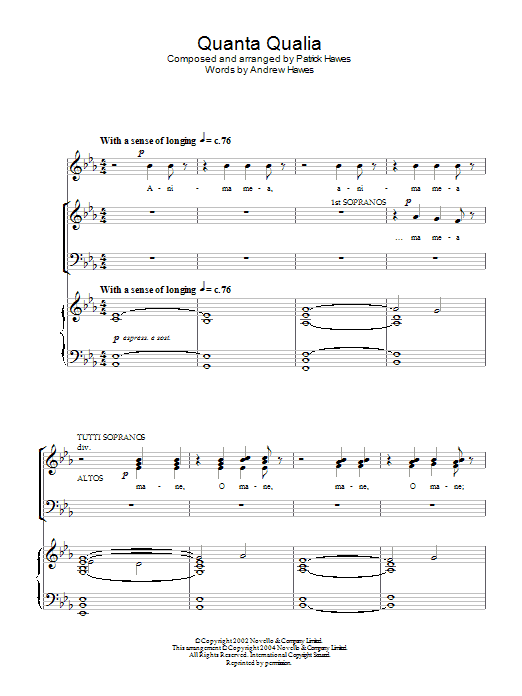
Quanta Qualia: SATB Choral Octavo

As performed by Patrick Hawes

Item: 35-DS00184939

Digital Download
$2.99
Description

Quanta Qualia: SATB Choral Octavo isn't in MakeMusic Cloud just yet...but it could be. Let us know you'd like to see it, and you'll help shape what comes next. In the meantime, start a free trial and dive into thousands of interactive titles your students can play along with today.

Sample Audio
No sample audio found.
Sample Video
Additional Details
Publisher: Hal Leonard
Page Count: 6
SKU: 35-DS00184939

More about this title

About the Artist: Patrick Hawes

Patrick Hawes is a British composer whose output spans orchestral, choral, and theatrical works. His music is marked by lyrical writing and harmonic sophistication, making him a go-to voice for contemporary concert ensembles seeking pieces with depth and accessibility.

Hawes has established himself as a composer who understands the practical demands of choral performance while refusing to compromise on musical substance. His work appears regularly on festival and competition programs across the UK and beyond.

Why we love this

Hawes brings genuine textural contrast to the SATB palette here, crafting moments where all four voices lock into satisfying harmonic density and others where the texture thins to reveal counterpoint. The piece reads as crafted for singers who enjoy clarity without sacrificing the warmth that keeps an audience leaning in.

What to expect

The music settles into a contemplative space, building through cumulative vocal color rather than through dramatic gesture. There is both intimacy and grandeur in the texture, a quality that emerges when voices move together as an instrument rather than as individual parts.

Who it's for

This octavo serves intermediate to advanced SATB choirs looking for concert repertoire that rewards careful preparation without excessive technical demands. It suits singers who can sustain line integrity through longer phrases and audiences who respond to harmonic language that feels both contemporary and rooted.

How to get the most out of it

  • Balance the alto and soprano lines carefully in measures where they carry the thematic material; they sit close enough that careless part independence creates mud rather than richness.
  • Attend to the vowel consistency between sections. The shifts from open to closed vowels will feel more intentional if singers understand how they shape the harmonic color at each moment.
  • Let the accompaniment breathe in its own time. A pianist rushing the harmonic movement will short-circuit the emotional pacing Hawes has written into the progression.

How to use it

This piece pairs well with Renaissance motets or other works that prioritize harmonic thinking, creating a program arc that traces how composers across centuries have used voice leading as the fundamental language of choral writing. It works equally as a closing piece where its accumulated warmth can resonate after the concert.

Skills your students will build

  • Sustaining independence of line within dense four-part harmony
  • Shaping long phrases with harmonic direction as the primary guide
  • Managing vowel consistency across extended passages
  • Reading Hawes's contemporary harmonic vocabulary

You May Also Like