
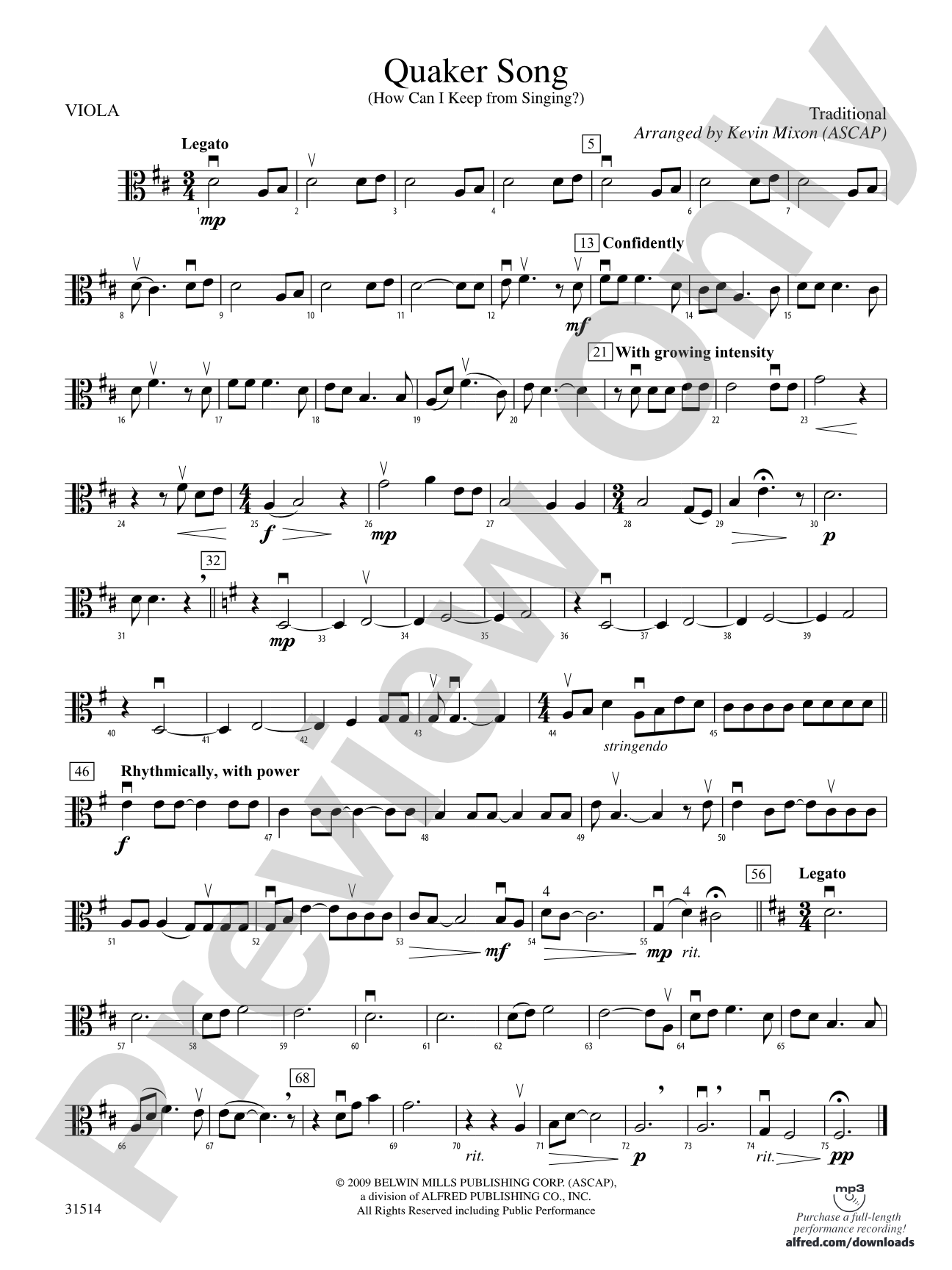

Quaker Song (How Can I Keep from Singing?): Viola
Arr. Kevin Mixon
Grade: 2.5
Item: 00-PC-0001708_VA1
$5.99
Pickup currently not available
Description
The Quakers are historically staunch pacifists but fervent advocates of women's rights, prison reform, humane treatment of the mentally ill and the abolition of slavery. Help introduce students to these important people in history through this setting of "How Can I Keep from Singing?," a popular, lyrical tune with strong melodic rhythms that represent the quiet power of the hymn's message. All sections are featured and contrasting styles will make this a favorite of players and audiences alike.


Don't just read it, hear it, play along with it, and watch your students grow with it. In MakeMusic Cloud, Quaker Song (How Can I Keep from Singing?): Viola comes alive with professional accompaniment, adjustable tempo, and built-in practice tools that turn solo practice into real progress.
Open in the Player
Jump straight in and assign it today.
Start Your Free Trial
Open this title and explore the full library in minutes.
Sample Audio
1
Audio File
--:--
0:00
0:00
Sample Video
No sample videos found.
Additional Details
Series:
Belwin Beginning String Orchestra
Publisher:
Alfred Music
Page Count:
76
SKU:
00-PC-0001708_VA1
More about this title
About the Arranger: Kevin Mixon

Kevin Mixon brings decades of experience in instrumental music education, currently teaching at Blodgett K-8 School in Syracuse City Schools, New York. He is a frequent clinician at major music education conferences including the International Society for Music Education Convention, the Midwest International Band and Orchestra Clinic, and MENC events, where he addresses topics ranging from urban and rural school contexts to multicultural music, special learners, and alternative rehearsal techniques. His scholarly work has been published in Music Educators Journal, Teaching Music, The Instrumentalist, and the National Band Association Journal.
Mixon holds degrees from Onondaga Community College, Syracuse University, and the University of Illinois (Urbana-Champaign), and is pursuing a Certificate of Advanced Studies in Educational Leadership. He has authored and co-authored books for music educators, including Reaching and Teaching All Instrumental Music Students and Teaching Music in the Urban Classroom. As a composer and arranger, he has published numerous works for band and orchestra that reflect his commitment to accessible, engaging repertoire for young musicians.
Why we love this
Mixon's arrangement honors the hymn's quiet conviction while remaining thoroughly playable at the Grade 2.5 level. The scoring gives every section meaningful musical material, which keeps young players invested and makes this ideal for festivals where you want adjudicators to hear genuine musicianship rather than just technical competence.
What to expect
Contemplative and dignified, with an underlying sense of resolute calm. The familiar melody carries a gentle strength that comes through even in this young arrangement, allowing players to feel connected to a long musical and spiritual tradition.
Who it's for
String orchestras at the intermediate level looking for repertoire with historical and social-emotional depth. This works for ensembles that want to program something beyond pure technique builders, where students benefit from understanding the context and meaning behind the music they perform.
How to get the most out of it
- Shape the phrasing with careful attention to breath points, even in an instrumental setting. This hymn's power comes from its unhurried expression, so resist the urge to rush through transitions.
- Balance the melody across sections as different instruments carry it. Make deliberate choices about who leads in each passage so the tune remains the focal point.
- Explore the contrast between sections as an interpretive opportunity. Let the contrasting styles specified in the arrangement breathe; they're designed to keep audiences engaged and show range within a single piece.
- Use dynamics subtly to reflect the hymn's message of quiet strength. Avoid broad volume swings; instead, let refinement of tone color do much of the expressive work.
How to use it
Pair this with a unit on American history, particularly lessons on the Quaker movement and social reform. It also fits beautifully in concert programs centered on hymns or spirituals, or as an opening piece that establishes a reflective tone before more energetic works.
Skills your students will build
- Lyrical phrasing and breath control in instrumental playing
- Melodic awareness across multiple parts and section balance
- Historical and cultural context for music (Quaker heritage, social justice movements)
- Expressive interpretation through dynamics and tone color
- Playing with contrasting styles within a single piece