
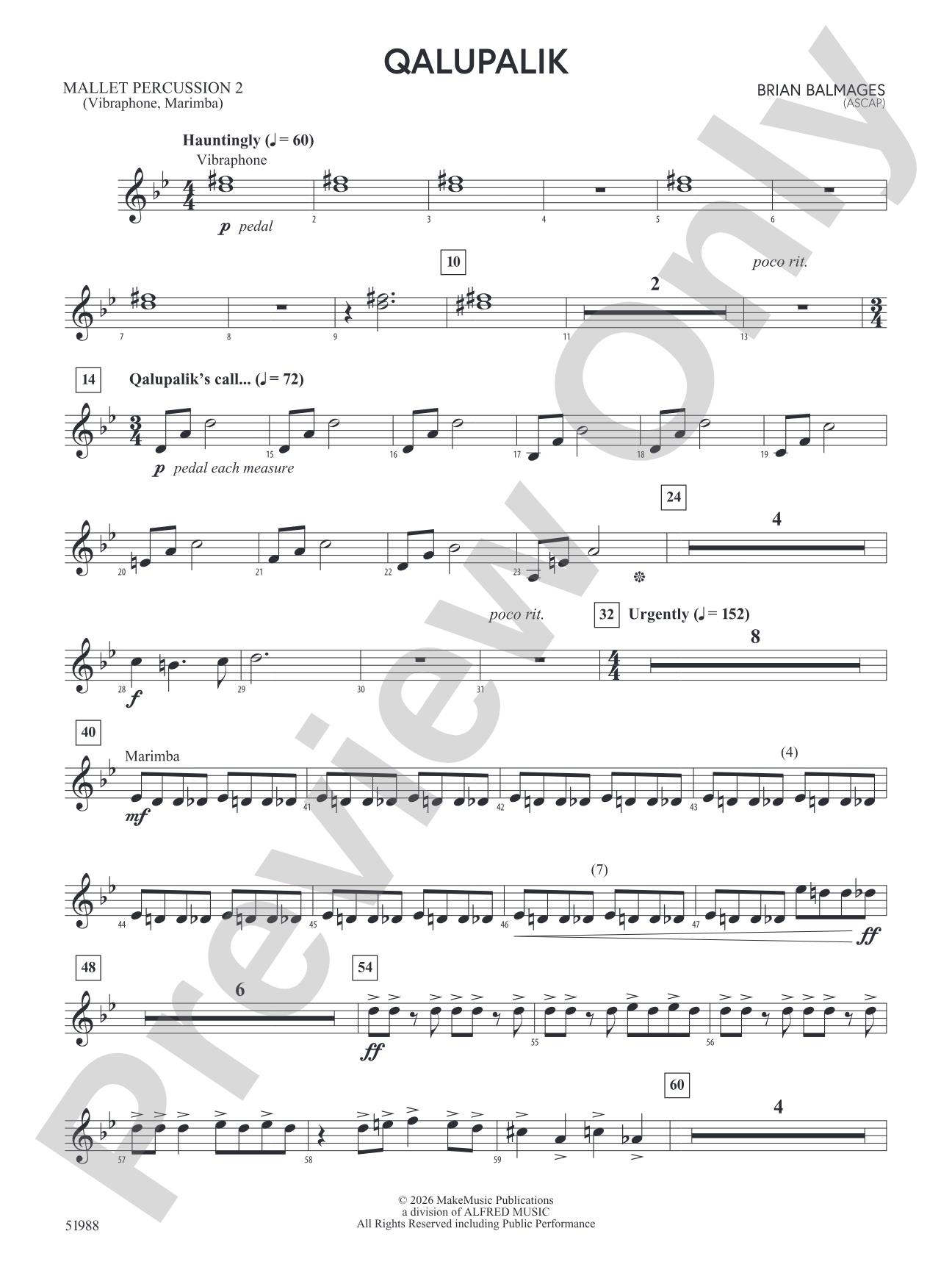

Qalupalik: 2nd Mallet Percussion
By Brian Balmages
Grade: 2.5
Item: 00-PC-0019791_M2
$3.00
Pickup currently not available
Description
Drawing from Inuit mythology, this evocative work by Brian Balmages tells the story of Qalupalik, mysterious sea-dwelling creatures that lurk beneath the icy waters in the Pacific Northwest. An eerie, haunting opening gives way to an aggressive section with amazing harmonies and pulse-pounding percussion. This is an experience unlike any other! (4:20)


Don't just read it, hear it, play along with it, and watch your students grow with it. In MakeMusic Cloud, Qalupalik: 2nd Mallet Percussion comes alive with professional accompaniment, adjustable tempo, and built-in practice tools that turn solo practice into real progress.
Open in the Player
Jump straight in and assign it today.
Start Your Free Trial
Open this title and explore the full library in minutes.
Sample Audio
1
Audio File
--:--
0:00
0:00
Sample Video
Additional Details
Series:
MakeMusic Young Band
Publisher:
MakeMusic Publications
SKU:
00-PC-0019791_M2
More about this title
About the Composer: Brian Balmages

Brian Balmages has built a reputation as a composer and conductor equally at home writing for orchestras, bands, and chamber ensembles. His works have premiered at venues including Carnegie Hall, the Kennedy Center, and Sydney Opera House, performed by ensembles spanning from professional orchestras to elementary school bands across the globe. He is an elected member of the American Bandmasters Association and received the A. Austin Harding Award from the American School Band Directors Association, along with winning the 2020 NBA William D. Revelli Composition Contest for Love and Light.
Balmages has served as a frequent guest conductor at the Midwest Clinic, College Band Directors Conference, and regional all-state ensembles worldwide. His music was performed during the 2013 Presidential Inaugural Prayer Service, and he has received commissions from major institutions including the University of Miami for the inauguration of its 6th president. He currently serves as Director of MakeMusic Publications and Digital Education for Alfred and MakeMusic.
Why we love this
Balmages crafts a piece that respects young band musicians while refusing to condescend to them. The shift from eerie, atmospheric writing to driving rhythmic sections gives your ensemble a chance to explore genuine contrasts in tone and energy, and the Inuit mythology frame invites students to connect music with cultural storytelling. At Grade 2.5, the technical demands stay reasonable, but the compositional sophistication and performance challenge keep both musicians and audiences engaged.
What to expect
The opening draws you into an icy, suspended world where mystery hangs in the air. Then the energy erupts: percussion drives forward with purpose, harmonies grow bolder and more complex, and the ensemble finds itself in the grip of something primal and urgent. It's a journey from shadow into intensity, and it lingers with listeners long after the final note.
Who it's for
Young band conductors seeking repertoire that combines accessible instrumentation with sophisticated storytelling and genuine musical depth. This work fits bands at the Grade 2.5 level who are ready for pieces that demand interpretive maturity alongside technical competency.
How to get the most out of it
- Shape the opening section with dynamic restraint. The mystery only works if you resist the urge to push the volume; let the low instruments create atmosphere while the higher voices add color without overwhelming.
- Lock in the rhythmic pulse when the aggressive section arrives. This contrast will hit harder if the ensemble has truly settled into the quieter material beforehand.
- Balance the harmony voicings carefully during the intense passage. Balmages writes rich chords, and muddy sonics will blur the detail he's written in; ensure each section knows its role in the harmonic fabric.
- Use the recorded accompaniment to support rehearsal efficiency, especially when synchronizing the transitions between the eerie and driving sections.
How to use it
Program this as a concert opener or as a centerpiece that justifies a thematic program around world cultures and mythology. Its four-minute duration and dramatic arc make it an ideal festival entry that will hold judges' attention while giving your musicians a meaningful performance experience.
Skills your students will build
- Dynamic contrast and phrasing across sustained passages
- Harmonic balance and blend in chromatic voicings
- Rhythmic precision and pulse maintenance during tempo transitions
- Attention to cultural context and interpretive storytelling in music