
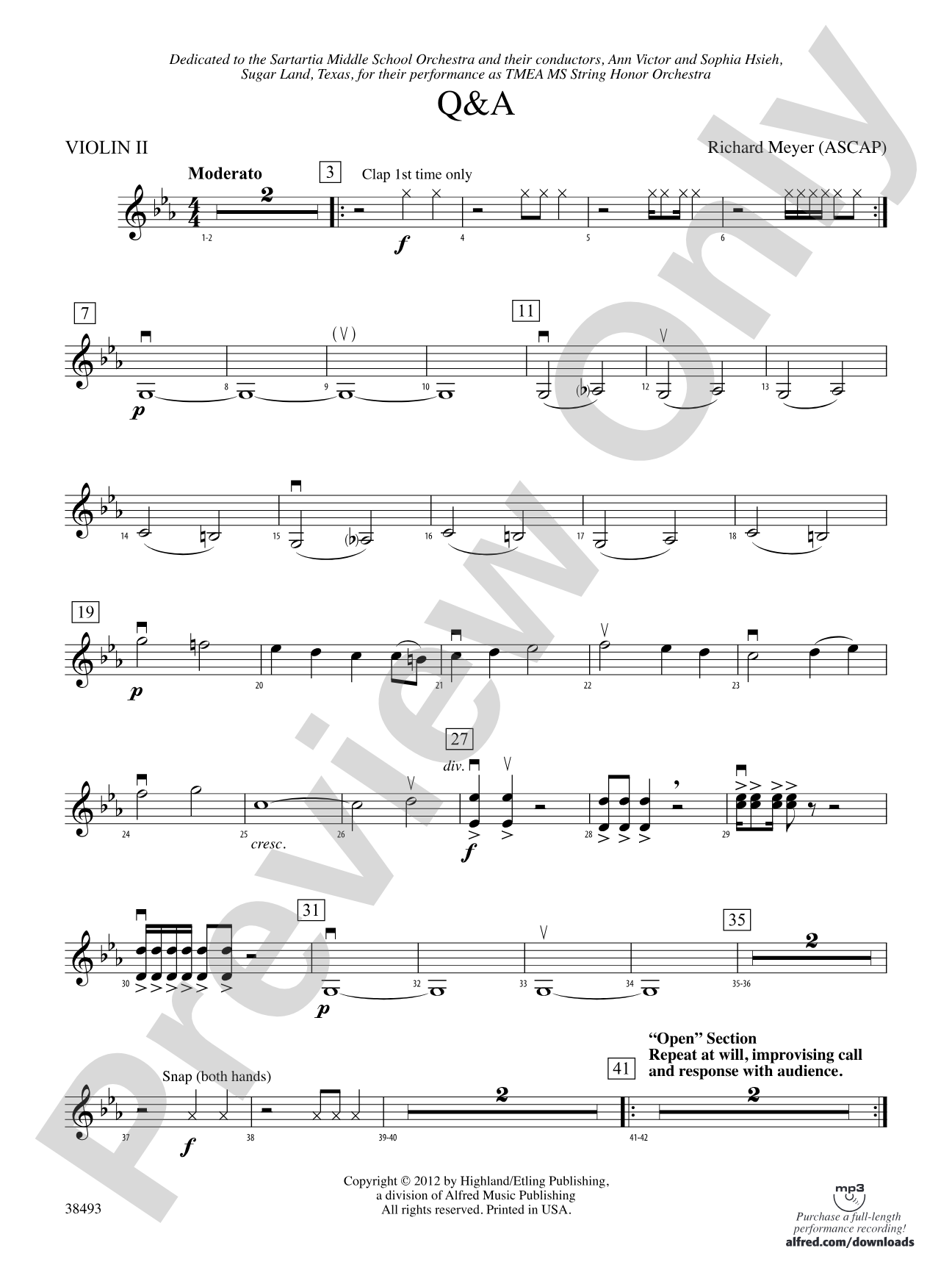

Q&A: 2nd Violin
By Richard Meyer
Grade: 2.5
Item: 00-PC-0015541_VN2
$5.99
Pickup currently not available
Description
Get your audience involved in this fun, interactive piece designed to break the "fourth wall" that divides performers and listeners. Fresh and hip-sounding, this creative selection is a clap, stomp, and snap "call-and-response" between the conductor (or student leader) and the audience. It's also an easy introduction to the key of C minor and lowered finger patterns. Add the cool hi-hat part and you've got the most unique piece on your concert, performed by everyone in the auditorium!


Don't just read it, hear it, play along with it, and watch your students grow with it. In MakeMusic Cloud, Q&A: 2nd Violin comes alive with professional accompaniment, adjustable tempo, and built-in practice tools that turn solo practice into real progress.
Open in the Player
Jump straight in and assign it today.
Start Your Free Trial
Open this title and explore the full library in minutes.
Sample Audio
1
Audio File
--:--
0:00
0:00
Sample Video
No sample videos found.
Additional Details
Series:
Highland/Etling String Orchestra
Publisher:
Alfred Music
Page Count:
128
SKU:
00-PC-0015541_VN2
More about this title
About the Composer: Richard Meyer

Richard Meyer spent 35 years teaching strings in public schools, building the Oak Avenue Intermediate School orchestras from 29 students to 200 and overseeing Temple City's elementary string program for two decades. His "Giving Bach" program, launched in 2009, pioneered interactive concert models that brought music to special needs and underserved students across Southern California, earning national recognition for its innovative approach.
Beyond the classroom, Meyer served as music director of the Pasadena Youth Symphony Orchestra for 16 years, leading ensembles on international tours to Vienna, Australia, and Canada. A prolific composer with over 190 published works, he also spent 16 years as string editor for Alfred Publishing and co-authored multiple string method series, including String Explorer and Sight-read It for Strings. He has presented at major conferences including A.S.T.A. National and the Texas Orchestra Directors' Association.
Why we love this
Meyer designed this piece with genuine understanding of what engages young audiences and what works on the middle school stage. The call-and-response format breaks isolation between performers and listeners in a way that feels natural, not forced, while the rhythmic vocabulary of claps, stomps, and snaps gives every student a visceral role in making music happen. For a concert program hungry for pieces that feel contemporary and generate real audience energy, this delivers both without sacrificing solid string pedagogy.
What to expect
Playful and rhythmically infectious, with the infectious momentum of a conversation between stage and audience. The piece pulses with contemporary energy through its percussion and body percussion elements, yet remains rooted in genuine string writing that keeps young players musically invested.
Who it's for
String orchestra directors at the middle school level who want a piece that energizes their audience and deepens student engagement simultaneously. This is ideal for conductors teaching the fundamentals of C minor tonality and shifted hand positions while introducing students to the practical experience of leading and responding in real time.
How to get the most out of it
- Establish clear, confident conducting gestures for the call sections; the ensemble will watch you intently for tempo cues, so your physical precision directly shapes the audience response.
- Bring the hi-hat part to life with crisp articulation and consistent dynamic control, as it anchors the piece's contemporary feel and guides the ensemble through the response phrases.
- Cue your audience participation deliberately during rehearsals; explain the call-and-response pattern clearly before the concert so listeners feel invited rather than ambushed.
- Balance the string texture so that rhythmic clarity doesn't overshadow melodic content; this piece works best when listeners hear both the groove and the musicality underneath it.
How to use it
Program this as a concert-opening or finale that resets audience expectations for what orchestral performance can be. It works especially well in casual concert settings, school assembly performances, or pops programs where breaking the fourth wall signals permission for listeners to be active participants rather than passive observers.
Skills your students will build
- Reading and performing in C minor tonality
- Shifted finger patterns and hand position changes
- Precise ensemble rhythm and synchronization across call-and-response structures
- Leadership and confidence as a student conductor or section leader
- Coordinate timing between string ensemble and non-pitched percussion (hi-hat)