
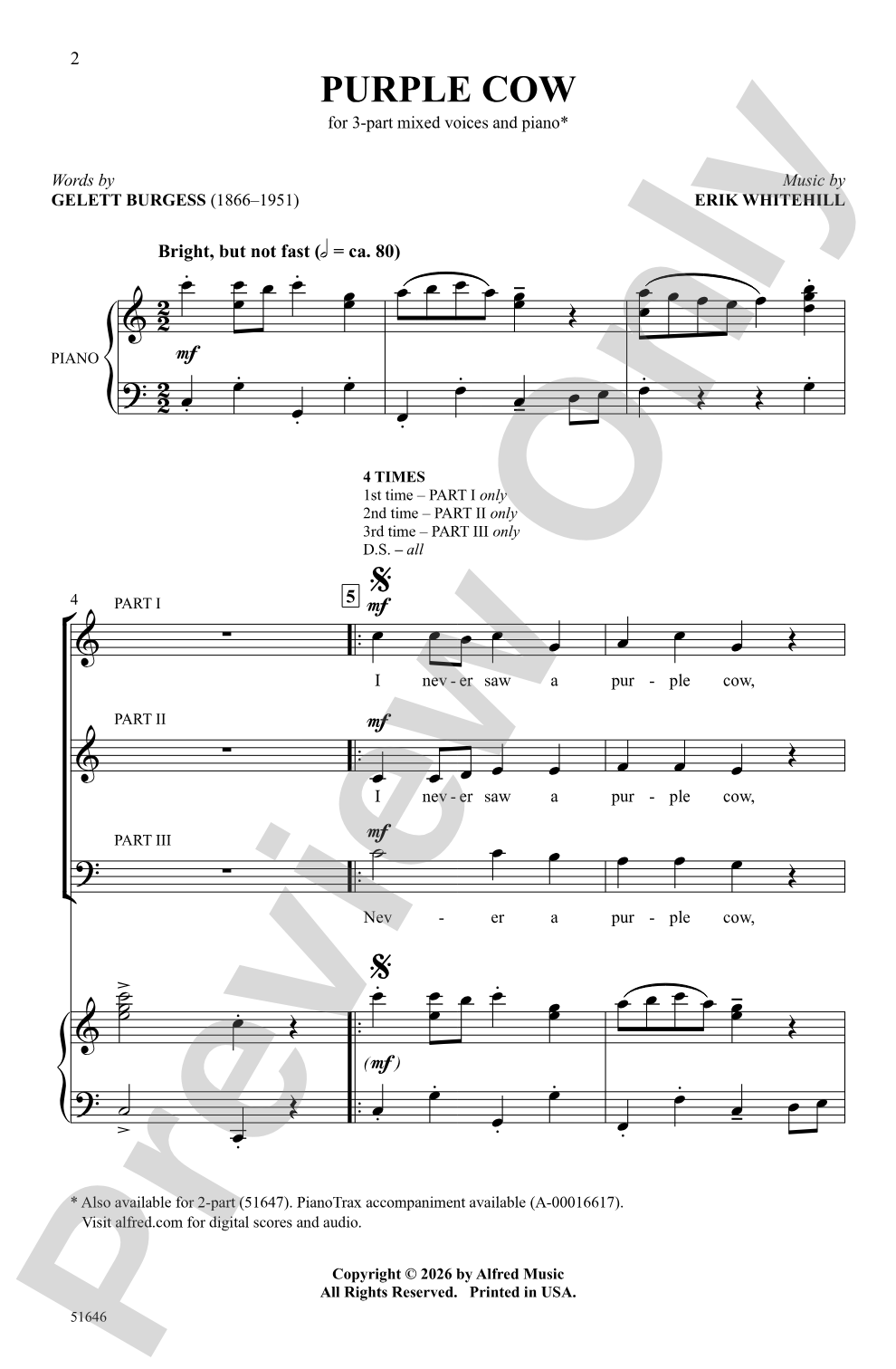

Purple Cow: 3-Part Mixed Choral Octavo
Words by Gelett Burgess, music by Erik Whitehill
Item: 00-PO-0007801
$2.40
Minimum order quantity: 20 copies
Pickup currently not available
Description
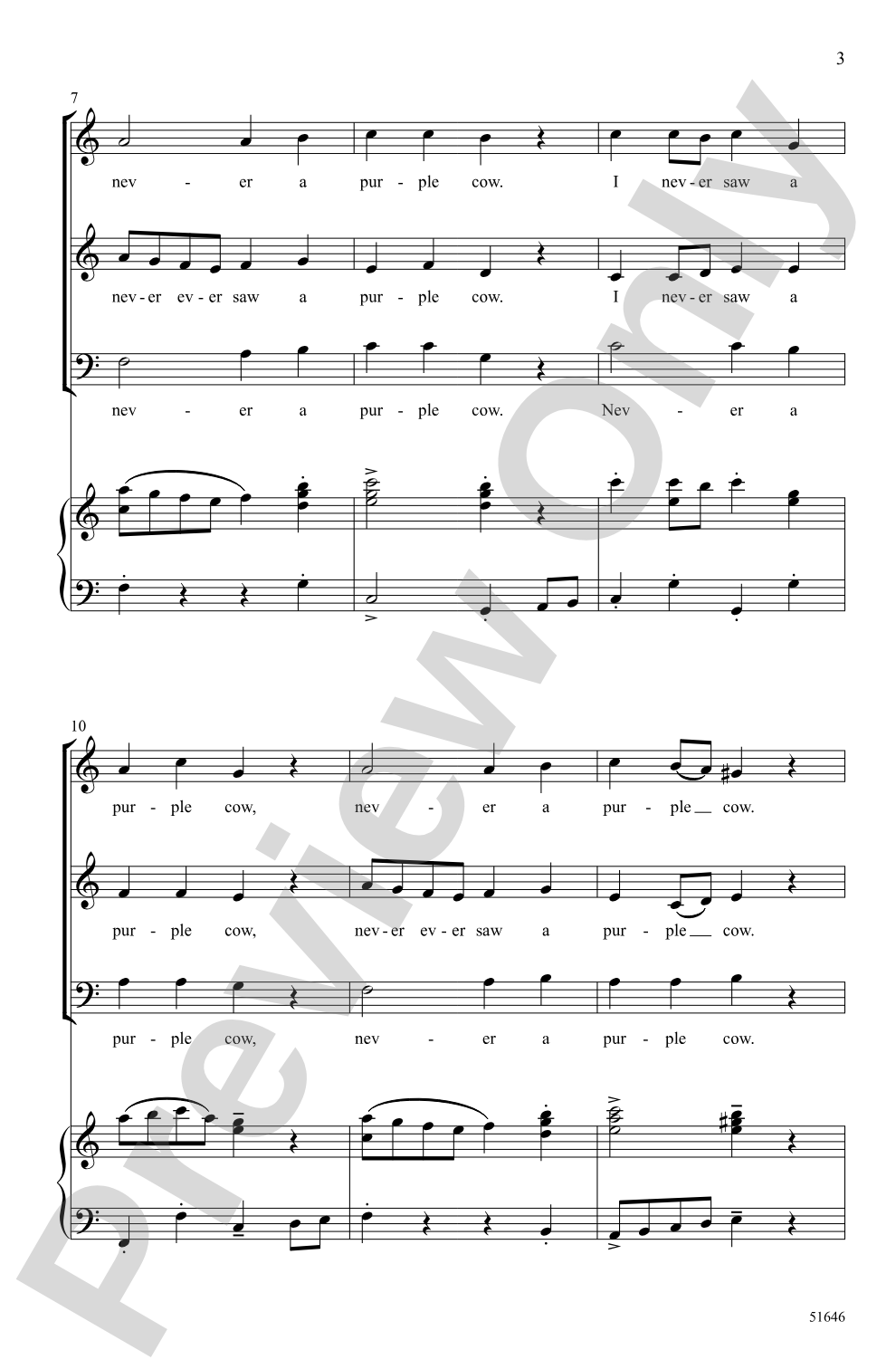
This nifty novelty adds madrigal-like music to a nonsensical poem from the Gilded Age. In just a few playful lines, the words invite us to ponder the extraordinary and embrace the silly. Its quirky charm reminds us that life is more fun when we celebrate the unexpected. Delightfully polyphonic in both voicings, this well-conceived teaching piece features independent voice parts that add more layers with each repeat.


Purple Cow: 3-Part Mixed Choral Octavo isn't in MakeMusic Cloud just yet...but it could be. Let us know you'd like to see it, and you'll help shape what comes next. In the meantime, start a free trial and dive into thousands of interactive titles your students can play along with today.
Request This Title
Tell us you want it.
Start Your Free Trial
Explore everything that's ready to play right now.
Sample Audio
1
Audio File
--:--
0:00
0:00
Sample Video
Additional Details
Series:
Alfred Choral Designs
Publisher:
Alfred Music
Page Count:
8
SKU:
00-PO-0007801
More about this title
About the Composer: Erik Whitehill

Erik Whitehill is a composer and music educator whose work bridges the classroom and concert hall. Based in Arizona, he earned his music education degree from Luther College in Iowa and has spent nearly two decades teaching general music and choir in the Tempe Elementary School District, where he has also served as district chairperson for both general music and elementary choir. His commitment to bringing new compositions into the choral repertoire has earned him recognition throughout the field.
Whitehill's credentials reflect both depth and breadth in music education. He holds Orff certification and has been active in the Arizona Orff chapter, serving on its board and presenting at conferences. His contributions to music education have been honored with the Arizona State University Outstanding Mentor Teacher Award (2012) and multiple excellence awards from his school district. His compositions appear with Heritage Music Press, Choristers Guild, Augsburg Fortress, Handbell Musicians of America, and Alfred.
Why we love this
This piece captures something rare in elementary choral music: genuine wit that doesn't talk down to singers or audiences. The polyphonic writing builds sophistication without sacrificing accessibility, and the nonsense text from the Gilded Age gives students permission to sing about something delightfully absurd. It's the kind of piece that makes rehearsal fun while still teaching real musical independence.
What to expect
Imagine a musical cabinet of curiosities: playful, ingeniously constructed, and gently absurd. The madrigal-like quality gives it a timeless charm, while the quirky text and independent voice lines create a sense of delightful discovery. There's joy in the polyphony here, a musical wink that reminds singers (and listeners) that serious musicianship can coexist with pure fun.
Who it's for
This octavo works well for mixed choral ensembles in upper elementary through middle school that have developed basic part-singing skills and are ready for something with genuine musical substance. It appeals equally to directors seeking concert repertoire that engages audiences and to those building festival libraries with pieces that challenge singers without overwhelming them.
How to get the most out of it
- Shape each voice part as a distinct melodic line rather than supporting accompaniment; the independence becomes more engaging when each section owns its phrase.
- Experiment with the layering effect by having singers hold their parts while other voices enter, showing how the polyphony thickens with each repeat.
- Let the text's whimsy guide your tempo and articulation choices; a slightly buoyant approach will highlight the novelty without rushing the harmonic movement.
- If using the recorded accompaniment, rehearse with it early so singers internalize the harmonic foundation before adding their interpretive choices.
How to use it
Program this alongside more serious repertoire on a concert to provide comic relief and showcase your singers' ability to handle multiple textures. It also pairs naturally with other novelty or contemporary pieces in a "light and lively" set, or stands alone as an engaging opening number that immediately wins over an audience. Consider it a festival piece that judges will remember, not because it's complicated, but because it's genuinely well-crafted and utterly charming.
Skills your students will build
- Independent voice part singing (SAB voicing with overlapping phrases)
- Understanding of polyphonic texture and layering effects
- Phrase shaping and musical storytelling through nonsense text
- Ensemble balance and blend across three distinct lines
- Interpretation of style conventions in secular madrigal writing