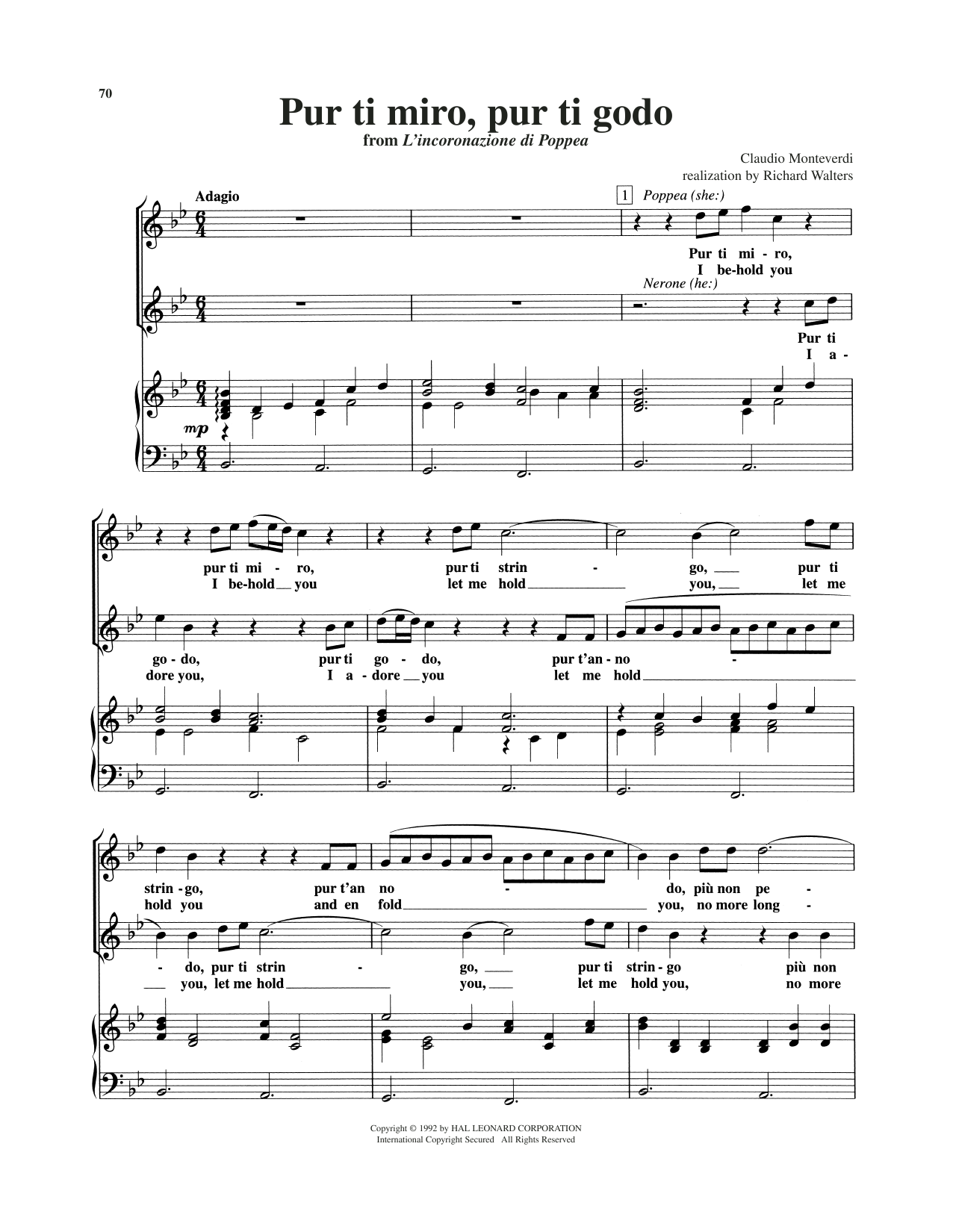
Pur ti miro, pur ti godo Sheet Music Preview

Pur ti miro, pur ti godo: Piano Vocal

As performed by Claudio Monteverdi / Edited by Richard Walters

Item: 35-DS01827472

Digital Download
$5.99
Description

Pur ti miro, pur ti godo: Piano Vocal isn't in MakeMusic Cloud just yet...but it could be. Let us know you'd like to see it, and you'll help shape what comes next. In the meantime, start a free trial and dive into thousands of interactive titles your students can play along with today.

Sample Audio
No sample audio found.
Sample Video
Additional Details
Publisher: Hal Leonard
Page Count: 6
SKU: 35-DS01827472

More about this title

About the Artist: Claudio Monteverdi

Claudio Monteverdi (1567–1643) fundamentally reshaped what vocal music could express. Working across the Renaissance and early Baroque, he developed the seconda prattica, a compositional approach that prioritized emotional text-painting and dramatic truth over strict counterpoint. His innovations in operatic writing and madrigal composition established conventions that composers would refine for centuries.

Monteverdi's vocal works demand singers who understand the intimate connection between words and music. His pieces reward careful attention to phrasing, ornamentation, and the rhetorical power of silence. For music students, studying his output provides essential context for understanding how composers moved from the Renaissance into the Baroque era.

Why we love this

This duet showcases Monteverdi's gift for writing music that feels both structurally coherent and emotionally immediate. The piece works beautifully in wedding programs and celebrations of love precisely because it avoids sentimentality in favor of genuine musical architecture. High voice singers will find the tessitura grateful and the opportunities for expressive singing abundant.

What to expect

The music radiates warmth and tenderness without losing its structural backbone. Monteverdi's harmonic language is both logical and generous, creating moments of gorgeous sonority that feel earned rather than obvious. Singing this piece feels like discovering how old music can still move modern listeners.

Who it's for

This piece suits advanced high voice singers with experience in early music or art song repertoire. It works equally well for solo recital and as a duet, making it adaptable for voice students, professional vocalists, or advanced choral singers seeking substantial solo material.

How to get the most out of it

  • Observe the text carefully for dramatic pacing. Monteverdi spaces words and phrases with intention; rushing passages obscures his rhetorical design.
  • Balance the vocal line against the keyboard part without overwhelming it. The piano provides harmonic foundation and color rather than accompaniment in the modern sense.
  • Allow yourself room for subtle ornamentation within the vocal phrases. Monteverdi's notation is often leaner than the style of performance demands.
  • Shape phrases toward natural speech rhythms. Baroque vocal music thrives when singers treat musical lines as extensions of language.

How to use it

Consider featuring this in a concert celebrating marriage, commitment, or joy without requiring thematic unity around a single era or composer. The six-page length makes it substantial enough to stand alone on a recital or as a centerpiece for a program pairing early Baroque vocal works. It also suits special occasions such as weddings or celebrations where meaningful art song matters more than purely contemporary repertoire.

Skills your students will build

  • Understanding seconda prattica compositional principles and text-expression
  • Singing Baroque vocal ornamentation and diminution within period style
  • Shaping phrasing to reflect language inflection and rhetorical gestures
  • Balancing solo vocal line with continuo keyboard accompaniment
  • Interpreting sparse notation with musical intuition and historical awareness

You May Also Like