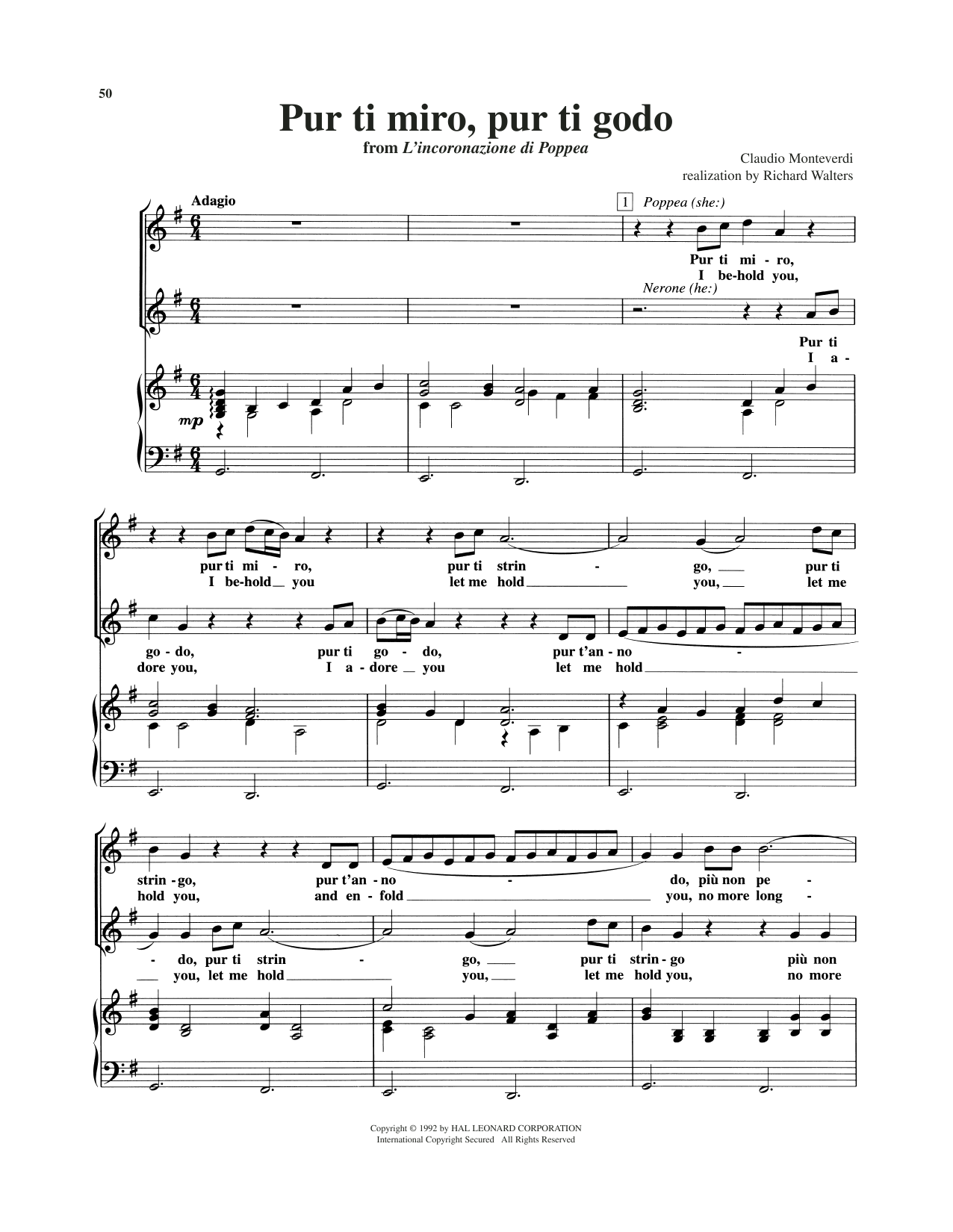
Pur ti miro, pur ti godo Sheet Music Preview

Pur ti miro, pur ti godo: Piano Vocal

As performed by Claudio Monteverdi / Edited by Richard Walters

Item: 35-DS01827470

Digital Download
$5.99
Description

Pur ti miro, pur ti godo: Piano Vocal isn't in MakeMusic Cloud just yet...but it could be. Let us know you'd like to see it, and you'll help shape what comes next. In the meantime, start a free trial and dive into thousands of interactive titles your students can play along with today.

Sample Audio
No sample audio found.
Sample Video
Additional Details
Publisher: Hal Leonard
Page Count: 6
SKU: 35-DS01827470

More about this title

About the Artist: Claudio Monteverdi

Claudio Monteverdi (1567–1643) stands as one of the pivotal figures in Western music history, bridging the Renaissance and Baroque eras with compositions that transformed how composers approached emotion and text expression. His decades as maestro di cappella at St. Mark's Basilica in Venice positioned him to experiment with vocal writing across sacred and secular genres, establishing techniques for dramatic intensity that influenced generations of composers.

Monteverdi's legacy rests on his command of the human voice as an instrument of profound expression. He understood how to marry text underlay to musical gesture in ways that made singers convey genuine feeling rather than mere technical display. His works remain essential to any vocalist's foundation in stylistically informed, text-driven singing.

Why we love this

This duet sits at the intersection of intimacy and grandeur. The writing balances two voices with the kind of conversational clarity Monteverdi mastered, making it rewarding for singers who want to explore Baroque vocal technique without requiring stratospheric ranges or extreme virtuosity. It's a genuine vehicle for musicianship rather than a showcase piece.

What to expect

Tender without being sentimental, this piece unfolds like a dialogue between two people discovering affection. The harmonic language is warm and grounded in Renaissance sensibility while the vocal writing shows the expressive freedom that made Monteverdi revolutionary. There's an unhurried elegance throughout, a sense of two voices meeting in conversation rather than competing for attention.

Who it's for

Singers with intermediate facility in Baroque style and teachers seeking authentic wedding or ceremonial repertoire with real musical substance. This works equally well for voice students building their classical song repertoire and for chamber ensembles looking to expand beyond standard instrumental groupings.

How to get the most out of it

  • Shape the opening phrases with gentle forward motion; Monteverdi's text setting responds to natural speech rhythm rather than rigid metric pulsing.
  • Coordinate breath points between both singers so that the dialogue feels uninterrupted. A slight overlap in entrances can enhance the sense of conversation.
  • Balance the keyboard part to support without overwhelming. The continuo figures anchor harmonic movement but should remain transparent beneath the vocal lines.
  • Explore subtle dynamic shaping within phrases rather than relying on forte and piano markings alone. This idiom thrives on nuance.

How to use it

Consider pairing this with other Monteverdi vocal works or Renaissance madrigals to create a short thematic set within a larger concert. Its modest length and emotional directness make it an excellent bridge between a formal opening and more elaborate pieces, or a thoughtful encore for a chamber music recital. Wedding ceremonies and special occasion performances benefit from the piece's inherent grace and authentic historical resonance.

Skills your students will build

  • Baroque text declamation and phrase shaping based on language rhythm
  • Two-part vocal coordination and balance in duet texture
  • Continuo accompaniment interpretation and supporting vocal lines
  • Expressive use of dynamic nuance within a restrained stylistic framework

You May Also Like