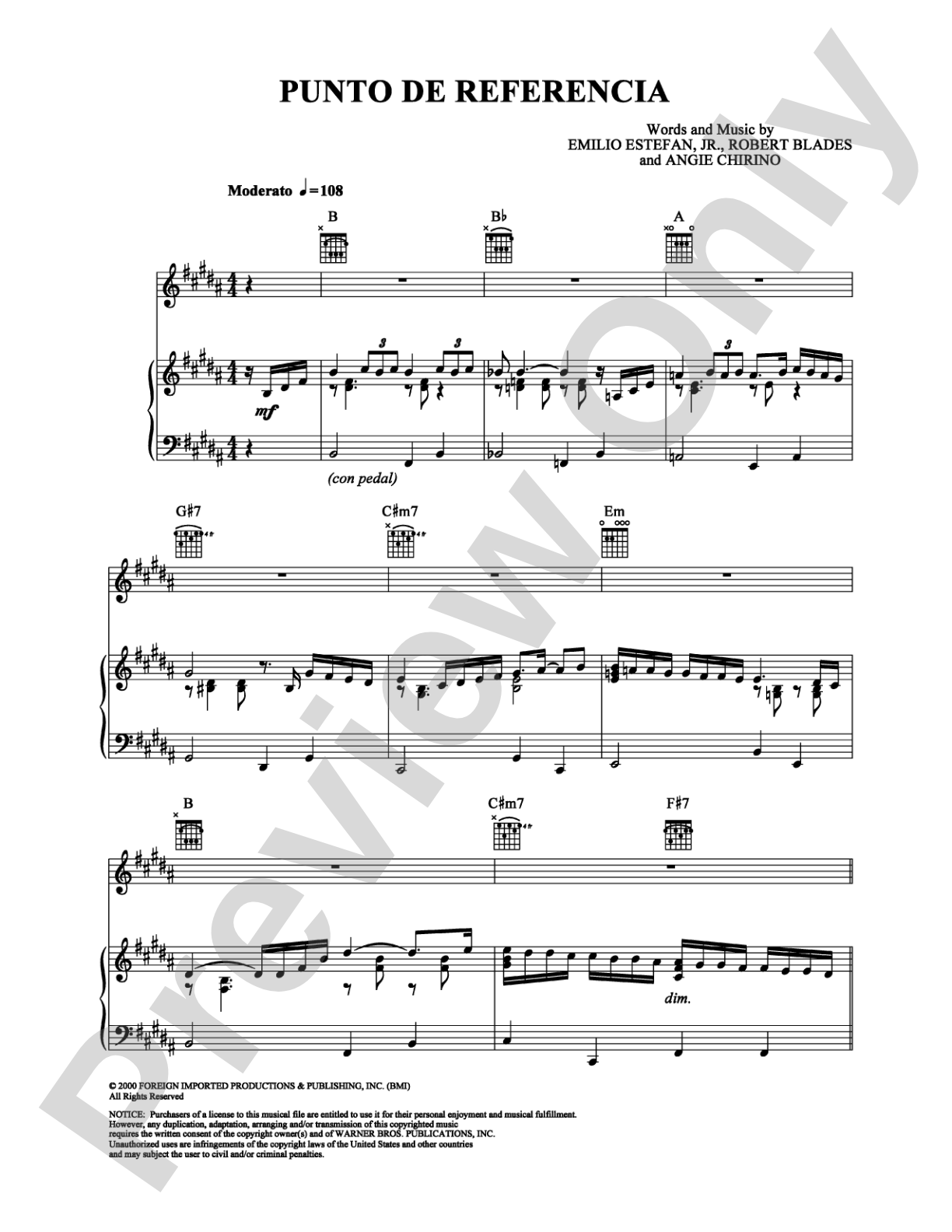
Punto de Referencia: Piano/Vocal/Chords Digital Sheet Music

Punto de Referencia: Piano/Vocal/Chords Digital Sheet Music

Gloria Estefan, Emilio Estefan, Jr., Robert D. Blades, Angie Chirino

Item: 00-PS-0001739

Digital Download
$3.99
Description

Punto de Referencia: Piano/Vocal/Chords Digital Sheet Music isn't in MakeMusic Cloud just yet...but it could be. Let us know you'd like to see it, and you'll help shape what comes next. In the meantime, start a free trial and dive into thousands of interactive titles your students can play along with today.

Sample Audio
No sample audio found.
Sample Video
Additional Details
SKU: 00-PS-0001739

More about this title

About the Artist: Gloria Estefan

Gloria Estefan rose from Miami's Cuban-American community to become one of the most influential crossover artists in pop music history. Her career, spanning four decades, has been defined by her ability to blend Latin rhythms with contemporary pop sensibilities, earning her multiple Grammy Awards and a permanent place in the Songwriters Hall of Fame.

Estefan's work in music education contexts extends beyond her recordings. Her bilingual approach to songwriting and her commitment to authentically representing Latin musical traditions make her catalog valuable for students exploring how cultural identity shapes artistic voice and commercial success.

Why we love this

Punto de Referencia exemplifies the sophisticated harmonic language and rhythmic drive that made Estefan's music compelling across radio formats and concert stages. The piano/vocal/chords arrangement opens this contemporary Latin-pop track to singers and pianists who want to study how a major artist constructs melodic hooks, manages key changes, and layers vocal phrasing over rhythmic precision. Choosing this piece signals to students that pop music deserves the same analytical attention as any other genre.

What to expect

Punto de Referencia carries the rhythmic vitality and emotional directness that defined Estefan's best work. The melody sits between accessibility and sophistication, inviting expressive delivery while the harmonic language creates moments of harmonic richness beneath a pop-oriented surface. Performing it requires balancing precision with personality.

Who it's for

This arrangement suits vocalists and pianist-vocalist duos at the intermediate to advanced level who want to work with recognizable, well-crafted contemporary repertoire. Teachers can assign it to students ready to engage with Latin-influenced pop from both performance and analytical angles. Singers preparing audition material or recital programs will find a piece that demands musicianship without requiring extreme range or technical excess.

How to get the most out of it

  • Pay close attention to the rhythmic relationship between the vocal melody and the underlying chord progression. Latin-influenced pop often sits slightly ahead of or behind the beat intentionally; lock in with the written rhythm rather than fighting it.
  • Use the chord symbols as a guide for understanding harmonic function, not just as accompaniment filler. Notice where Estefan's melodies sit relative to the root, third, and fifth of each chord.
  • Shape the vocal line by marking phrase boundaries in pencil before you sing. This piece benefits from clear breath placement and intentional phrasing that respects both the lyrical content and the musical architecture.
  • If performing with a pianist, establish a solid tempo reference early. The groove is the foundation; rhythm section precision matters as much in this style as it does in classical ensemble work.

How to use it

This piece works well in recitals celebrating contemporary songwriting or Latin influences in American popular music. It pairs naturally with other crossover pop or Latin-inflected pieces in a student recital or concert exploring cultural identity in music. The arrangement also serves as a teaching piece for understanding how professional songwriters construct singable, harmonically interesting melodies.

Skills your students will build

  • Reading and interpreting chord symbols in a contemporary pop context
  • Managing Latin-influenced rhythmic feels and syncopation
  • Vocal phrasing and expression within a rhythmically precise groove
  • Understanding harmonic function through real-world songwriting
  • Ensemble communication and timing between vocalist and accompanist

You May Also Like