
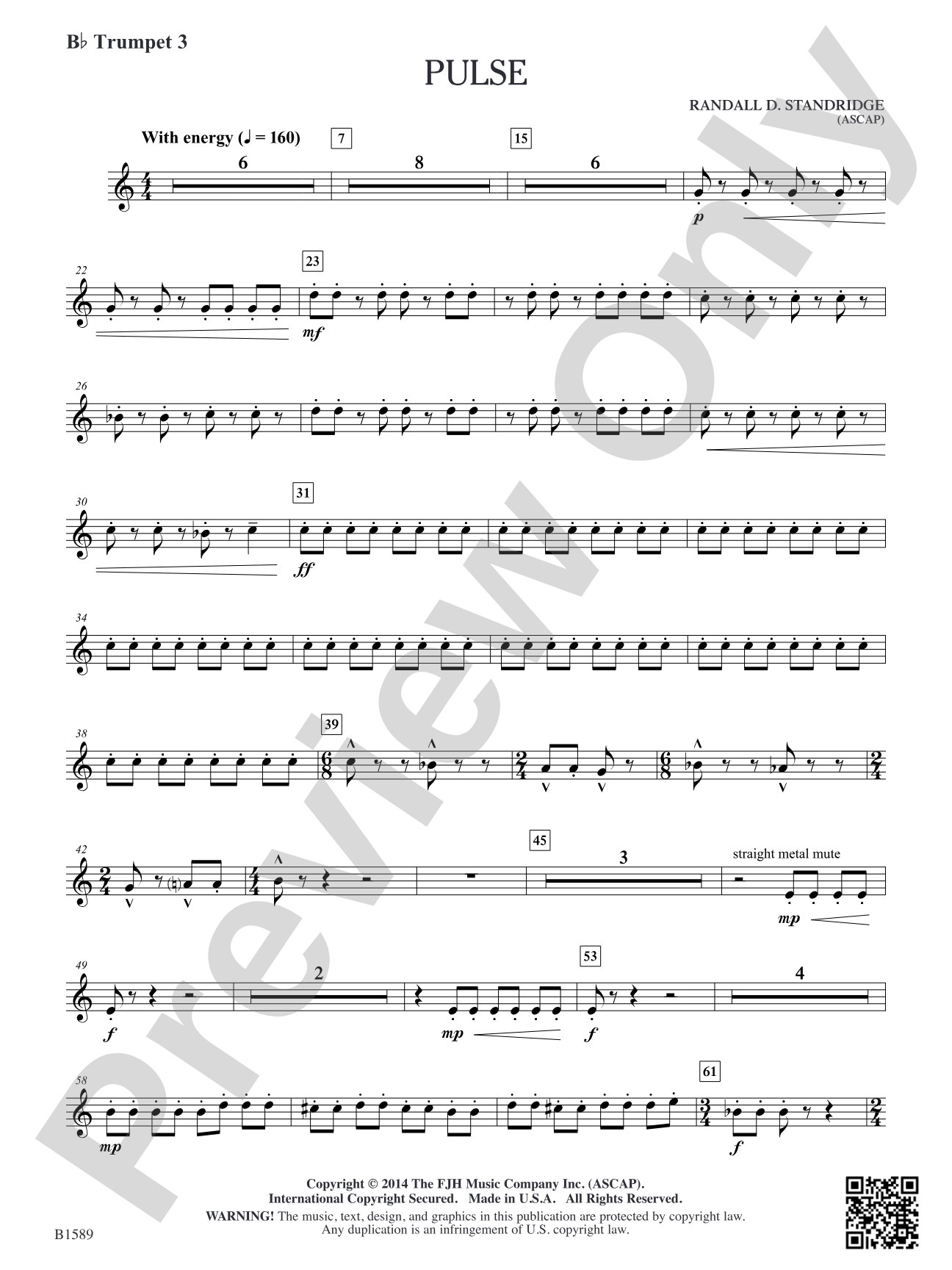

Pulse: B-flat Trumpet 3
By Randall Standridge
Grade: 4
Item: 98-PC-DB1589_T3
$7.00
Pickup currently not available
Description
An unrelenting sense of rhythm and forward motion characterizes this exciting opener. Inspired by the painting techniques of the pointillism movement, the exciting themes, minimalistic techniques, and creative textural effects all combine to create a significant work that will be an outstanding opener or closer to any concert or festival program. (3:30)


Don't just read it, hear it, play along with it, and watch your students grow with it. In MakeMusic Cloud, Pulse: B-flat Trumpet 3 comes alive with professional accompaniment, adjustable tempo, and built-in practice tools that turn solo practice into real progress.
Open in the Player
Jump straight in and assign it today.
Start Your Free Trial
Open this title and explore the full library in minutes.
Sample Audio
1
Audio File
--:--
0:00
0:00
Sample Video
No sample videos found.
Additional Details
Series:
FJH Symphonic Band
Publisher:
The FJH Music Company, Inc.
SKU:
98-PC-DB1589_T3
More about this title
About the Composer: Randall Standridge

Randall Standridge holds degrees in music education and composition from Arkansas State University, where he studied under Dr. Tom O'Connor and Dr. Tim Crist. He directed the band program at Harrisburg High School in Arkansas for over a decade before transitioning to full-time composition and marching arts design in 2013.
Standridge's catalog spans concert band, marching ensembles, and educational literature published through multiple outlets including Alfred Music, FJH Music, and his own Randall Standridge Music imprint. His works have earned recognition at the Midwest Clinic, appeared in the Teaching Music Through Performance in Band series, and been selected repeatedly for J.W. Pepper's editor's choice. Beyond composition, he designs drill and colorguard concepts for competitive marching programs and maintains an active presence in both wind band and marching arts communities.
Why we love this
Standridge crafts an opener that genuinely energizes a program without relying on bombast. The pointillism-inspired orchestration keeps parts engaged across the ensemble, and the minimalistic approach leaves room for ensemble balance work rather than demanding overwhelming technical fireworks. This is the kind of contest opener that audiences recognize as substantial while judges appreciate the compositional sophistication.
What to expect
Propulsive and deliberate. The piece unfolds with hypnotic forward motion, built from layered rhythmic and textural ideas that accumulate rather than announce themselves. Despite its drive, there's an undercurrent of restraint and precision that creates tension between momentum and control.
Who it's for
Grade 4 bands with solid fundamentals and the ability to sustain ensemble focus through minimalistic writing. Directors seeking a compelling opener or closer that challenges students to think beyond traditional melody-and-accompaniment structures will find this piece rewarding for both performance and artistic growth.
How to get the most out of it
- Establish a rock-solid internal pulse in sectionals before full ensemble rehearsal. The rhythmic drive depends on every player internalizing the forward motion, not just following a conductor.
- Highlight the textural shifts that emerge from the minimalistic writing. These moments of color change are as important to the overall shape as the primary themes.
- Balance precision with energy. The short runtime (3:30) means every note and silence counts; avoid rushing the tempo even when the momentum feels natural.
- Use the rhythmic ostinatos as teaching moments for understanding how pointillism functions musically. Have players identify which sections carry the main gesture and which provide textural support.
How to use it
Program this as a contest or festival opener to set an artistic tone from the opening downbeat. It also serves effectively as a sophisticated closing piece, giving the ensemble a strong final statement that relies on compositional craft rather than sheer instrumentation. The compact length makes it ideal for festival schedules while its substantial musical content prevents any sense of filler.
Skills your students will build
- Maintaining ensemble pulse and forward motion across minimalistic textures
- Distinguishing and balancing textural layers built from rhythmic ostinatos
- Interpreting contemporary compositional techniques inspired by visual art (pointillism)
- Sustaining musical interest without reliance on traditional melodic development
- Precision in rhythmic execution and ensemble alignment