
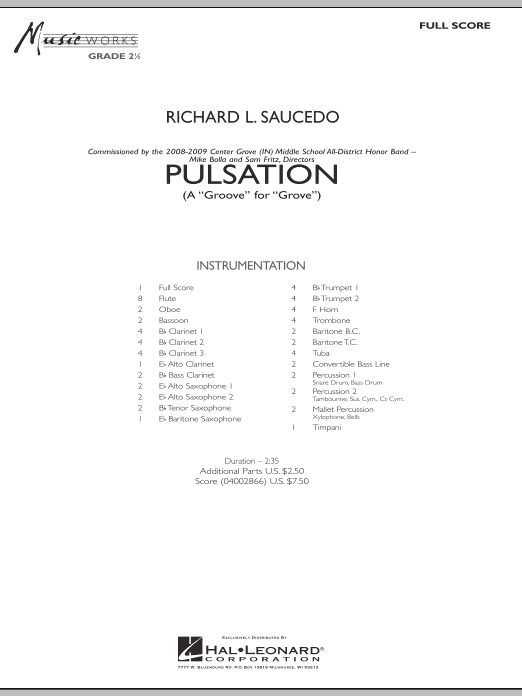

Pulsation: Concert Band Conductor Score & Parts
By Richard L. Saucedo
Grade: 2.5
Item: 35-PK00126741
$65.00
Pickup currently not available
Buy Extra Parts (Digital PDF Download)
| Product | Price | Quantity |
|---|---|---|
| Pulsation - Full Score | $10.00 | |
| Pulsation - Flute | $6.00 | |
| Pulsation - Oboe | $6.00 | |
| Pulsation - Bassoon | $6.00 | |
| Pulsation - Bb Clarinet 1 | $6.00 | |
| Pulsation - Bb Clarinet 2 | $6.00 | |
| Pulsation - Bb Clarinet 3 | $6.00 | |
| Pulsation - Eb Alto Clarinet | $6.00 | |
| Pulsation - Bb Bass Clarinet | $6.00 | |
| Pulsation - Eb Alto Saxophone 1 | $6.00 | |
| Pulsation - Eb Alto Saxophone 2 | $6.00 | |
| Pulsation - Bb Tenor Saxophone | $6.00 | |
| Pulsation - Eb Baritone Saxophone | $6.00 | |
| Pulsation - Bb Trumpet 1 | $6.00 | |
| Pulsation - Bb Trumpet 2 | $6.00 | |
| Pulsation - F Horn | $6.00 | |
| Pulsation - Trombone | $6.00 | |
| Pulsation - Baritone B.C. | $6.00 | |
| Pulsation - Baritone T.C. | $6.00 | |
| Pulsation - Tuba | $6.00 | |
| Pulsation - Convertible Bass Line | $6.00 | |
| Pulsation - Percussion 1 | $6.00 | |
| Pulsation - Percussion 2 | $6.00 | |
| Pulsation - Mallet Percussion | $6.00 | |
| Pulsation - Timpani | $6.00 |
Parts Added to Cart!
Description
Written entirely in one tempo, but with the meter alternating between 4/4 and 6/8 throughout, Richard Saucedo creates an ingenious effect of pulsating motion along with layers of textures and sounds. Starting with a soloistic dialogue between flute and clarinet the work progresses to thicker sonorities and percussive effects including clapping and shouting. Definitely an enjoyable work that is off the beaten path! Dur: 2:35 (Grade 2-1/2)


Pulsation: Concert Band Conductor Score & Parts isn't in MakeMusic Cloud just yet...but it could be. Let us know you'd like to see it, and you'll help shape what comes next. In the meantime, start a free trial and dive into thousands of interactive titles your students can play along with today.
Request This Title
Tell us you want it.
Start Your Free Trial
Explore everything that's ready to play right now.
Sample Audio
No sample audio found.
Sample Video
No sample videos found.
Additional Details
Publisher:
Hal Leonard
SKU:
35-PK00126741
More about this title
About the Composer: Richard L. Saucedo

Richard L. Saucedo built Carmel High School's band program into a powerhouse during his 31 years as Director of Bands and Performing Arts Chairman in Indiana. His ensembles earned state and national recognition across concert, jazz, and marching categories, with the Wind Symphony I performing at the Music for All National Festival three times and the Marching Greyhounds placing in the BOA Grand National top ten for 17 consecutive years. The program achieved the rare distinction of winning a BOA National Championship while simultaneously performing at the Midwest Clinic in 2005.
Beyond his classroom legacy, Saucedo has contributed substantially to the activity as a composer, arranger, and judge. He served as Brass Arranger and Composer for the Cavaliers Drum Corps during five DCI World Championship seasons and currently holds positions as music coordinator for the Blue Devils and Senior Educational Consultant for Music for All. His honors include Indiana's Bandmaster of the Year (1998-99), induction into both the Music for All Hall of Fame (2015) and DCI Hall of Fame (2022), and election to the American Bandmasters Association.
Why we love this
Saucedo solves a real rhythmic puzzle here by keeping the tempo constant while shifting between 4/4 and 6/8, creating genuine forward momentum rather than the static feel of a single meter. The scoring builds intelligently from a intimate flute-clarinet exchange into fuller textures with percussion and body percussion, giving you natural pacing for rehearsal focus and audience engagement alike. Grade 2.5 bands rarely find contemporary works this clever about structure.
What to expect
Energy builds gradually from a curious, almost tentative conversation between two soloists into a kinetic surge of overlapping rhythms and timbres. The piece pulses with forward drive even as the meter keeps shifting beneath it, creating a sense of organized momentum punctuated by moments of unexpected color and texture. Despite its contemporary approach, it remains lyrical and engaging rather than austere.
Who it's for
Grade 2.5 concert bands seeking contemporary repertoire with real compositional substance rather than simple arrangements. Directors who want to challenge students with metric modulation and layered orchestration without overwhelming a developing ensemble. Bands that enjoy unconventional sounds and interactive performance elements.
How to get the most out of it
- Lock the meter changes into muscle memory during sectional rehearsals by isolating just the rhythm section (timpani, bass drum, bass clarinet) across one meter shift at a time. The visual difference between duple and triple subdivisions will click faster if students feel it kinesthetically first.
- Build the clapping and shouting passages carefully with your ensemble. These moments demand rhythmic precision even though they sound spontaneous; rehearse them separately with the same focus you'd give to any technical passage.
- Shape the opening flute-clarinet dialogue as genuine conversation, not trading solos. Ask those players to listen actively to each other's phrasing and dynamic contours, treating call-and-response as authentic dialogue.
- Map out the textural layers on your score well before rehearsals start. Mark which sections are melodic, harmonic, or rhythmic/textural in each system so you can communicate part roles clearly and avoid the thick section from feeling muddy.
How to use it
Program this as a concert opener or pre-intermission work where its compact length (2:35) and distinctive character catch the audience's attention without overshadowing longer works. It works especially well alongside lighter, more traditional repertoire to show your band's stylistic range and modern sensibilities. Spring concerts and festival showcase programs value pieces that demonstrate both technique and musical personality.
Skills your students will build
- Reading and performing meter changes (4/4 and 6/8 alternation) within a consistent tempo
- Layering independent rhythmic and melodic lines to build composite textures
- Precision in body percussion and non-traditional performance techniques
- Listening interdependence between soloistic dialogue and ensemble sections
- Sustaining energy and forward motion through metric complexity