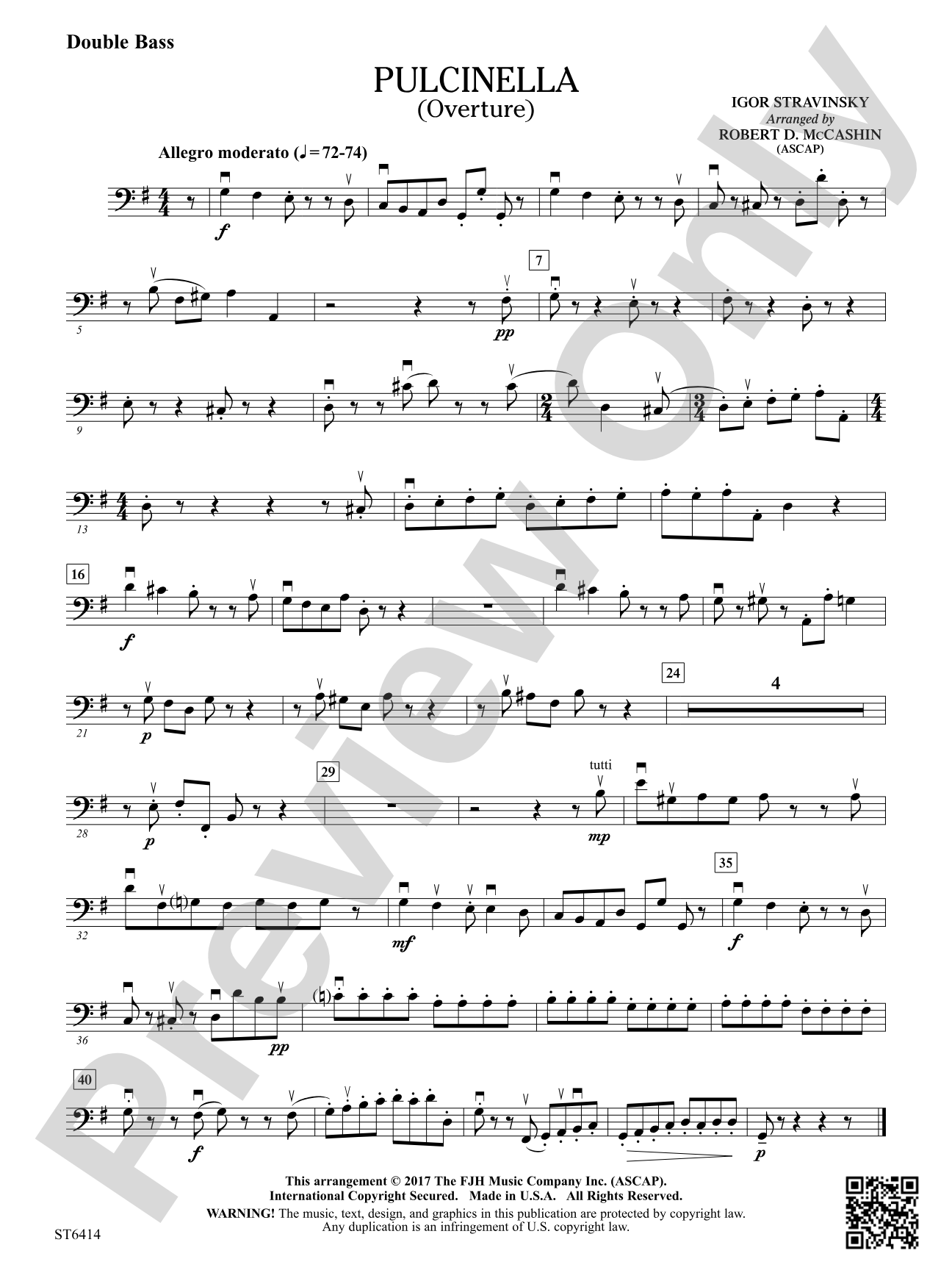
Puicinella: Double Bass Sheet Music Preview

Puicinella: Double Bass

By Igor Stravinsky / arr. Robert D McCashin

Grade: 3.5

Item: 98-PC-DST6414_SB

Digital Download
$7.00
Description
Featuring the overture of Stravinsky's landmark work, this adaptation was drawn from the original piano/vocal ballet score, and retains all of the original, well-known thematic and rhythmic material. An ideal way to feature several soloists within the ensemble, this outstanding string arrangement will delight players and audience alike!

Puicinella: Double Bass isn't in MakeMusic Cloud just yet...but it could be. Let us know you'd like to see it, and you'll help shape what comes next. In the meantime, start a free trial and dive into thousands of interactive titles your students can play along with today.

Sample Audio
0:00
0:00
Sample Video
Additional Details
Series: FJH String Orchestra
Publisher: The FJH Music Company, Inc.
SKU: 98-PC-DST6414_SB

More about this title

About the Composer: Igor Stravinsky

Igor Stravinsky (1882–1971) fundamentally changed how composers approached rhythm, orchestration, and harmonic language in the twentieth century. His ballets for Sergei Diaghilev's Ballets Russes, beginning with The Firebird in 1910, established him as a master of theatrical music and instrumental color. Stravinsky's influence on music education extends far beyond concert halls; his works have become essential repertoire for training musicians in rhythmic precision, twentieth-century idiom, and the relationship between music and movement.

Why we love this

This arrangement captures the vitality and wit of Stravinsky's Pulcinella without the complexity of the full score, making a genuine masterwork accessible to developing orchestras. The writing for soloists within the ensemble gives talented players moments to shine while maintaining transparency and ensemble cohesion. At Grade 3.5, it delivers authentic Stravinsky character and distinctive rhythmic language to students ready to engage with twentieth-century compositional thinking.

What to expect

Pulcinella dances with sharp rhythmic angles, clever orchestral jokes, and a carnival-like energy that feels both playful and precisely crafted. The melodies are long-lined and memorable, but they move through unexpected harmonic territory and rhythmic patterns that keep listeners engaged and surprised.

Who it's for

String orchestras at the intermediate to early advanced level who are ready to explore twentieth-century repertoire with personality and rhythmic drive. This arrangement works equally well for festival play, concert programming, or as a stepping stone before tackling larger Stravinsky works.

How to get the most out of it

  • Establish clear articulation patterns early in rehearsal, especially in the rhythmically driven sections. Stravinsky's humor and energy depend on crisp attacks and defined phrase shapes.
  • Balance the solo passages so they cut through the ensemble without overwhelming the texture. The soloists should sound like featured voices within a unified group, not disconnected from it.
  • Pay attention to the harmonic shifts and unexpected chord juxtapositions; they define much of the piece's character. Intonation in these moments directly impacts how the audience receives the music's wit and color.
  • Conduct with clear, economical gestures to help the orchestra navigate the metric shifts and syncopated figures that give Pulcinella its characteristic bounce and liveliness.

How to use it

Program this as a contrasting centerpiece on a concert that includes Baroque-inspired pieces or other twentieth-century works; its neoclassical roots make it a natural bridge between eras. The soloists-within-the-ensemble format also makes it ideal for a concert celebrating individual players, or as a festival selection that showcases both ensemble precision and musicianship.

Skills your students will build

  • Reading and performing twentieth-century idioms and harmonic language
  • Executing rhythmic precision in syncopated and metrically intricate passages
  • Balancing solo passages within an ensemble texture
  • Understanding neoclassical form and Stravinsky's approach to melodic material
  • Developing intonation awareness in unconventional harmonic contexts

You May Also Like