
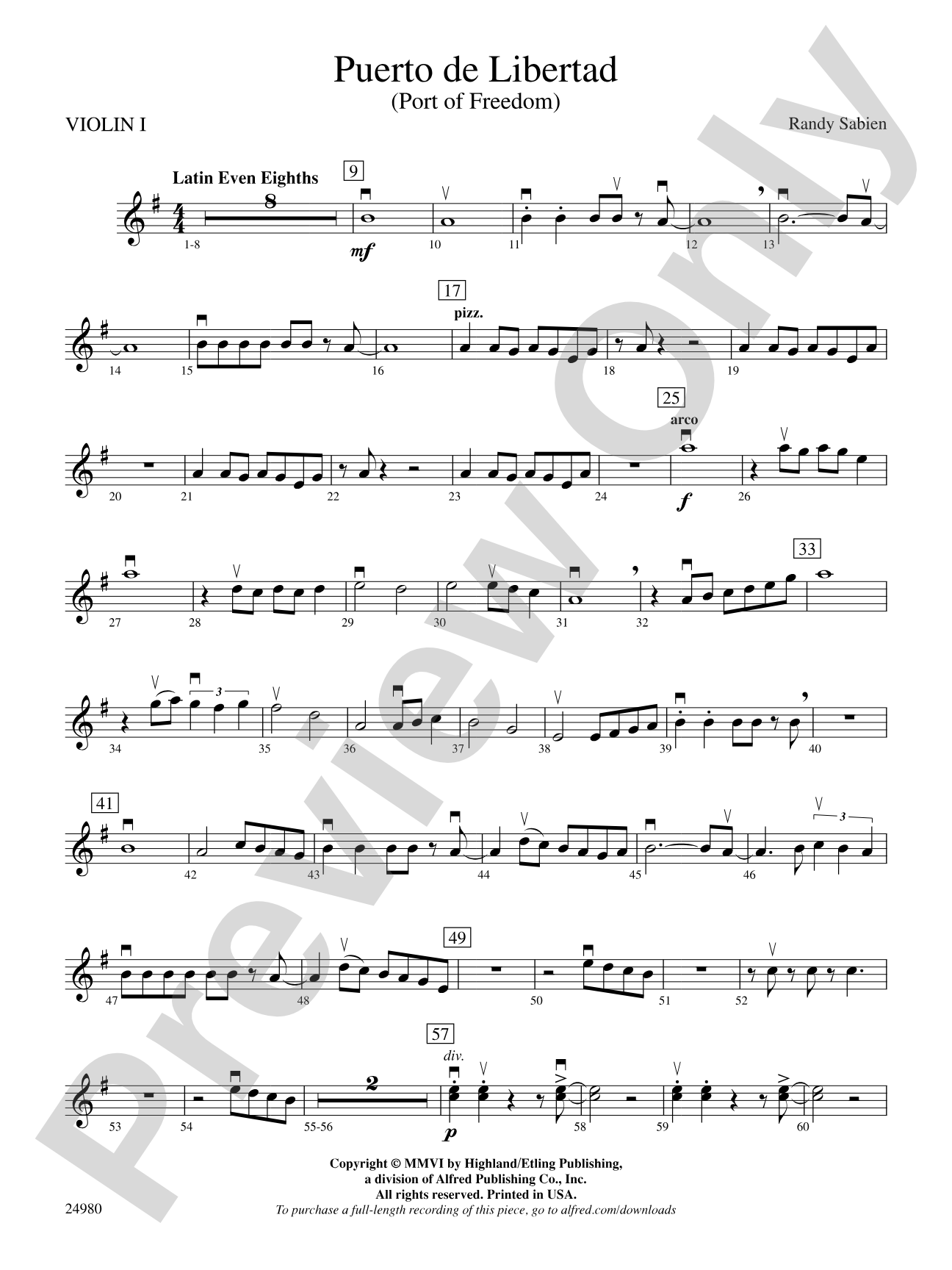

Puerto de Libertad (Port of Freedom): 1st Violin
By Randy Sabien
Grade: 2
Item: 00-PC-0000963_VN1
$5.99
Pickup currently not available
Description
Totally cool! Written in a Latin-rock style popularized in the 1960's by Carlos Santana, "Puerto de Libertad" has three sections: a recurring call and response riff, a lyrical melody in four part harmony, and soli sections jamming on a two chord vamp. All solos are written out but feel free to improvise if you like! This piece also gives the percussion section the chance to cut loose on the cowbell, guere, and congas. All parts are in first position and may serve as an introduction to syncopation with easy rhythms.


Don't just read it, hear it, play along with it, and watch your students grow with it. In MakeMusic Cloud, Puerto de Libertad (Port of Freedom): 1st Violin comes alive with professional accompaniment, adjustable tempo, and built-in practice tools that turn solo practice into real progress.
Open in the Player
Jump straight in and assign it today.
Start Your Free Trial
Open this title and explore the full library in minutes.
Sample Audio
1
Audio File
--:--
0:00
0:00
Sample Video
No sample videos found.
Additional Details
Series:
Highland/Etling String Alternatives
Publisher:
Alfred Music
Page Count:
144
SKU:
00-PC-0000963_VN1
More about this title
About the Composer: Randy Sabien
Randy Sabien has built a reputation as a composer and arranger who understands what works in the string classroom. His arrangements for Highland/Etling consistently balance accessibility with genuine musical substance, giving young players repertoire that sounds professional while remaining technically manageable.
Sabien's work reflects a deep understanding of how strings develop rhythmic confidence and ensemble cohesion. His approach to instrumentation and pedagogical pacing has made his pieces a reliable choice for directors seeking contemporary, engaging material for Grade 2 ensembles.
Why we love this
Randy Sabien writes string music that actually excites young players. "Puerto de Libertad" brings the energy of 1960s Latin-rock into the orchestra classroom without requiring advanced technique, which means your students get to sound and feel like serious musicians right away. The written-out solos with permission to improvise strike the perfect balance between structure and creative freedom for this level.
What to expect
Energetic and accessible. The piece pulses with the swagger of 1960s Latin-rock but never loses sight of string musicality. You'll hear the riff stick in your head, watch the four-part harmonies bloom with warmth, and feel the whole group tighten when the ensemble locks into that two-chord vamp.
Who it's for
Grade 2 string orchestras ready to explore style and rhythm beyond classical traditions. This works well for ensembles with players comfortable in first position and eager to engage with grooves, call-and-response, and the textural variety that comes from writing percussion into the arrangement.
How to get the most out of it
- Lock the rhythm section first. Have your section leaders work out the call-and-response riff and two-chord vamp with precision before adding the full ensemble; the soloist will land much more confidently when the foundation is rock-solid.
- Let percussionists explore their parts as genuine melodic material, not accompaniment. The cowbell, guero, and congas drive the groove, so give them rehearsal time and confidence to own their rhythms.
- If your students choose to improvise the solo sections, keep those rehearsals playful and encourage risk-taking. The written-out solos are there as safety nets, not rules.
- Shape the lyrical four-part harmony section with clear phrasing despite the Latin-rock context. This contrast makes both sections shine.
How to use it
Use this as a concert opener to set an upbeat, contemporary mood, or pair it alongside classical and folk repertoire to show your audience the full range of your orchestra's musicianship. It also works as a mid-year piece when your ensemble has enough technical confidence to focus on style and ensemble blend rather than note-reading.
Skills your students will build
- Syncopated rhythms and Latin-rock groove
- Call-and-response phrasing
- Four-part harmonic texture and balance
- First position confidence across multiple string voicings
- Listening to and supporting a solo line
- Basic improvisation within a harmonic framework
- Ensemble cohesion in a contemporary style context