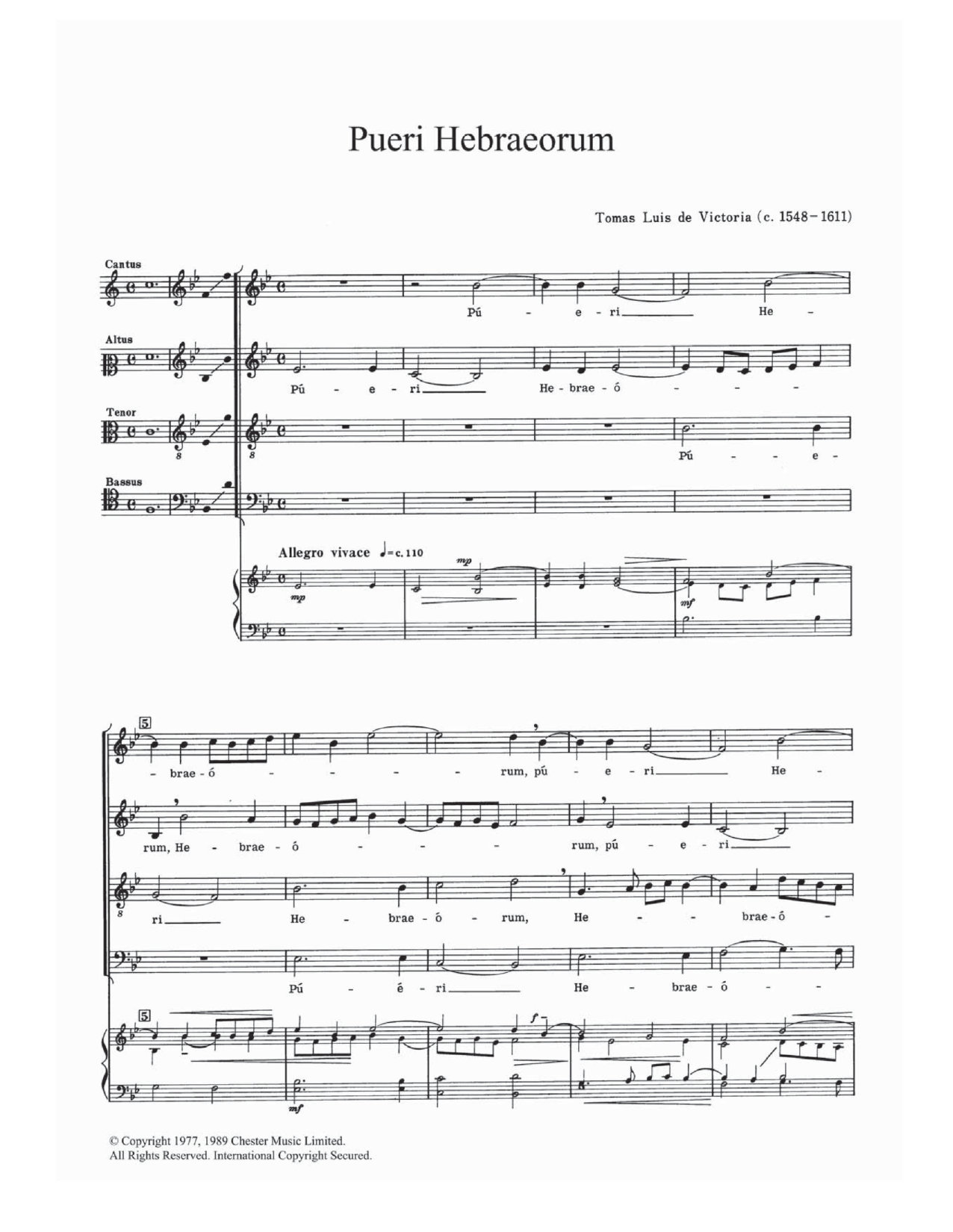
Pueri Hebraeorum Sheet Music Preview

Pueri Hebraeorum: Choral Octavo

As performed by Tomàs Luis de Victoria

Item: 35-DS00314856

Digital Download
$2.99
Description

Pueri Hebraeorum: Choral Octavo isn't in MakeMusic Cloud just yet...but it could be. Let us know you'd like to see it, and you'll help shape what comes next. In the meantime, start a free trial and dive into thousands of interactive titles your students can play along with today.

Sample Audio
No sample audio found.
Sample Video
Additional Details
Publisher: Hal Leonard
Page Count: 4
SKU: 35-DS00314856

More about this title

About the Artist: Tomàs Luis de Victoria

Tomàs Luis de Victoria (c. 1548-1611) stands among the most significant Spanish composers of the Renaissance, rivaling Palestrina in his mastery of polyphonic writing. He spent formative years in Rome studying with Orlando di Lasso and immersed in the sacred music traditions that shaped his compositional voice, before returning to Spain where he served as maestro de capilla and composed extensively for the Church.

Victoria's output centers almost entirely on sacred music, and his motets reveal a composer of remarkable textural clarity and emotional depth. His ability to balance structural sophistication with direct spiritual expression makes his works invaluable to choirs seeking Renaissance polyphony that communicates powerfully without sacrificing musical substance.

Why we love this

Victoria's writing here exemplifies why Renaissance polyphony rewards serious ensemble singing. The four-voice texture allows each line genuine independence while the harmonic language creates moments of unexpected warmth that land with real impact when balanced properly. Your singers will discover that precision and blend unlock the piece's spiritual character.

What to expect

The piece unfolds with quiet dignity and contemplative clarity. Victoria's restraint creates space for the Latin text to resonate, and the harmonic motion suggests devotion without sentimentality. There's an almost austere beauty in how the voices interweave, asking listeners to lean in rather than overwhelm them.

Who it's for

Choirs with solid Renaissance polyphony experience and secure music reading skills will find this piece rewarding. It works equally well for collegiate programs, community choirs, and advanced high school ensembles seeking substantial sacred repertoire.

How to get the most out of it

  • Establish a clear vowel foundation across all voice parts before layering text; Victoria's counterpoint becomes muddy if singers aren't unified on pure vowels beneath the words
  • Shape phrases by the text's natural breathing points rather than notated bar lines, allowing the Latin prosody to guide rubato and phrasing
  • Balance the inner voices equally with the outer ones; this four-part texture demands that alto and tenor lines receive the same attention as soprano and bass

How to use it

Pair this with other Renaissance motets for a unified concert section, or use it to anchor a sacred music program alongside works from the Franco-Flemish tradition. The modest page count makes it an ideal addition to a choral concert where you want substantive but concise programming.

Skills your students will build

  • Reading soprano, alto, tenor, and bass clefs with fluency
  • Balancing independent melodic lines within dense four-part counterpoint
  • Singing Latin text with authentic pronunciation and clear articulation
  • Understanding Renaissance harmonic language and functional harmony in modal contexts
  • Maintaining intonation across sustained polyphonic writing

You May Also Like