
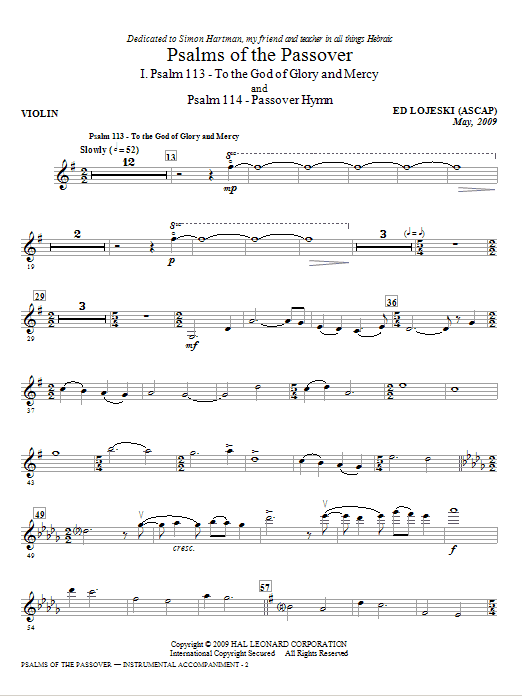

Psalms Of The Passover: Choral Instrumental Pak
By Ed Lojeski
Item: 35-PK00141580
$40.00
Pickup currently not available
Buy Extra Parts (Digital PDF Download)
| Product | Price | Quantity |
|---|---|---|
| Psalms Of The Passover - Violin: Choral Instrumental Pak | $7.00 | |
| Psalms Of The Passover - Bb Clarinet: Choral Instrumental Pak | $7.00 | |
| Psalms Of The Passover - Cello: Choral Instrumental Pak | $7.00 |
Parts Added to Cart!
Description
This major work for chorus, soloists and piano quartet (piano, violin, clarinet, cello) is based on the Psalms used in the Passover Seder dinner from the Old Testament times to the present. Psalms 113 to 118 are set in four movements and unite the Judeo-Christian community in song, as mentioned in the New Testament (Matthew 26:30 and Mark 14:26). These Psalms may have been the last songs Jesus sang with his disciples at the Last Supper before his death. Includes: To the God of Glory and Mercy (Psalm 113); Passover Hymn (Psalm 114); The One True God (Psalm 115); Thanksgiving (Psalm 116); Summons to Praise (Psalm 117); Processional Hymn (Psalm 118) - based on HAD GADYA, an ancient Aramaic song used at the conclusion of the Passover Seder. Piano Quartet (parts for Violin, Clarinet and Cello). Duration: ca. 23:00.


Psalms Of The Passover: Choral Instrumental Pak isn't in MakeMusic Cloud just yet...but it could be. Let us know you'd like to see it, and you'll help shape what comes next. In the meantime, start a free trial and dive into thousands of interactive titles your students can play along with today.
Request This Title
Tell us you want it.
Start Your Free Trial
Explore everything that's ready to play right now.
Sample Audio
No sample audio found.
Sample Video
No sample videos found.
Additional Details
Publisher:
Hal Leonard
SKU:
35-PK00141580
More about this title
About the Composer: Ed Lojeski
Ed Lojeski is a composer and arranger with deep roots in choral and vocal music. His work spans sacred repertoire, popular arrangements, and concert pieces that combine accessibility with musical substance, making him a frequent choice for festivals and worship settings.
Why we love this
This work takes six interconnected psalms and transforms them into a genuine concert experience rather than a meditative one. The integration of soloists and chamber ensemble creates textural variety that keeps audiences engaged across 23 minutes, and the theological coherence gives your singers something meaningful to convey beyond the notes.
What to expect
The music flows between intimate moments of solo reflection and moments of communal affirmation, mirroring the structure of an actual Passover gathering. There's a sense of ritual and reverence without becoming static; the chamber ensemble keeps things moving forward even in quieter passages.
Who it's for
Choirs with intermediate to advanced singers who want to program a full concert work with genuine spiritual weight. This is equally suited to worship settings pursuing concert-quality sacred music and secular festivals exploring religious traditions.
How to get the most out of it
- Balance the chamber ensemble with your chorus carefully in rehearsals. The piano quartet provides harmonic and rhythmic structure, so clear entrances from the players pay dividends when singers lock in.
- Give soloists time to prepare emotionally. These psalms move through different emotional territories (praise, questioning, thanksgiving, procession), and singers need to understand the arc before polishing details.
- Pay attention to the HAD GADYA connection in the final movement. If your audience knows the Passover context, that moment lands harder. A brief program note explaining the historical connection enriches the listening experience.
- Consider staging the piano quartet visibly. Since the piece spans six distinct movements with different textural demands, watching the ensemble respond to the choir creates visual momentum.
How to use it
This works beautifully as a centerpiece for a spring concert, particularly in years when you want to explore interfaith repertoire or celebrate the connections between Jewish and Christian traditions. You could also perform individual movements as part of a multi-work concert, though the six-psalm structure has genuine narrative momentum when presented complete.
Skills your students will build
- Singing over active chamber accompaniment with clear text projection
- Shifting between homophonic and contrapuntal textures within a single work
- Sustaining musicality across an extended form without losing shape
- Interpreting psalmic texts as emotional rather than purely devotional
- Ensemble listening and response to instrumental cues from multiple players