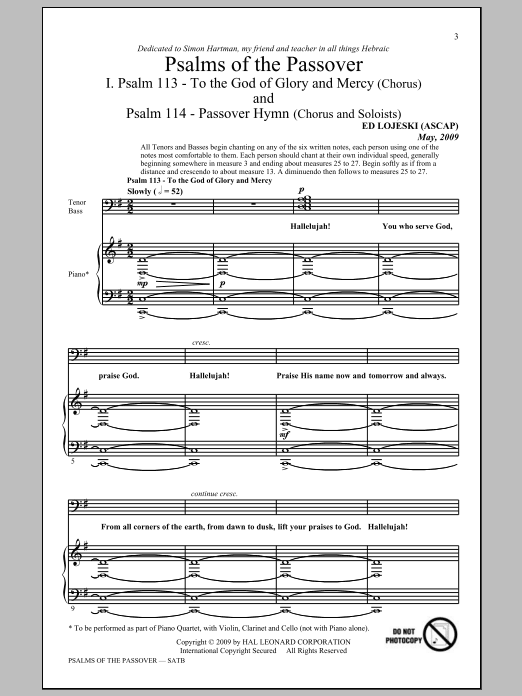
Ed Lojeski has spent decades composing and arranging music for choirs of all levels, with a particular gift for making sacred texts both accessible and musically substantial. His work appears regularly in festival programs and concert seasons across North America, where directors value his ability to balance singability with harmonic sophistication.
Why we love this
Lojeski crafts settings of Passover psalms that feel genuinely liturgical without demanding a specialized ensemble. The SATB writing sits comfortably for mixed choirs while the harmonic language and text setting give singers something real to communicate.
What to expect
The music breathes with a reverent, contemplative quality that honors the psalmist's voice without sentimentality. Harmonic movement unfolds gradually, creating moments of warmth and depth that feel both timeless and immediate.
Who it's for
Choirs preparing sacred concert repertoire or festival programs will find these settings work equally well in worship contexts or concert halls. The piece suits intermediate to advanced ensembles with solid intonation and blend but does not require soloistic voices.
How to get the most out of it
Anchor the vocal lines to the text's natural speech rhythms rather than mechanically observing every note value, especially in passages where the psalmic language carries the weight.
Balance the four parts carefully during full texture passages; make sure inner voices (alto and tenor) project equally with soprano and bass rather than sliding into accompaniment roles.
Allow space for breath between phrases to honor the liturgical nature of the text and keep voices from sounding pressed or rushed.
Shape phrases toward points of harmonic or textual significance rather than treating each line as equally important; this directs listener attention and deepens musical meaning.
How to use it
Pair this with other choral works exploring sacred texts to build a program with thematic coherence, or use it as a centerpiece in a liturgical context where the Passover connection deepens the congregation's engagement. The 16 pages suggest substantial musical content that can anchor a concert half or stand as a significant festival entry.
Skills your students will build
Lyrical phrasing in sacred texts
Part independence within four-part harmonic textures
Intonation stability in chromatic harmonic progressions
Expressive interpretation of liturgical language
Sustained legit singing across longer phrases
You May Also Like
Scan to Complete Your Purchase
Use your phone's camera to scan the code below
You'll log in on your phone and the order will be added to your account