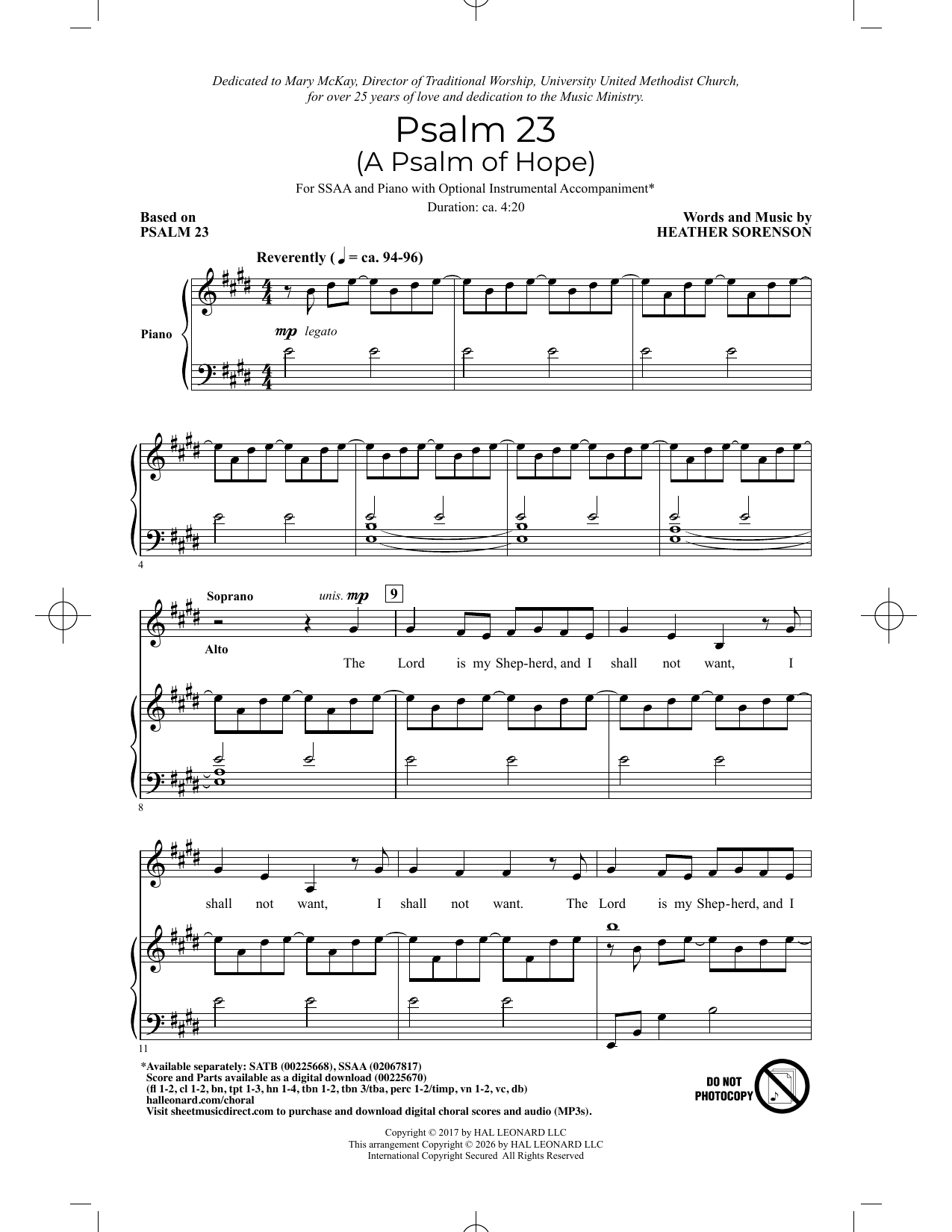
Psalm 23 (A Psalm Of Hope) Sheet Music Preview

Psalm 23 (A Psalm Of Hope): SSAA Choral Octavo

By Heather Sorenson

Item: 35-DS01874632

Digital Download
$2.50
Description

Psalm 23 (A Psalm Of Hope): SSAA Choral Octavo isn't in MakeMusic Cloud just yet...but it could be. Let us know you'd like to see it, and you'll help shape what comes next. In the meantime, start a free trial and dive into thousands of interactive titles your students can play along with today.

Sample Audio
No sample audio found.
Sample Video
Additional Details
Publisher: Hal Leonard
Page Count: 10
SKU: 35-DS01874632

More about this title

About the Composer: Heather Sorenson

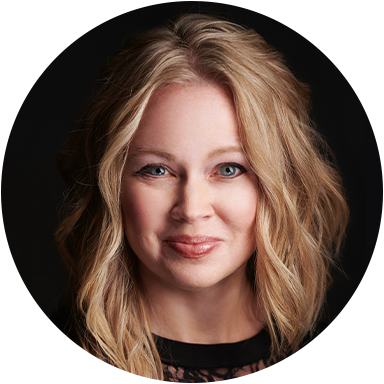
Heather Sorenson

Heather Sorenson has built an international reputation as a composer and arranger whose works appear regularly in worship spaces, academic settings, and concert halls across North America and beyond. Based in Dallas, she commands both traditional hymnic language and contemporary musical idioms with equal fluency, a rare ability that allows her to create pieces that feel simultaneously rooted and current. Her commissions span from major institutions like Carnegie Hall and Texas A&M University to individual churches and musicians seeking her distinctive voice.

Sorenson's background as a pianist informs every score she writes, and her years teaching elementary music at Grace Academy of Dallas and as an adjunct professor at Baylor University shaped her understanding of what works in real rehearsal rooms. She remains active as a guest conductor and clinician at worship conferences and universities nationwide, and continues to direct benefit concerts for nonprofits close to her heart.

Why we love this

Sorenson's gift for setting sacred texts with both dignity and accessibility shines here. The SSAA voicing opens this piece to changing choirs and women's ensembles that might otherwise struggle to find repertoire that feels contemporary without abandoning reverence. The musical language balances harmonic depth with singability, giving singers something meaningful to inhabit while staying within reasonable ranges.

What to expect

Gentle and grounding, with the quiet confidence of a faith statement rather than a proclamation. Sorenson's harmonic language creates moments of warmth and stability that match the psalm's promise of refuge and comfort. The piece invites singers and listeners into a space of reflection without requiring technical fireworks.

Who it's for

Women's choirs, small mixed ensembles working with flexible voicing, church music programs needing accessible sacred repertoire, and groups seeking contemporary settings of traditional texts. The SSAA voicing makes it particularly suited for high school choirs and community ensembles with limited male voices.

How to get the most out of it

  • Pay attention to the text painting in moments where Sorenson shifts harmonic color; these subtle shifts should feel organic rather than dramatic. Let the singers discover where the emotion naturally lives.
  • Encourage blend across the three or four voice parts by having singers listen outward rather than to their own line. This piece rewards ears that hear the full chord.
  • The digital format means you can print exactly the number of copies you need. Consider printing a few extras for soloists or for singers who may join mid-rehearsal cycle.

How to use it

This works beautifully in a service of worship or a sacred concert program where it can stand alone or anchor a thematic set about trust and protection. Consider pairing it with other Sorenson arrangements to showcase her stylistic range, or use it as a centerpiece for a program exploring contemporary settings of traditional psalms. Its modest length makes it an ideal addition to a longer work or as part of a meditative concert segment.

Skills your students will build

  • Singing sustained, lyrical lines with consistent tone quality across longer phrases
  • Listening to and balancing individual voice parts within four-part harmony
  • Interpreting harmonic shifts and text painting as expressive choices
  • Maintaining musical line and phrase shape in slower tempos
  • Reading SSAA voicing with flexible alto and soprano placement

You May Also Like