
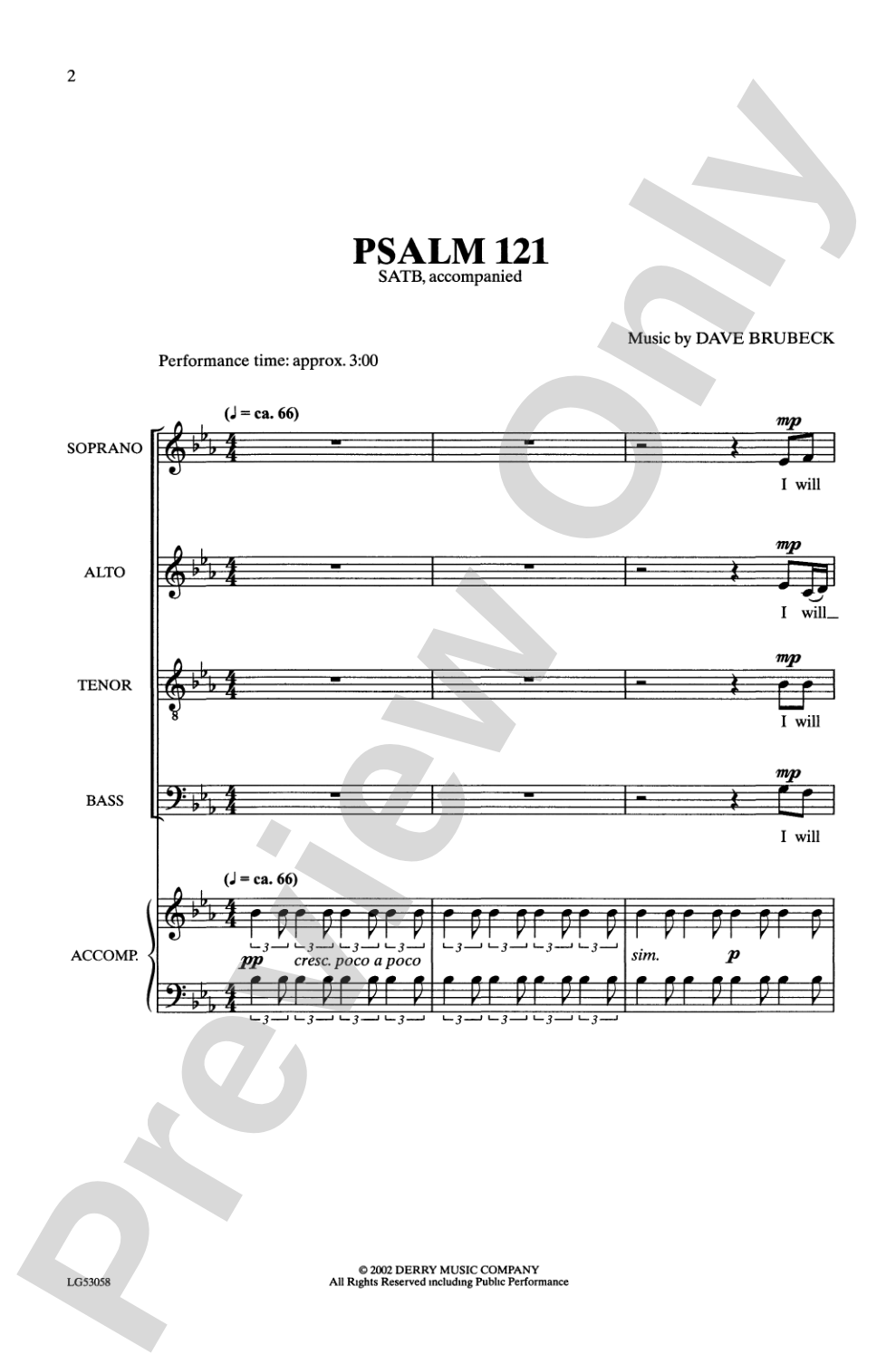
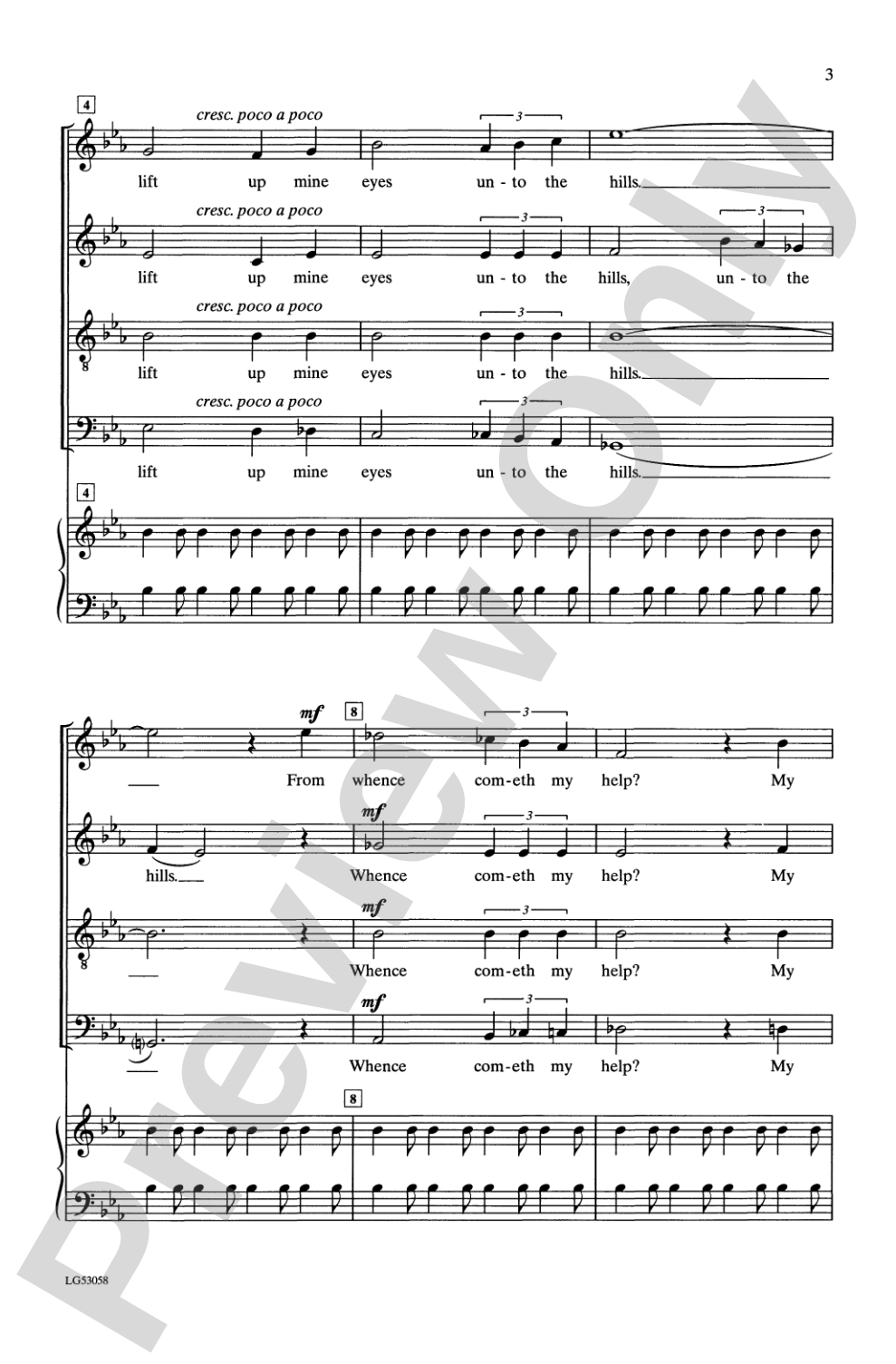

Psalm 121: SATB Choral Octavo
Music by Dave Brubeck
Level: Moderately Difficult
Item: 00-PO-0006793
$2.25
Minimum order quantity: 20 copies
Pickup currently not available
Related Items
Psalm 121: SATB Choral Octavo |
$2.25
|
View |
Description


Psalm 121: SATB Choral Octavo isn't in MakeMusic Cloud just yet...but it could be. Let us know you'd like to see it, and you'll help shape what comes next. In the meantime, start a free trial and dive into thousands of interactive titles your students can play along with today.
Request This Title
Tell us you want it.
Start Your Free Trial
Explore everything that's ready to play right now.
Sample Audio
1
Audio File
--:--
0:00
0:00
Sample Video
No sample videos found.
Additional Details
Series:
Alfred Archive Edition: Lawson-Gould Music Publishers
Publisher:
Alfred Music
Page Count:
12
SKU:
00-PO-0006793
More about this title
About the Composer: Dave Brubeck
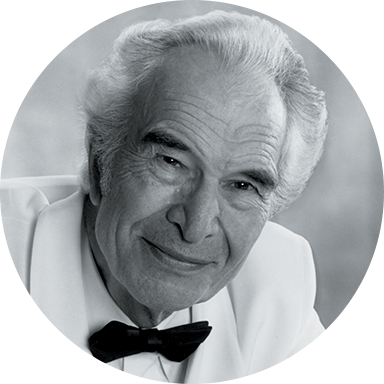
Dave Brubeck combined his identity as a jazz innovator with a profound commitment to classical composition across nearly every genre. Beyond his iconic role in jazz history—including the groundbreaking album Time Out and the standard "Take Five"—he wrote choral works, orchestral pieces, chamber music, and large-scale compositions for chorus and orchestra that have been performed worldwide by ensembles ranging from cathedral choirs to the London Symphony Orchestra. His studies with Darius Milhaud at Mills College shaped his conviction that jazz language and classical discipline could coexist in serious musical works.
Brubeck's cultural impact extended far beyond the concert hall. He was a pioneer in breaking racial barriers in American music during the mid-20th century, and his honors reflect both his artistic and social legacy: the Grammy Lifetime Achievement Award, the Presidential Medal of the Arts, induction into the American Classical Music Hall of Fame, and a lifetime achievement award from the London Symphony Orchestra. His sacred works, including the widely performed mass To Hope! and oratorios recorded by major orchestras, demonstrate his deep engagement with spiritual themes and large ensemble writing.
Why we love this
Brubeck's approach to sacred music brings together his jazz sensibility and formal training into something genuinely fresh for choral directors. This octavo sits at Grade 4 difficulty, making it accessible without sacrificing the sophisticated harmonic language and rhythmic interest that come naturally to a composer of his caliber. Programming a Brubeck choral work signals to your singers and audience that sacred music can be contemporary, intellectually engaging, and deeply moving.
What to expect
Psalm 121 invokes both reverence and rhythmic vitality, balancing the contemplative nature of the text with Brubeck's characteristic harmonic color and forward momentum. The piece carries a sense of spiritual assurance that emerges not from simplicity but from the interweaving of four independent voices into coherent purpose.
Who it's for
This octavo is ideal for intermediate to advanced high school choirs or accomplished community ensembles seeking sacred literature with contemporary compositional language. It demands singers who read confidently and directors comfortable with Brubeck's harmonic vocabulary and rhythmic sophistication.
How to get the most out of it
- Attend carefully to Brubeck's harmonic language, which often includes extended chords and chromatic voice leading typical of his jazz-influenced writing. Tune these moments generously and avoid rushing through sustained sonorities.
- Shape the text with the rhythmic precision Brubeck demands; his phrases often rely on rhythmic specificity rather than traditional text-painting, so rhythmic clarity serves the composition's intent.
- Balance transparency across all four voices. Brubeck's textures frequently distribute melodic and harmonic interest throughout the ensemble rather than relegating it to the sopranos, requiring genuine voice part independence.
How to use it
This work fits naturally into a concert devoted to American sacred music or modern interpretations of biblical texts. Consider programming it alongside spirituals or other 20th-century choral works to show the range of American compositional voices. The 12-page score makes it substantial enough to anchor a section of a concert program without overshadowing other works.
Skills your students will build
- Reading and sustaining jazz-influenced harmony (extended chords, chromatic voice movement)
- Independent voice part accuracy in texturally complex writing
- Rhythmic precision in non-traditional metric contexts
- Balancing text delivery across all voice parts rather than defaulting to soprano-driven performance