
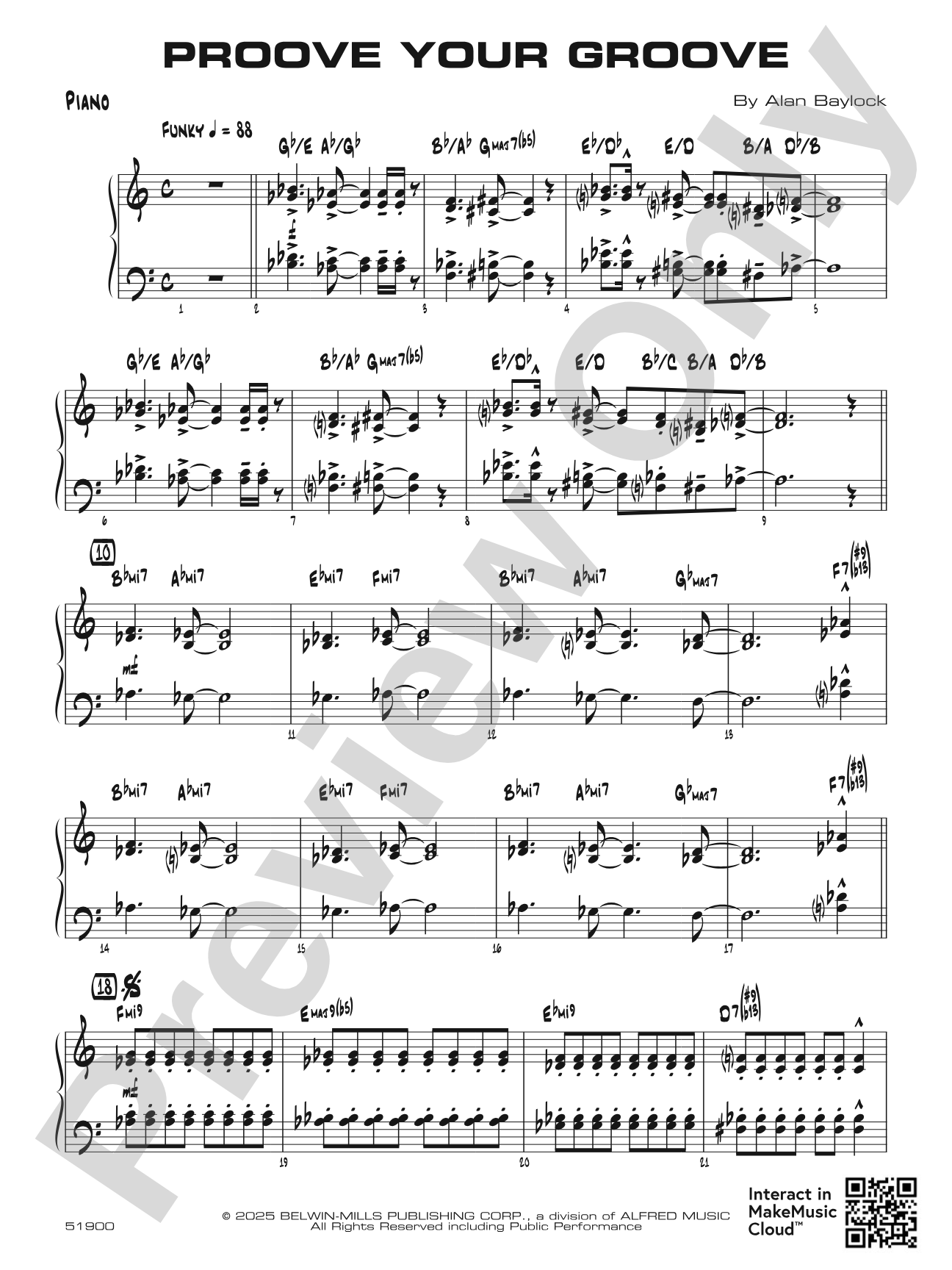

Proove Your Groove: Piano Accompaniment
By Alan Baylock
Grade: 4
Item: 00-PC-0019592_K
$3.00
Pickup currently not available
Description
Yes, it's funky in many ways, performed around 88 BPM. The groove is deep and full of harmonic colors start to finish. Lead trumpet range to written high C, solos are for trombone 1, with a suggested written-out solo, and for drumset. Optional parts include vibes and flute. Although there is no written percussion part, adding congas is suggested. This is festival material. (5:00)


Proove Your Groove: Piano Accompaniment isn't in MakeMusic Cloud just yet...but it could be. Let us know you'd like to see it, and you'll help shape what comes next. In the meantime, start a free trial and dive into thousands of interactive titles your students can play along with today.
Request This Title
Tell us you want it.
Start Your Free Trial
Explore everything that's ready to play right now.
Sample Audio
1
Audio File
--:--
0:00
0:00
Sample Video
Additional Details
Series:
Premier Jazz Series
Publisher:
Alfred Music
SKU:
00-PC-0019592_K
More about this title
About the Composer: Alan Baylock

Alan Baylock directs the Grammy-nominated One O'Clock Lab Band at the University of North Texas, building on a 20-year career as Chief Arranger for the United States Air Force Band's Airmen of Note in Washington, D.C. He led the Alan Baylock Jazz Orchestra for over 15 years, releasing three critically acclaimed albums and touring extensively across the country. Baylock holds degrees from Shenandoah University, where he later served as Jazz Composer-in-Residence, and the University of North Texas.
Beyond his work as a composer and arranger, Baylock has guest-conducted more than 100 jazz ensembles at professional, collegiate, and high school levels and served on the faculty of the National Jazz Workshop. In 2022, he co-founded Brava Jazz Publishing with composer and arranger Annie Booth to champion women composers and arrangers in big band jazz. His music has been performed and recorded by artists including Melissa Aldana, Michael and Randy Brecker, Maynard Ferguson, Stefon Harris, Sean Jones, Joshua Redman, and many others.
Why we love this
Baylock brings the sensibility of a working arranger for world-class ensembles into a Grade 4 package that doesn't condescend. The harmonic language is sophisticated without becoming academic; the groove sits deep enough to feel authentic, but the ensemble writing gives every section room to lock in. This is festival material that rewards serious preparation and teaches students what real funk ensemble playing demands.
What to expect
Funky and warm, with harmonic depth that keeps revealing new colors the more you listen. The groove invites you to lock in and move; at 88 BPM, it feels relaxed but purposeful, never rushed. There's sophistication wrapped inside accessibility, a piece that sounds effortless when it's played right.
Who it's for
Grade 4 jazz ensembles ready for serious festival work, particularly groups with strong improvisation skills and a solid rhythm section. This piece rewards experienced student soloists and asks the ensemble to understand groove and ensemble cohesion at a higher level.
How to get the most out of it
- Lock the rhythm section (drums and bass) into that 88 BPM pocket first; everything else follows once the groove is rock solid and the comping is tight.
- Let the lead trumpet soar into that written high C without forcing it; the range is achievable with good preparation and breath support.
- Shape the trombone 1 solo (with or without the written-out version) so that it breathes and sits naturally over the groove rather than fighting against it.
- Add congas to deepen the harmonic colors and texture even though no dedicated part is written; this small addition transforms the ensemble sound significantly.
How to use it
Program this as a centerpiece on a festival or concert set where you want to show the ensemble's groove pocket and soloist strength. It pairs well with straight-ahead swing and modal jazz pieces, or place it strategically to shift the energy of your program and remind the audience that jazz ensembles can swing hard and move bodies.
Skills your students will build
- Locking into a consistent groove and understanding pocket rhythm
- Jazz comping and harmonic movement in a funk context
- Improvisation over blues and funk changes (trombone and drums)
- Balancing ensemble cohesion with individual voice and expression
- Reading and executing written jazz solos as templates for personal interpretation
- Managing range and endurance at the upper register (lead trumpet)