
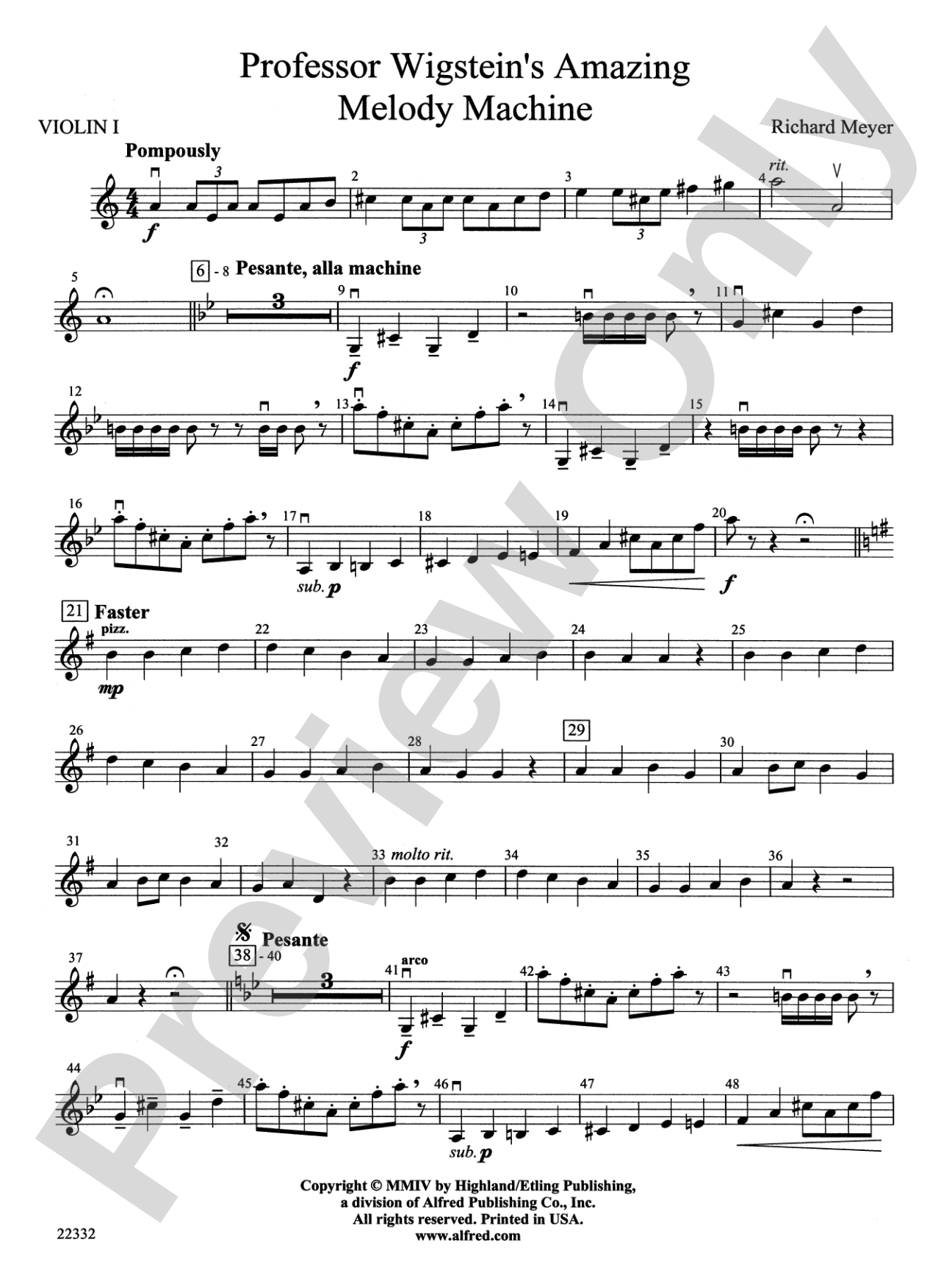

Professor Wigstein's Amazing Melody Machine: 1st Violin
By Richard Meyer
Grade: 2.5
Item: 00-PC-0000581_VN1
$5.99
Pickup currently not available
Description
This fun and original piece for string orchestra introduces the technique of "tone painting." It depicts inventor Professor Wigstein's proud creation, a machine that plays some of the world's most famous melodies. The introduction portrays the ceremonious (and rather pompous) unveiling of the amazing machine. With four turns of its crank, the machine comes to life, grinding and churning as it prepares to produce a melody. "Ode to Joy" is heard, played pizzicato by the entire orchestra, and appropriately accompanied by generic "machine" sounds (ratchet and bell). Soon, the machine winds down, and the melody comes to a halt. Once again, the machine is cranked, and begins working at another tune; "Eine Kleine Nachtmusik" is heard. The machine winds down again, only to be cranked up a third time. The melody to Offenbach's "Can-Can" emerges. Midway through the tune, however, something goes wrong with the machine. Fragments of all three melodies are heard (in a variety of clashing keys) as the machine goes out of control, eventually exploding. A few hisses, and some dying moans are emitted. Finally, Chopin's "Funeral March" is heard as the machine plays its own death knoll, dying with a final soft hiss.


Don't just read it, hear it, play along with it, and watch your students grow with it. In MakeMusic Cloud, Professor Wigstein's Amazing Melody Machine: 1st Violin comes alive with professional accompaniment, adjustable tempo, and built-in practice tools that turn solo practice into real progress.
Open in the Player
Jump straight in and assign it today.
Start Your Free Trial
Open this title and explore the full library in minutes.
Sample Audio
1
Audio File
--:--
0:00
0:00
Sample Video
No sample videos found.
Additional Details
Series:
Highland/Etling String Orchestra
Publisher:
Alfred Music
Page Count:
132
SKU:
00-PC-0000581_VN1
More about this title
About the Composer: Richard Meyer

Richard Meyer brings three decades of string teaching experience to his work as a composer and conductor. His tenure directing orchestras at Oak Avenue Intermediate School transformed a program of 29 students into 200, and he has guest-conducted All-State orchestras across multiple states and led the Pasadena Youth Symphony Orchestra through international performances in Vienna, Australia, and Canada. His "Giving Bach" initiative, launched in 2009, pioneered the use of interactive concerts to reach special needs and underserved students throughout Southern California, earning national recognition for its innovative approach to music access.
Meyer's compositional output reflects his deep understanding of what works in the rehearsal room. With nearly 200 published compositions and arrangements, plus 16 years as string editor for Alfred Publishing Company, he has shaped the landscape of accessible string orchestra repertoire. He co-authored the String Explorer Series and Sight-read It for Strings, resources widely used in string programs across the country.
Why we love this
Meyer orchestrates pure theatrical joy here. The narrative arc unfolds with a composer's clarity about pacing and effect, building genuine suspense as the machine malfunctions and collapses into Chopin's funeral dirge. Young orchestras thrive on this kind of storytelling because it gives them a concrete dramatic reason to shape phrases, control dynamics, and coordinate ensemble sounds that aren't about "playing expressively" but about making the audience believe in Professor Wigstein's increasingly chaotic contraption.
What to expect
Pompous ceremony gives way to mechanical grinding and whirring as the machine springs to life. Familiar melodies emerge through the mechanical chaos, creating moments of recognition and delight, until the machine spirals into a frenetic tangle of clashing fragments and finally collapses into hushed, mournful silence. The entire journey is both humorous and oddly poignant.
Who it's for
This piece works beautifully for Grade 2.5 string orchestras that are ready to engage with narrative and character but still need straightforward technical demands. It rewards ensembles with solid intonation and ensemble balance, and it delights audiences of all ages because the story transcends typical concert music listening.
How to get the most out of it
- Balance the pizzicato passages carefully so the famous melodies remain the focal point while the machine sounds (ratchet, bell) stay in the background; the comedy lands when the audience recognizes the tune, not the sound effects.
- Use the chaos section (where all three melodies fragment simultaneously in clashing keys) as an opportunity to rehearse ensemble precision under pressure. The "out of control" effect requires controlled ensemble playing, not actually sloppy execution.
- Shape the Funeral March ending with restraint. The contrast between the frantic explosion and the quiet, dignified death knoll will resonate most powerfully if you resist over-interpreting the final moments.
How to use it
Program this as a centerpiece for a "Stories in Music" concert, pairing it with other character pieces or narrative works that invite audiences to follow a dramatic arc. It also serves as an excellent opening number when you want to capture attention immediately and set a lighter, more playful tone for the evening. Young audiences especially respond to the humor and spectacle, making it ideal for family concerts or school assemblies.
Skills your students will build
- Tone painting through orchestral color and sound effects
- Managing pizzicato technique across the full orchestra
- Ensemble coordination during fast-paced dramatic shifts
- Intonation control, especially in the dissonant fragmentation section
- Dynamic shaping and phrasing within a narrative framework
- Listening to section balance while multiple melodic lines occur simultaneously