Proclamation Sheet Music Preview

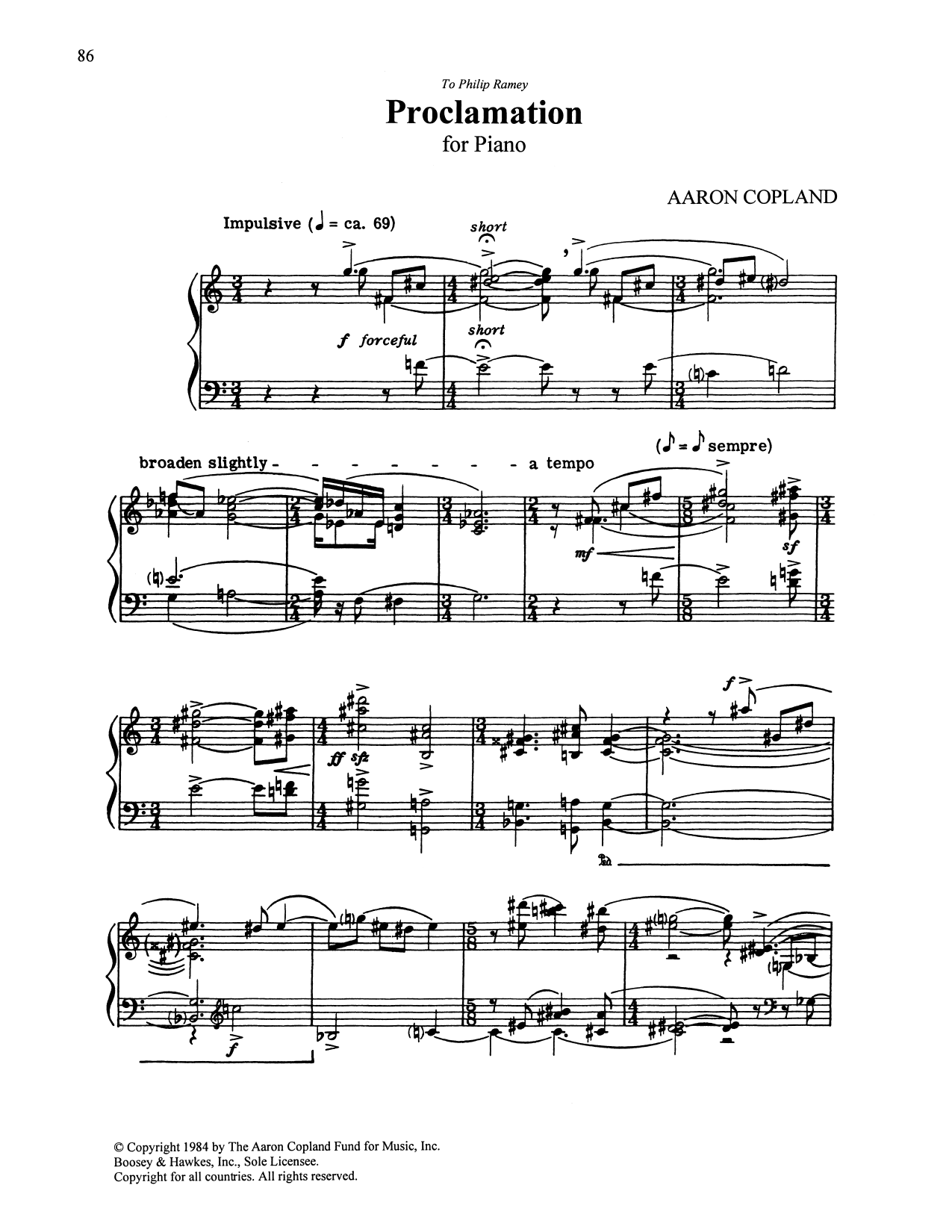
Proclamation: Piano Solo

By Aaron Copland

Item: 35-DS01979716

Digital Download
$5.99
One moment…
Description

Discover MakeMusic Cloud: thousands of interactive titles your students can play along with today.

Sample Audio
No sample audio found.
Sample Video
Additional Details
Publisher: Hal Leonard
Page Count: 3
SKU: 35-DS01979716

More about this title

About the Composer: Aaron Copland

Aaron Copland (1900-1990) shaped American classical music by creating works that captured the sound of the nation itself. His gift lay in weaving folk idioms, open harmonies, and accessible melodies into sophisticated concert pieces that never talked down to their audiences. As both composer and conductor, Copland championed American music in performances and writings, making him essential to any musician's understanding of 20th-century composition.

Copland's piano works occupy a special place in his catalog. While many know his orchestral masterpieces, his solo keyboard music distills his compositional voice into intimate, focused statements. These pieces reward careful study and reveal how economically he could build emotional weight through harmonic language and rhythmic clarity.

Why we love this

Proclamation stands apart because it packs substantial musical ideas into just three pages, making it accessible for students who aren't yet ready for Copland's larger solo works. The piece carries his unmistakable harmonic fingerprint without sacrificing structural clarity or emotional directness.

What to expect

Proclamation unfolds with quiet authority, like a statement delivered with conviction rather than volume. The writing feels open and spacious, grounded in a distinctly American harmonic language that avoids European Romantic lushness in favor of something leaner and more direct.

Who it's for

Advanced high school pianists and early undergraduate students ready to explore American classical music beyond the standard Romantic canon. This piece serves pianists seeking repertoire that combines historical significance with reasonable technical demands.

How to get the most out of it

  • Identify the underlying pulse before diving into the surface rhythms; Copland's directness depends on absolute metric clarity underneath any syncopation or rubato
  • Let the harmony breathe by thinking about chord changes as points of arrival rather than rushing through them
  • Balance the declaration in the title with the restraint Copland uses; this piece announces something important, but never shouts

How to use it

Pair this with other American piano works to build a concert segment exploring indigenous classical tradition. Alternatively, program it as the contemporary work in a recital built primarily around earlier repertoire, allowing audiences to hear how Copland's generation reimagined American musical identity.

Skills your students will build

  • Interpreting Copland's harmonic language and open sonorities
  • Balancing decorative figuration with harmonic structure
  • Maintaining pulse independence while shaping melodic lines
  • Negotiating the intersection of folk idiom and classical form
  • Executing clean voice leading across register shifts

You May Also Like