Procession of the Sardar: B-flat Bass Clarinet Sheet Music Preview

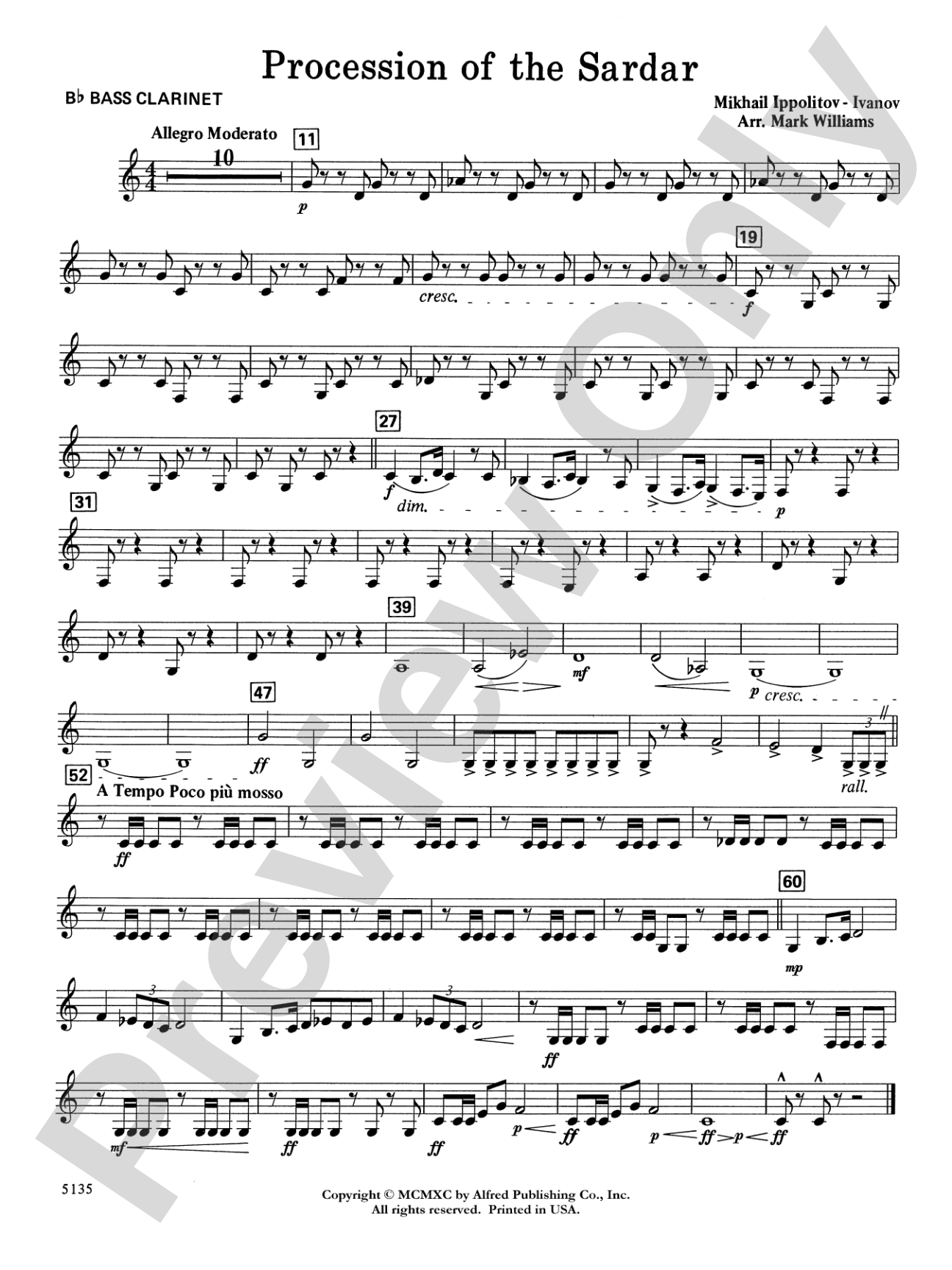
Procession of the Sardar: B-flat Bass Clarinet

By Mikhail Ippolitov-Ivanov / arr. Mark Williams

Grade: 2 (Medium Easy)

Item: 00-PC-0001872_CBC

Digital Download
$3.00
Description
Mikhail Ippolitov-Ivanov (1859-1935) was a Russian composer who studied under Rimsky-Korsakov and later was the director for the Moscow Conservatory for many years. His most famous compostion, Procession of the Sardar, is the fourth movement of his 'Caucasian Sketches' for orchestra, which was inspired by the folk music of the Caucasas mountain region. The exotic eastern scales and colorful percussion parts will add a touch of mystery and adventure to your next concert program. (Grade 2)

Don't just read it, hear it, play along with it, and watch your students grow with it. In MakeMusic Cloud, Procession of the Sardar: B-flat Bass Clarinet comes alive with professional accompaniment, adjustable tempo, and built-in practice tools that turn solo practice into real progress.

Sample Audio
No sample audio found.
Sample Video
Additional Details
Series: Young Symphonic
Publisher: Alfred Music
Page Count: 128
SKU: 00-PC-0001872_CBC

More about this title

About the Composer: Nicolai Ippolitov-Ivanov

Nicolai Ippolitov-Ivanov (1859-1935) was a Russian composer and conductor who studied composition under Nikolai Rimsky-Korsakov at the Saint Petersburg Conservatory. After establishing himself as a composer and conductor in Russia's musical centers, he served as director of the Moscow Conservatory for over two decades, where he shaped generations of Russian musicians and composers.

Ippolitov-Ivanov's output spans orchestral works, operas, and chamber music, but he remains best known for Caucasian Sketches, a suite that captures the folk melodies and instrumental colors of the Caucasus region. His gift for orchestration and ear for exotic harmonic color made him a significant figure in late Russian Romanticism, and his works continue to showcase the richness of Eastern European musical traditions.

Why we love this

Mark Williams' arrangement captures the original's lush orchestral colors within a Grade 2 band setting, making this beloved Russian masterwork accessible without sacrificing its character. The exotic scales and percussion writing create immediate engagement for students while teaching authentic musical storytelling, and the piece checks every box for a concert that needs both sophistication and approachability.

What to expect

A journey through desert caravans and mountain passes, driven by insistent rhythms and richly colored instrumental solos. The writing evokes mystery and pageantry in equal measure, with moments of genuine drama balanced by lighter, dance-like passages that capture folk tradition.

Who it's for

Concert bands working at the Grade 2 level who want to program a recognized masterwork without needing advanced technical facility. This arrangement suits bands preparing for festival appearances, concert series, or showcase performances where musical maturity and audience appeal matter as much as difficulty.

How to get the most out of it

  • Balance the melodic lines across woodwind and brass sections so the Eastern-influenced themes sing clearly; this piece lives or dies by smooth phrase shaping, not volume.
  • Give percussion players space to articulate their parts with precision. The colorful percussion writing is central to the exotic sound; under-rehearsing the battery diminishes the whole effect.
  • Lock in the rhythmic feel early. Ippolitov-Ivanov's melodies sit on top of steady accompaniment patterns, so anchor your woodwind and low brass section first, then layer in the solo voices.
  • Shape the dynamic contours as a single conductor gesture across the ensemble. The music breathes in long arcs rather than moment-to-moment changes; thinking in phrases rather than measures will tighten ensemble response.

How to use it

Program this as a centerpiece that elevates the sophistication of a concert without requiring a virtuoso ensemble. Its length and lyrical content make it a strong partner for American contemporary works or lighter classical pieces, and its orchestral roots give bands a chance to explore the concert band repertoire beyond twentieth-century compositions.

Skills your students will build

  • Reading modal and exotic scale passages
  • Balancing multiple melodic lines within the ensemble
  • Executing precise rhythmic coordination in steady accompaniment patterns
  • Performing with sustained dynamic control across long phrases
  • Listening for orchestral color and blend in a concert band context

You May Also Like