
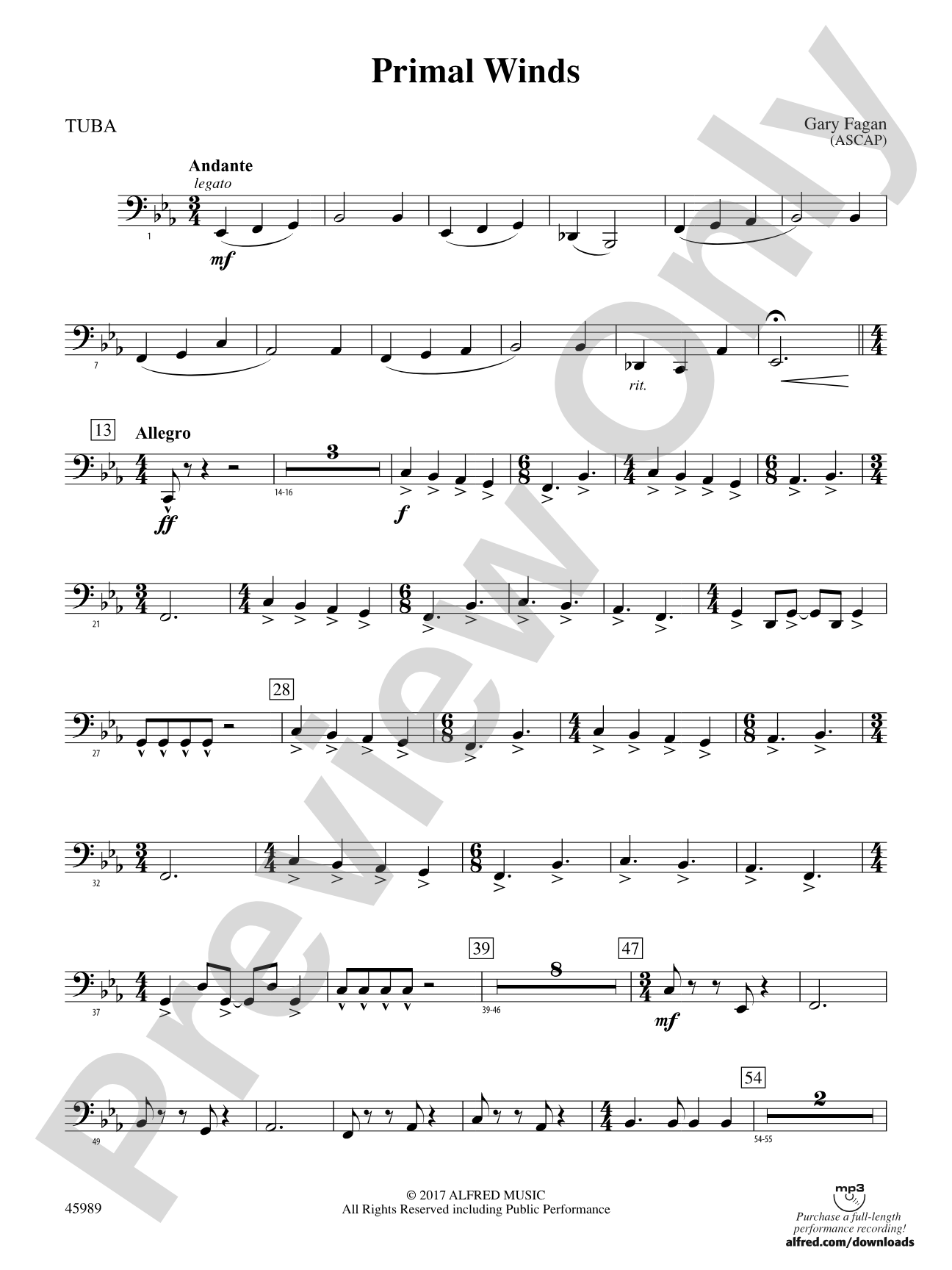

Primal Winds: Tuba
By Gary Fagan
Grade: 3 (Medium)
Item: 00-PC-0017715_TB1
$5.99
Pickup currently not available
Description
Many young and developing musicians experience difficulty with mastering rhythmic accuracy with confidence. This piece seeks to challenge young players rhythmically and uses multiple meter changes to create interesting, appealing, and unique rhythmic textures. (3:45)


Don't just read it, hear it, play along with it, and watch your students grow with it. In MakeMusic Cloud, Primal Winds: Tuba comes alive with professional accompaniment, adjustable tempo, and built-in practice tools that turn solo practice into real progress.
Open in the Player
Jump straight in and assign it today.
Start Your Free Trial
Open this title and explore the full library in minutes.
Sample Audio
1
Audio File
--:--
0:00
0:00
Sample Video
Additional Details
Series:
Young Symphonic
Publisher:
Alfred Music
Page Count:
268
SKU:
00-PC-0017715_TB1
More about this title
About the Composer: Gary Fagan

Gary Fagan's 36-year career as a band director in Albemarle County established him as a respected voice in Virginia music education. His compositions have traveled far beyond his home state, heard at the Midwest Band and Orchestra Clinic, the White House, and the inauguration of former Virginia Governor Douglas Wilder. He holds degrees from Bridgewater College (Music Education) and James Madison University (Master's), and his work has earned recognition including selection as Central Virginia Outstanding Middle School Teacher and multiple Outstanding Educator Awards.
Since retiring from the classroom, Fagan has remained deeply engaged in music education as a University Supervisor at JMU and adjunct faculty member teaching arranging. He serves as a percussionist and Assistant Director with the Charlottesville Band, works actively as a clinician and adjudicator, and maintains memberships in ASCAP, Phi Beta Mu Bandmasters Fraternity, and the National Band Association. His dual expertise in pedagogy and composition makes his writing distinctly practical for developing musicians.
Why we love this
Fagan writes with the ear of someone who has spent decades in the rehearsal room with young musicians. Instead of sidestepping rhythmic complexity, he confronts it head-on through meter changes that feel purposeful rather than arbitrary, building student confidence through strategic challenge. The result is a piece that develops real musicianship while remaining engaging enough for both concert and festival settings.
What to expect
Primal Winds captures raw energy and motion through its rhythmic texture rather than melody alone. The meter changes create a sense of building momentum and transformation, keeping listeners and players engaged through unexpected harmonic and rhythmic turns.
Who it's for
Directors working with Grade 3 bands who want to push rhythmic literacy without overwhelming the ensemble. This works especially well for programs aiming to develop strong rhythm section players and for groups preparing festival or contest repertoire that demands precision.
How to get the most out of it
- Establish the pulse clearly before sections with meter changes; use silent conducting patterns during transitions so students stay anchored even when the time signature shifts.
- Mark beat groupings in each meter within parts so players can quickly internalize how to subdivide. This transforms what might feel chaotic into predictable rhythmic architecture.
- Record a sectional rehearsal where rhythm section locks in the meter changes first, then layer in melodic voices. Students absorb stability from hearing the framework established.
- Give the piece several complete run-throughs before the performance. Familiarity dissolves the cognitive load of the rhythm changes and lets the musical shape emerge.
How to use it
Program this on a concert alongside a lyrical selection to showcase your band's rhythmic sophistication and range. At festivals, it demonstrates technique and musicianship at Grade 3 level. It also serves well as a powerful closer to a concert program, ending on an impression of forward drive and energy.
Skills your students will build
- Reading and performing multiple meter changes (3/4, 4/4, and others) with rhythmic security
- Subdividing within different time signatures to maintain ensemble precision
- Responding to conductor gestures through transitional passages
- Building confidence in rhythmic accuracy under musical pressure
- Developing ensemble togetherness across metric shifts