
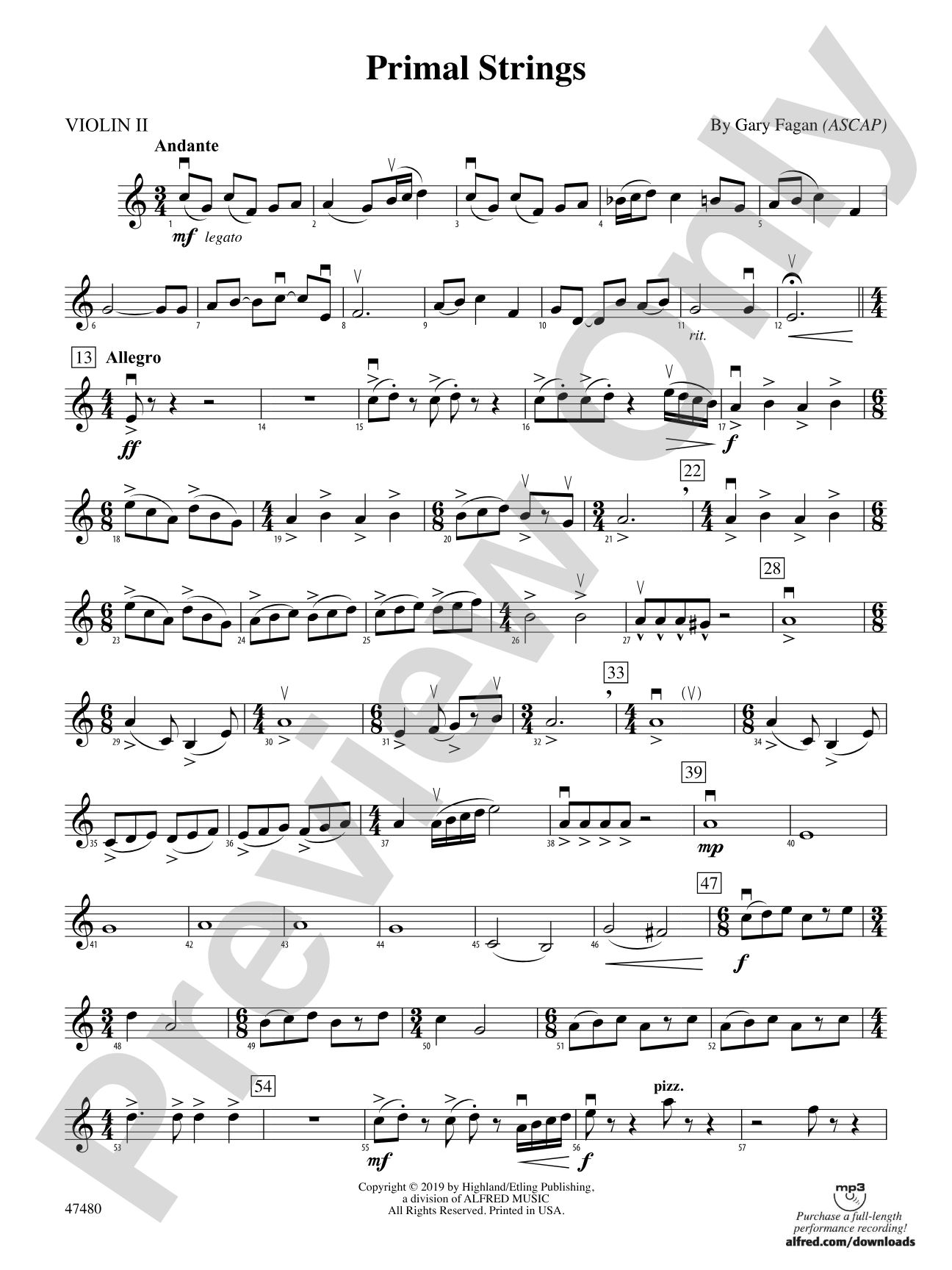

Primal Strings: 2nd Violin
By Gary Fagan
Grade: 3
Item: 00-PC-0018008_VN2
$5.99
Pickup currently not available
Description
The word primal is defined as "relating to an early stage in development" or "basic, fundamental, essential, elemental." Imagine this tune challenging your players who fit that definition.
Many young and developing musicians experience difficulty with mastering rhythmic accuracy with confidence. Yet, rhythm is essential to music performance. Student proficiency in reading rhythmic figures and being able to move comfortably from one meter to another should be a goal of the orchestra director. This work provides rhythmic challenges and uses multiple meter changes to create interesting, appealing, and unique rhythmic textures.


Many young and developing musicians experience difficulty with mastering rhythmic accuracy with confidence. Yet, rhythm is essential to music performance. Student proficiency in reading rhythmic figures and being able to move comfortably from one meter to another should be a goal of the orchestra director. This work provides rhythmic challenges and uses multiple meter changes to create interesting, appealing, and unique rhythmic textures.
Don't just read it, hear it, play along with it, and watch your students grow with it. In MakeMusic Cloud, Primal Strings: 2nd Violin comes alive with professional accompaniment, adjustable tempo, and built-in practice tools that turn solo practice into real progress.
Open in the Player
Jump straight in and assign it today.
Start Your Free Trial
Open this title and explore the full library in minutes.
Sample Audio
1
Audio File
--:--
0:00
0:00
Sample Video
Additional Details
Series:
Highland/Etling String Orchestra
Publisher:
Alfred Music
Page Count:
124
SKU:
00-PC-0018008_VN2
More about this title
About the Composer: Gary Fagan

Gary Fagan is a Virginia-based composer and educator whose works have been heard at prestigious venues ranging from the Midwest Band and Orchestra Clinic to the White House. He completed his undergraduate studies in Music Education at Bridgewater College and earned a master's degree from James Madison University. After 36 years directing bands in Albemarle County, he transitioned to university teaching, where he serves as a University Supervisor at JMU and teaches arranging as adjunct faculty.
Fagan's contributions to music education have been recognized through multiple honors, including Central Virginia Outstanding Middle School Teacher from the University of Virginia's Phi Delta Kappa chapter and Outstanding Educator Awards from both the Virginia Governor's School for the Visual and Performing Arts and the Piedmont Council of the Arts. He remains active as a clinician, adjudicator, and percussionist with the Charlottesville Band while maintaining his work as a composer and arranger. He holds membership in ASCAP, the National Band Association, Phi Beta Mu Bandmasters Fraternity, and maintains involvement with the Music Educators National Conference and Virginia Band and Orchestra Directors Association.
Why we love this
Fagan builds rhythmic competency without resorting to grinding exercises. The shifting meters create genuine musical interest rather than feeling like a pedagogical chore, so your students stay engaged while internalizing the exact skills they need. The straightforward accessibility at Grade 3 means you can tackle real rhythmic development with orchestras still building their foundational reading skills.
What to expect
Primal Strings pulses with forward momentum despite its rhythmic complexity. The meter shifts create a sense of discovery and unpredictability that keeps the ensemble engaged, while the fundamental harmonic language keeps everything grounded and approachable.
Who it's for
Young string orchestras working to move past steady-state rhythmic reading into flexible, confident navigation of metric changes. This score works well for ensembles with developing sight-readers who need meaningful challenge without overwhelming difficulty.
How to get the most out of it
- Work the meter changes in sections before running full passages. Once strings grasp the 3/4 to 4/4 shift, rehearse the transition at tempo so students anticipate the feel rather than stumbling at the barline.
- Use a clear preparatory gesture for each new meter. Students who are still developing rhythmic confidence need visual confirmation that the conductor understands the coming change and has their back.
- Lock in the rhythm section first (cellos and basses). A solid harmonic foundation makes the rhythmic textures much easier for upper strings to navigate.
- Mark key meter changes in individual parts with color or circled numbers. Student awareness of what's coming reduces hesitation and builds confidence in execution.
How to use it
Program this as a centerpiece for a young orchestra concert where you want to showcase growing technical skill and musicianship. The combination of concert appeal and clear pedagogical purpose makes it equally strong for festival or contest settings where adjudicators appreciate thoughtful work designed with student growth in mind.
Skills your students will build
- Reading and executing multiple meter changes (3/4, 4/4, and others) in the same piece
- Maintaining rhythmic accuracy and ensemble unity across metric shifts
- Internal pulse stability when navigating asymmetrical rhythmic patterns
- Confidence in interpreting rhythmically complex material at tempo
- Collaborative listening and rhythm section awareness