
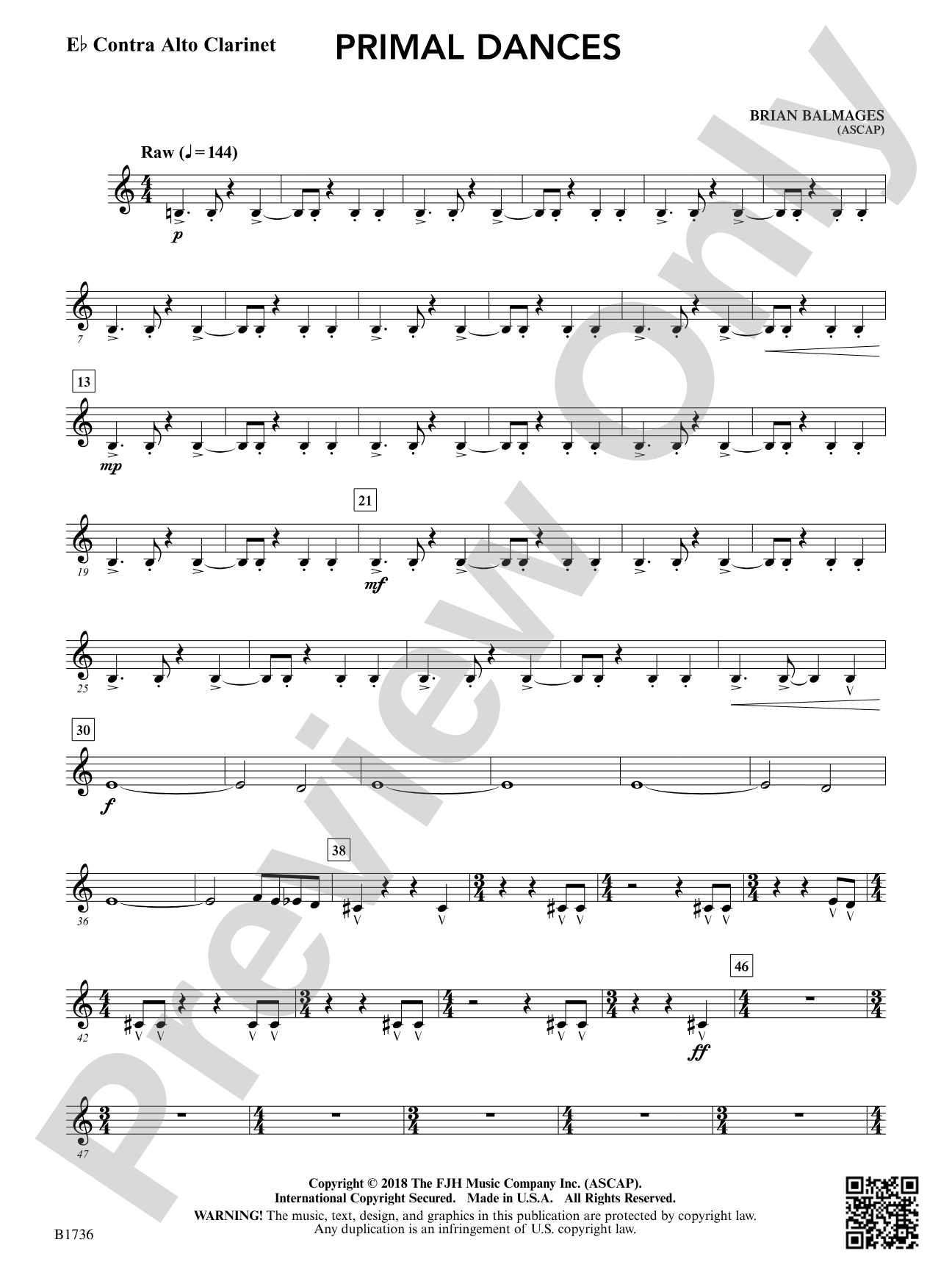

Primal Dances: E-flat Contra Alto Clarinet
By Brian Balmages
Grade: 3
Item: 98-PC-DB1736_CAC
$7.00
Pickup currently not available
Description
Primal in every sense of the word, this work infuses complex harmonies with angular melodies to elicit a primitive atmosphere full of anticipation. Driven by percussion and the dissonant rhythmic pulse in the lower voices, the music eventually gives way to a slower, mystical section. As the music’s primal nature begins once again, everything ultimately leads to the adrenaline-packed ending punctuated by racing woodwind ostinatos and extraordinary brass chords. Intense!


Don't just read it, hear it, play along with it, and watch your students grow with it. In MakeMusic Cloud, Primal Dances: E-flat Contra Alto Clarinet comes alive with professional accompaniment, adjustable tempo, and built-in practice tools that turn solo practice into real progress.
Open in the Player
Jump straight in and assign it today.
Start Your Free Trial
Open this title and explore the full library in minutes.
Sample Audio
1
Audio File
--:--
0:00
0:00
Sample Video
Additional Details
Series:
FJH Concert Band
Publisher:
The FJH Music Company, Inc.
SKU:
98-PC-DB1736_CAC
More about this title
About the Composer: Brian Balmages

Brian Balmages has established himself as a composer and conductor working fluently across orchestral, band, and chamber idioms. His works have been heard in some of the world's most prestigious venues, including Carnegie Hall, the Kennedy Center, and the Sydney Opera House, performed by ensembles ranging from professional orchestras to school groups. He is a member of the American Bandmasters Association and received the A. Austin Harding Award from the American School Band Directors Association, along with the 2020 NBA William D. Revelli Composition Contest for Love and Light.
Balmages maintains an active conducting schedule with all-state and regional ensembles as well as university and professional orchestras worldwide. He has guest conducted at major conferences including the Midwest Clinic, Western International Band Clinic, and College Band Directors Conference. His music was performed at the 2013 Presidential Inaugural Prayer Service and has been commissioned by universities including the University of Miami for presidential inauguration ceremonies. He currently serves as Director of MakeMusic Publications and Digital Education for Alfred and MakeMusic.
Why we love this
Balmages crafts an orchestral architecture that demands attention from the very first moment. The intelligent layering of dissonance and angular melody creates genuine sophistication without sacrificing the visceral impact your students will feel, making this a serious yet deeply engaging choice for contest or festival programming at the Grade 3 level.
What to expect
Primal Dances pulses with raw energy and architectural intention. The opening establishes an unsettling, anticipatory mood through angular melodic gestures and dissonant harmonies, then pivots unexpectedly into introspection before hurtling toward a cathartic, percussion-driven finale that leaves the listener exhilarated.
Who it's for
Band directors programming at the Grade 3 level who want to introduce students to modernist language and complex harmonic thinking. This score works equally well for concert groups seeking a challenging yet rewarding festival piece and for ensembles that thrive on music with genuine dramatic arc.
How to get the most out of it
- Balance the dissonant rhythmic pulse in the lower voices so it drives forward without overwhelming the melodic content in the woodwinds and brass.
- Shape the transition to the slower, mystical section as a genuine pivot point; resist the temptation to rush the tempo change.
- Lock the racing woodwind ostinatos in the final section with the brass chord entries so the accelerating energy reads as intentional, not chaotic.
- Use percussion strategically throughout to reinforce the primal atmosphere without letting any single instrument dominate the overall sonority.
How to use it
Program this as a contest or festival opener or as the centerpiece of a concert exploring twentieth-century band literature. It pairs well alongside more traditional or lyrical works on the same program, providing stark stylistic contrast while remaining accessible to young musicians.
Skills your students will build
- Reading and performing dissonant harmonic language
- Executing rapid articulation in woodwind ostinatos
- Balancing complex rhythmic pulses across multiple sections simultaneously
- Responding to dramatic tempo and character shifts
- Ensemble clarity in angular, non-traditional melodic writing