
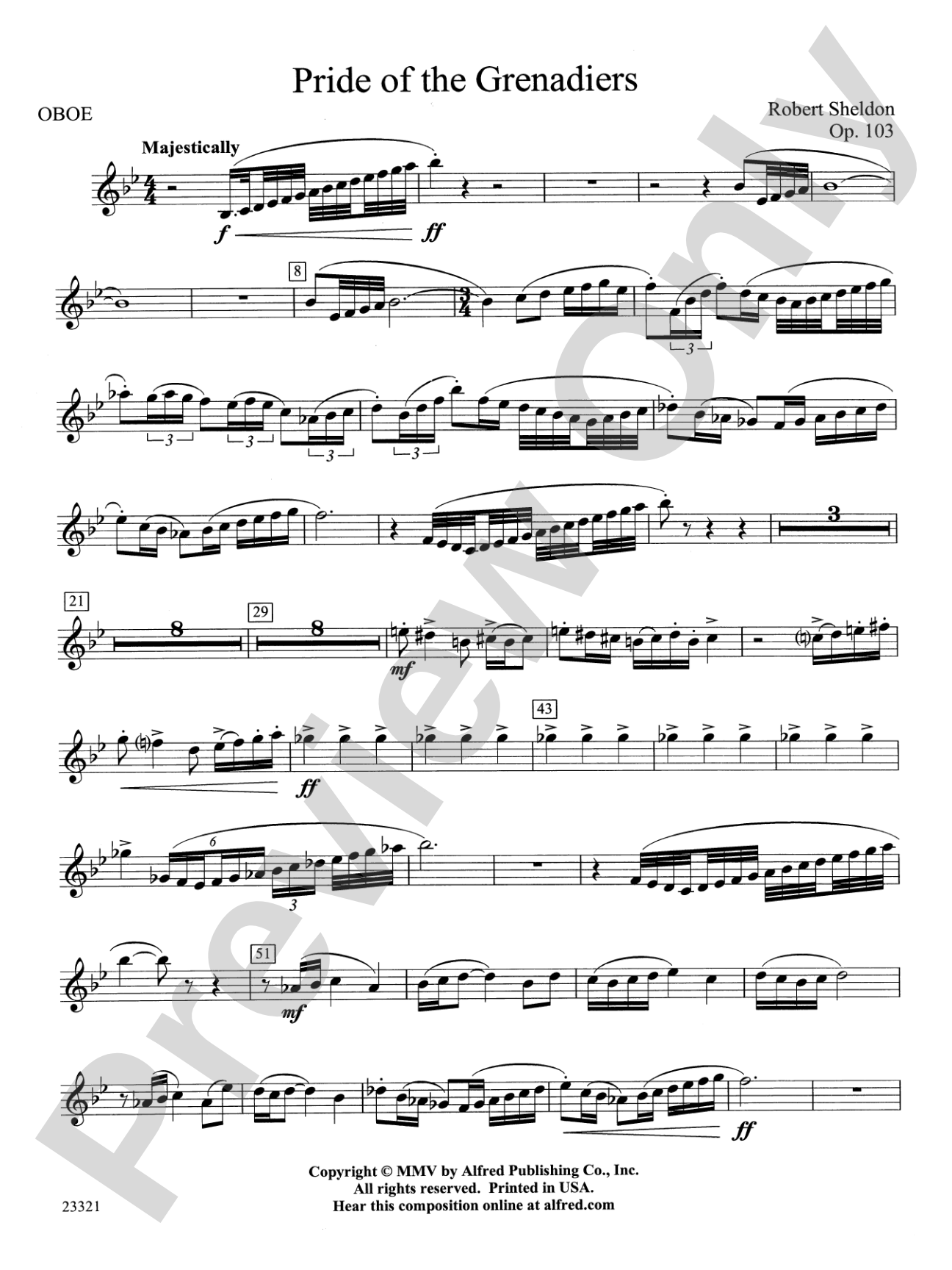

Pride of the Grenadiers: Oboe
Music by Robert Sheldon
Item: 00-PC-0000670_O1
$3.00
Pickup currently not available
Description
Pride of the Grenadiers is a tour-de-force for the concert band, featuring brass fanfares and woodwind flourishes throughout the opening processional. A reverent lyrical movement represents the band's Rochambeau ceremony while the multi-meter final movement provides a playful theme which is used in combination with the other thematic material, bringing the piece to a powerful and energetic conclusion.


Don't just read it, hear it, play along with it, and watch your students grow with it. In MakeMusic Cloud, Pride of the Grenadiers: Oboe comes alive with professional accompaniment, adjustable tempo, and built-in practice tools that turn solo practice into real progress.
Open in the Player
Jump straight in and assign it today.
Start Your Free Trial
Open this title and explore the full library in minutes.
Sample Audio
1
Audio File
--:--
0:00
0:00
Sample Video
No sample videos found.
Additional Details
Series:
Alfred Concert Band
Publisher:
Alfred Music
SKU:
00-PC-0000670_O1
More about this title
About the Composer: Robert Sheldon

Robert Sheldon's compositions occupy a central place in the concert band repertoire. His works appear regularly on state and national festival lists, and his music has been performed at Carnegie Hall, Symphony Hall, the Kennedy Center, and the Sydney Opera House. Beyond his prolific output as a composer, Sheldon has shaped music education through his role as lead author of Sound Innovations for Concert Band and through countless guest conducting appearances with All-State and Regional Honor Bands across the United States and internationally.
Sheldon's accolades include honors from the American School Band Director's Association, Phi Beta Mu, and the American Society of Composers, Authors and Publishers, along with a honorary doctorate from VanderCook College of Music. He regularly conducts clinics at universities and state music education conferences, and has worked with ensembles in Japan, Canada, Italy, Germany, Australia, and China. His approach to composition consistently balances accessibility with musical substance, making his works valuable for both educational and concert settings.
Why we love this
Sheldon's architecture here moves the ensemble through distinct emotional and technical terrain without losing musical coherence. The opening processional grabs attention immediately with its brass and woodwind interplay, the lyrical Rochambeau movement gives performers something genuinely expressive to communicate, and the rhythmic complexity of the finale energizes any concert while rewarding the ensemble's interpretive growth.
What to expect
The piece marches in with ceremonial grandeur, all brass brilliance and woodwind shimmer, then pivots unexpectedly into quiet introspection where melody breathes and harmony deepens. The final movement dissolves that reverence into rhythmic playfulness, layering themes atop one another until the energy peaks in a celebration that feels both powerful and earned.
Who it's for
Band directors preparing a graduation concert, end-of-year festival, or ceremonial concert need a piece with genuine dramatic scope and musical substance. Sheldon's writing here accommodates most high school concert bands while providing sophisticated harmonic and textural material that respects both the performers and the occasion.
How to get the most out of it
- Establish the processional swagger early in rehearsals by isolating the brass fanfare material with the woodwind counterpoint; the piece's momentum depends on rhythmic precision and articulation clarity from bar one.
- Shape the reverent lyrical section by encouraging sustained, singing tone quality across all sections; this movement's effectiveness relies on phrase architecture rather than technical display.
- Balance the multi-meter final movement by rehearsing each meter separately before combining them; mark beat subdivisions clearly in all parts so players maintain their groove while the overall texture becomes deliberately complex.
How to use it
Position this as your concert closing for a graduation ceremony or spring concert finale; its three-movement arc and tonal variety make it an ideal anchor piece that can stand alone or balance a program of shorter selections. The ceremonial character also suits special events like band banquets, alumni concerts, or festival performances where you want to mark the occasion musically.
Skills your students will build
- Articulation precision in fast brass and woodwind passages
- Sustained melodic phrasing in the lyrical movement
- Multi-meter reading and execution (mixing different time signatures in the finale)
- Balance and blend across full concert band voicing
- Ensemble cohesion while playing complex rhythmic material simultaneously