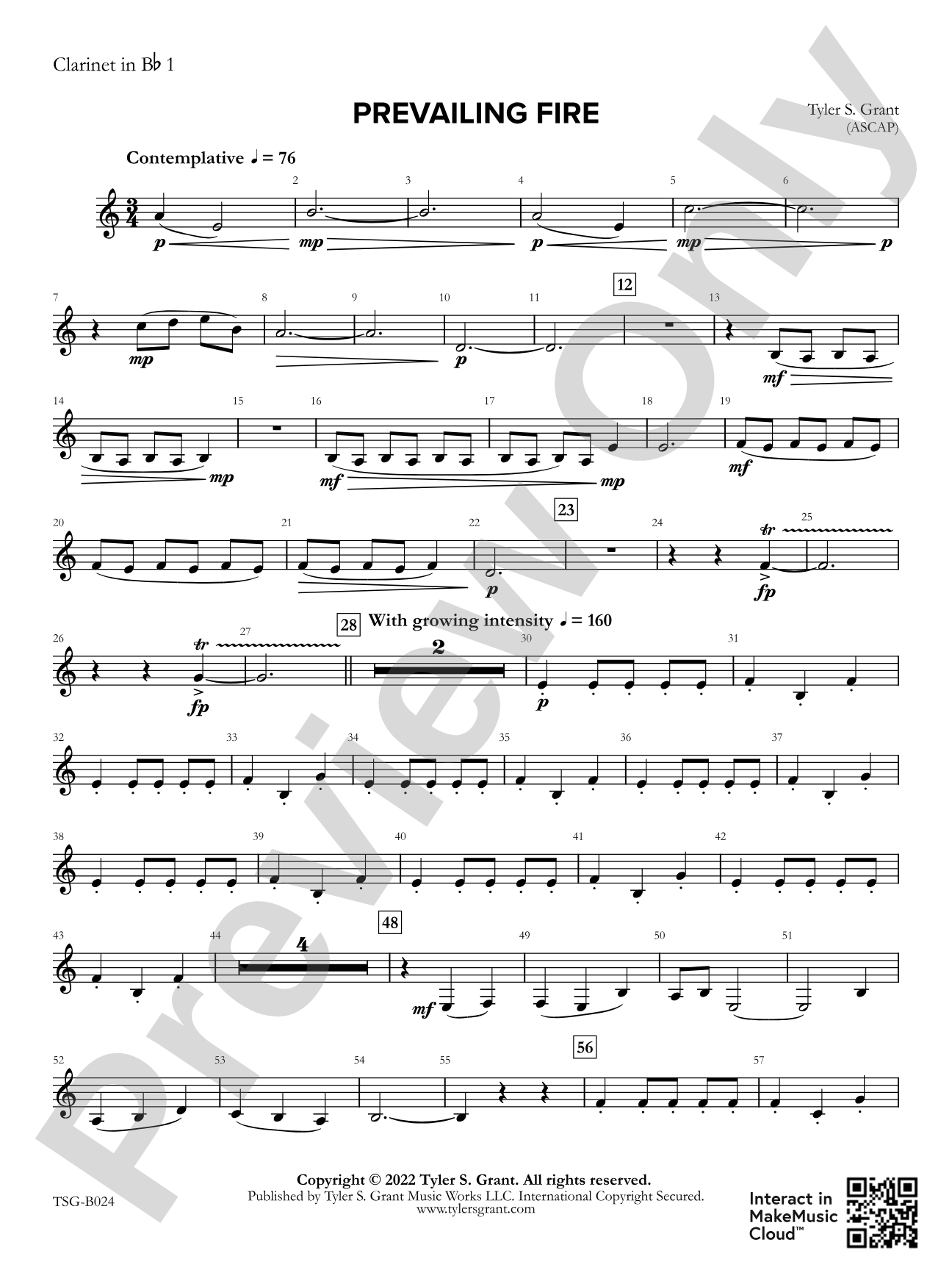
Prevailing Fire: 1st B-flat Clarinet Sheet Music Preview

Prevailing Fire: 1st B-flat Clarinet

By Tyler S. Grant

Grade: 2

Item: 98-PC-TGB024_C1

Digital Download
$4.50
Description
Opening with a brief three-note motif, this work expands into an array of rhythmic flurries, intense melodies, and driving percussion that paint the image of a passion-filled blaze. Excellent scoring and very comfortable ranges will make your young musicians sound strong, full, and confident. Prevailing Fire by Tyler S. Grant is truly unique! Recorded by the Atlanta Wind Symphony. (3:10)

Prevailing Fire: 1st B-flat Clarinet isn't in MakeMusic Cloud just yet...but it could be. Let us know you'd like to see it, and you'll help shape what comes next. In the meantime, start a free trial and dive into thousands of interactive titles your students can play along with today.

Sample Audio
0:00
0:00
Sample Video
Additional Details
Series: Tyler S. Grant Music Works
Publisher: Tyler S. Grant Music Works, LLC.
SKU: 98-PC-TGB024_C1

More about this title

About the Composer: Tyler S. Grant

Tyler S. Grant

Tyler S. Grant composes and arranges for concert bands, orchestras, and chamber ensembles across all difficulty levels. His works appear regularly on state and regional honor ensemble programs and consistently earn recognition on international editors' and publishers' choice repertoire lists. His composition Panoramic Fanfare won the Dallas Wind Symphony's 2014 Call for Fanfares Competition and has since been performed by collegiate and professional ensembles throughout North America.

Beyond composing, Grant maintains an active presence as a clinician and conductor, working with over 100 school instrumental music programs across 15 states and leading ensembles at The Midwest Clinic and all-state bands nationwide. He holds a bachelor's degree in instrumental music education from the University of Alabama and studied conducting with Professor Randall Coleman. Since 2010, he has accepted regular commissions and released new publications annually for bands and orchestras.

Why we love this

Grant's scoring here is genuinely transparent. Young musicians sit comfortably in their ranges and hear themselves as full contributors rather than struggling with technical demands that obscure the music. The work's narrative arc (brief motif expanding into rhythmic momentum and propulsive melodies) gives your band a clear story to tell, making rehearsals focused and performances memorable.

What to expect

Prevailing Fire ignites through propulsive rhythm and vivid percussion color, painting kinetic energy without chaos. The melodic lines breathe with passion, and the overall arc builds from a whisper of an idea into something undeniable and alive.

Who it's for

Grade 2 concert bands seeking repertoire with genuine musicality and confident scoring. This work works equally well for developing ensembles building rhythmic independence and for stronger Grade 2 groups looking to program something that impresses without overreaching technically.

How to get the most out of it

  • Establish the three-note opening motif as your tonal anchor. Return to it mentally throughout rehearsals so the ensemble recognizes how the subsequent sections grow from this kernel.
  • Let the percussion drive the rhythmic flurries without overwhelming the ensemble. These passages should feel propulsive, not frenetic; clarity of pulse matters more than speed.
  • Balance intensity with breath. The "passion-filled blaze" imagery works best when musicians phrase through the driving sections rather than attacking every entrance as if it were a new peak.

How to use it

Program this early in a concert as a high-energy opener that sets an assured tone for the ensemble. It also pairs well on festival or contest programs where you need a showpiece that demonstrates both musicianship and technical competence without requiring advanced technique.

Skills your students will build

  • Executing rhythmic figures with precision and control in ensemble settings
  • Balancing individual melodic lines within a full band texture
  • Responding to dynamic and intensity shifts within a driving musical narrative
  • Maintaining steady pulse through complex rhythmic accompaniment patterns
  • Phrasing in context of percussive and harmonic momentum

You May Also Like