
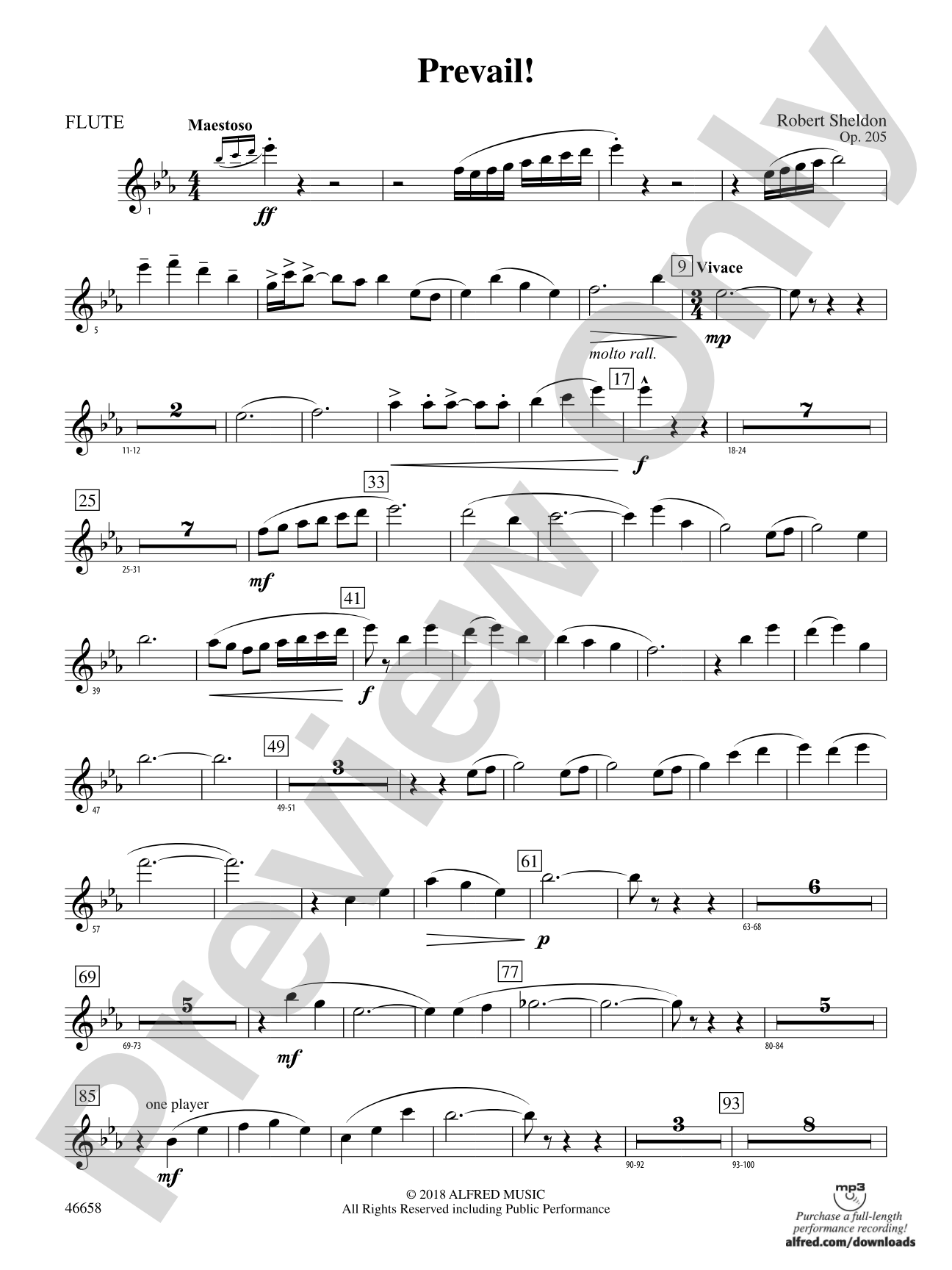

Prevail!: Flute
By Robert Sheldon
Grade: 3 (Medium)
Item: 00-PC-0018088_F1
$3.00
Pickup currently not available
Description
An uplifting and up-tempo piece that offers moments of optimism and nobility, including a brief encounter with a strife-ridden episode that ultimately yields to a return of the triumphant opening fanfare and a final recapitulation.


Don't just read it, hear it, play along with it, and watch your students grow with it. In MakeMusic Cloud, Prevail!: Flute comes alive with professional accompaniment, adjustable tempo, and built-in practice tools that turn solo practice into real progress.
Open in the Player
Jump straight in and assign it today.
Start Your Free Trial
Open this title and explore the full library in minutes.
Sample Audio
1
Audio File
--:--
0:00
0:00
Sample Video
Additional Details
Series:
Young Symphonic
Publisher:
Alfred Music
Page Count:
268
SKU:
00-PC-0018088_F1
More about this title
About the Composer: Robert Sheldon

Robert Sheldon stands among the most widely performed composers in wind band repertoire today. His work has earned recognition from the American School Band Director's Association, Phi Beta Mu, and the American Society of Composers, Authors and Publishers. Sheldon's compositions appear regularly on international concert and contest programs, and ensembles worldwide perform his music with increasing frequency.
Beyond composing, Sheldon co-authored Sound Innovations for Concert Band and maintains an active schedule as guest conductor for All-State and Regional Honor Bands. He has conducted his own works at Carnegie Hall, Orchestra Hall, Boston Symphony Hall, the Sydney Opera House, and the Kennedy Center. His clinician work spans the United States and six continents, and VanderCook College of Music awarded him an honorary doctorate in 2020.
Why we love this
Sheldon understands what Grade 3 bands need: a piece with genuine dramatic arc that doesn't require virtuosity to succeed. Prevail! earns its emotional weight through smart orchestration and clear musical ideas rather than technical difficulty, making it deeply rewarding for conductors working with developing ensembles. The contest-and-concert dual purpose means you can program it confidently in either setting.
What to expect
The music opens with bright optimism and a sense of forward motion, establishing a heroic character through fanfare writing. A middle section introduces genuine tension and conflict, creating dramatic contrast before the opening triumph returns with even greater force, leaving audiences with a sense of resolution and uplift.
Who it's for
Grade 3 concert bands preparing for both festival and contest performances. Directors seeking a piece with genuine emotional substance that develops musicianship without overwhelming intermediate players will find this work ideal. Sheldon's writing sits comfortably in the technical range of most mid-level high school and upper middle school bands.
How to get the most out of it
- Build the opening fanfare with a unified, confident tone across the entire ensemble. The nobility of this gesture sets the piece's emotional foundation, so establish clear articulation and dynamic control before exploring the more complex sections.
- Shape the strife episode with genuine contrast in color and intensity. Sheldon writes this section to feel genuinely unsettled, so allow the turbulent passages to breathe and feel destabilized before the return of triumph.
- Balance transparency in the final recapitulation. The triumphant return should feel inevitable and powerful, but keep inner lines audible so the full orchestration registers clearly.
- Use the conductor's score to map phrase structure carefully. At this grade level, clear gestures for section entries and harmonic changes help students feel secure during transitions.
How to use it
Prevail! works equally well as a contest selection or as a concert opener that establishes an uplifting tone for your program. Its moderate length and emotional clarity make it an effective choice for music festival settings where you want to showcase ensemble growth without programming something overly technical.
Skills your students will build
- Conducting unified ensemble attacks and releases across large groups
- Balancing tone and intonation within full band voicings
- Responding to subtle dynamic and articulation changes that shape musical phrases
- Navigating rhythmic precision through fanfare passages and complex harmonic sections
- Understanding dramatic contrast and emotional arc in concert music