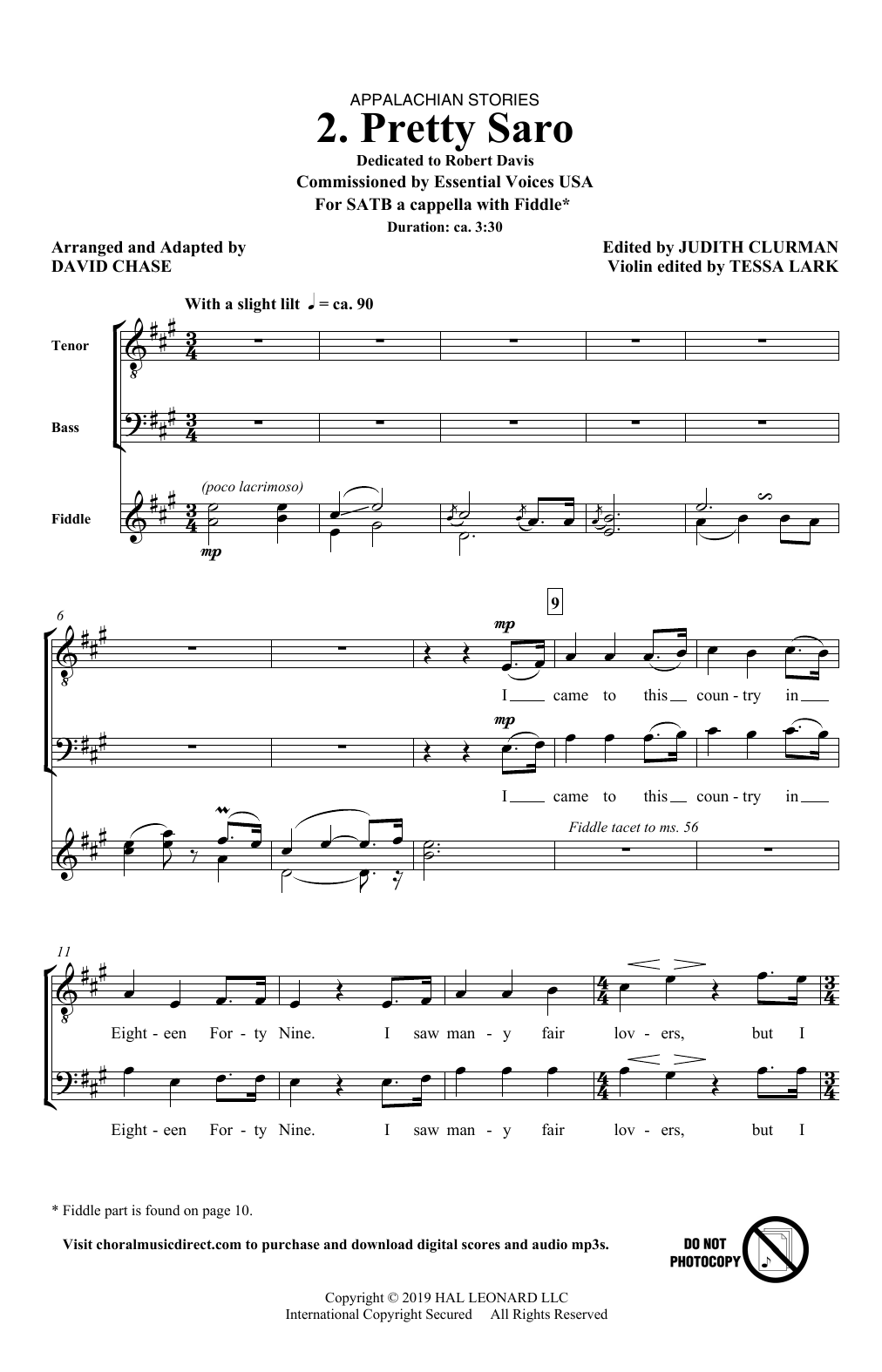
Pretty Saro (No. 2 from Appalachian Stories) Sheet Music Preview

Pretty Saro (No. 2 from Appalachian Stories): SATB Choral Octavo

Arranged by David Chase / Edited by Judith Clurman / Edited by Tessa Lark

Item: 35-DS00461222

Digital Download
$2.99
Description

Pretty Saro (No. 2 from Appalachian Stories): SATB Choral Octavo isn't in MakeMusic Cloud just yet...but it could be. Let us know you'd like to see it, and you'll help shape what comes next. In the meantime, start a free trial and dive into thousands of interactive titles your students can play along with today.

Sample Audio
No sample audio found.
Sample Video
Additional Details
Publisher: Hal Leonard
Page Count: 10
SKU: 35-DS00461222

More about this title

Why we love this

David Chase's arrangement honors the modal simplicity of this Appalachian ballad while building genuine harmonic depth through his SATB writing. The piece demands nothing flashy from singers but rewards attention to blend, tuning, and the narrative arc of the text. It's the kind of arrangement that sounds effortless but reveals itself through careful rehearsal.

What to expect

Intimate and grounded. The melody carries the spare, haunting quality of an old ballad passed hand to hand across generations, while the harmonies anchor it in place without overshadowing its plainness. There's a timelessness to it, neither aggressively modern nor self-consciously archaic.

Who it's for

Choirs seeking repertoire that sits comfortably in the intermediate range but offers artistic substance. This arrangement works equally well for college choirs, strong high school ensembles, and community choruses looking to build their folk music library.

How to get the most out of it

  • Establish the modal character early by having sopranos and altos lock their opening melody line together for several phrases before the lower voices enter. This clarity pays dividends when parts weave together later.
  • Attend closely to the vowel consistency across all four parts, particularly in sustained passages. The Appalachian dialect naturally lends itself to slight vowel modifications; coordinate these intentionally across the section rather than letting them happen by accident.
  • Record a rehearsal specifically focused on the tenor and bass lines independent of the sopranos and altos. These lines often move differently than the melody and need separate security before full ensemble work.
  • Shape the dynamic contour across the entire piece rather than treating each phrase in isolation. A folk narrative needs breathing room and moments of gathering intensity.

How to use it

Pair this with other Appalachian works or American folk arrangements to create a concert section that explores vernacular storytelling. It also serves well as a thoughtful closer to a mixed program, offering audiences a moment to settle into something rooted and genuine before they leave the hall.

Skills your students will build

  • Singing in modal contexts and understanding tonality beyond major and minor
  • Blend and balance across four independent lines moving at different rhythmic speeds
  • Interpretation of text-driven vocal music with minimal accompaniment
  • Tuning challenges in open voicings typical of folk harmony

You May Also Like