
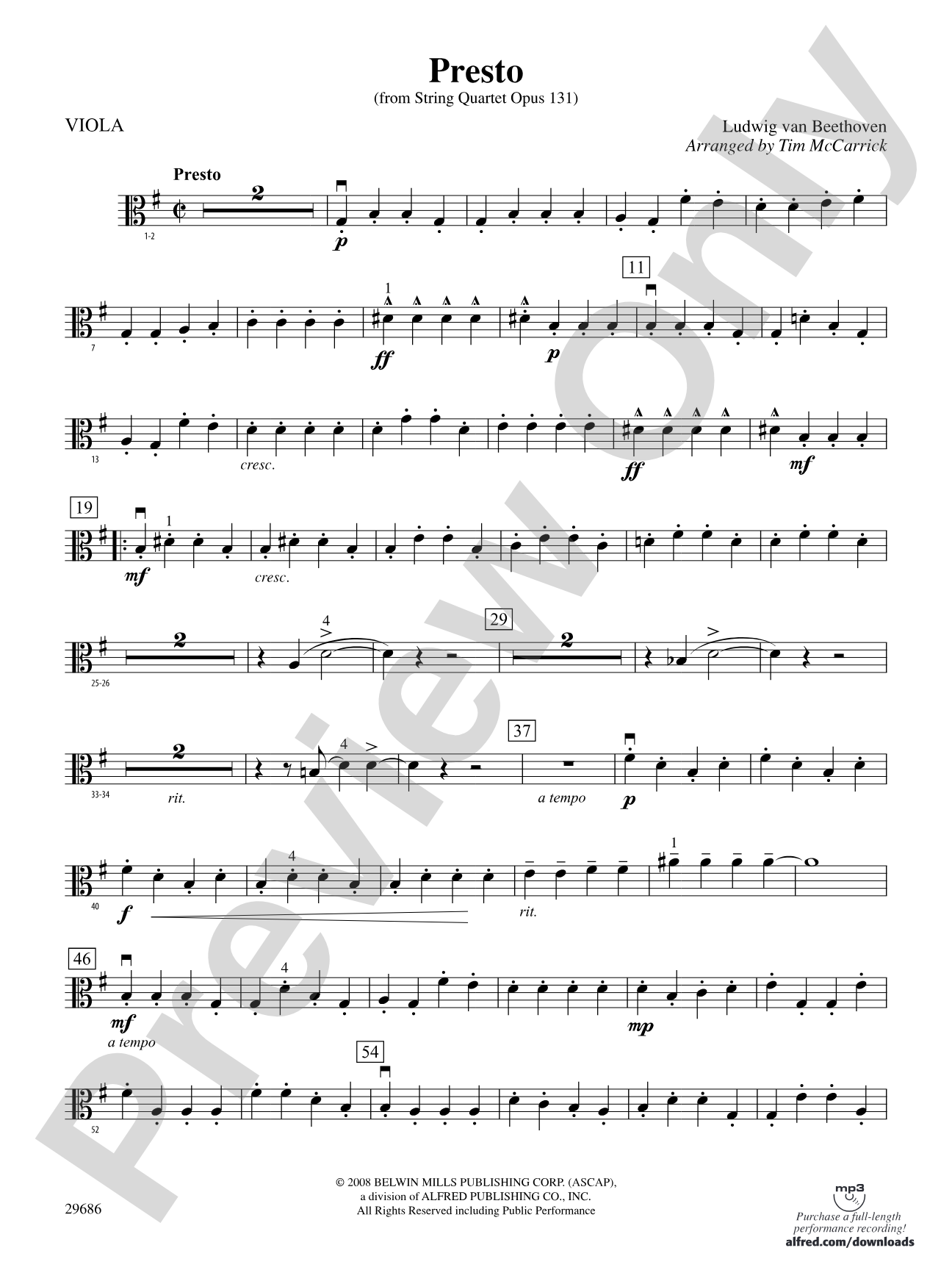

Presto: Viola
By Ludwig van Beethoven / arr. Tim McCarrick
Grade: 4
Item: 00-PC-0001554_VA1
$5.99
Pickup currently not available
Description
The "Late Quartets" of Beethoven have been considered unreachable for student musicians, and yet, by changing key and simplifying certain passages, this arrangement makes one of Beethoven's most famous and exuberant quartet movements available for your students! This piece is fun to play and fun to watch as Beethoven playfully bounces the melodies between players like a game until he interrupts with a totally unexpected pizzicato passage, only to bring you back to the game again. Leonard Bernstein drew the ire of critics when he arranged this presto for the Vienna Philharmonic, but the players and the audience loved it! (3:50)


Don't just read it, hear it, play along with it, and watch your students grow with it. In MakeMusic Cloud, Presto: Viola comes alive with professional accompaniment, adjustable tempo, and built-in practice tools that turn solo practice into real progress.
Open in the Player
Jump straight in and assign it today.
Start Your Free Trial
Open this title and explore the full library in minutes.
Sample Audio
1
Audio File
--:--
0:00
0:00
Sample Video
No sample videos found.
Additional Details
Series:
Belwin Concert String Orchestra
Publisher:
Alfred Music
Page Count:
124
SKU:
00-PC-0001554_VA1
More about this title
About the Composer: Ludwig van Beethoven
Ludwig van Beethoven (1770–1827) fundamentally transformed classical music by expanding the emotional and structural possibilities of every genre he touched. His late string quartets represent the summit of his creative output: works of such harmonic boldness and psychological depth that they challenged performers and audiences alike and continue to inspire musicians today.
Beethoven's revolutionary approach to form, harmony, and orchestration shaped the course of Romantic music. His works demand both technical precision and interpretive maturity from performers, making them enduring benchmarks in music education and concert programming.
Why we love this
Tim McCarrick has opened a door that seemed locked. Grade 4 orchestras can now experience one of Beethoven's most spirited and playful movements, complete with the dialogue between players and that delicious pizzicato surprise that makes audiences lean forward in their seats. The arrangement preserves Beethoven's essential character and humor while respecting what your students can actually accomplish.
What to expect
Playful, energetic, almost mischievous. Beethoven sets up a musical game where themes ricocket between players in bright, unpredictable patterns, building momentum and wit until a sudden shift to pizzicato breaks the spell entirely. The piece radiates joy and invention, inviting both orchestra and audience into the composer's sense of musical humor.
Who it's for
String orchestras at the Grade 4 level seeking repertoire with genuine compositional substance and immediate appeal. This arrangement works equally well for concert performance and festival competition, engaging players who hunger for music by canonical composers but need an accessible entry point.
How to get the most out of it
- Shape the thematic exchanges as genuine conversation between sections. The melody bounces deliberately from violins to cellos to violas; each section should own its moment before handing off cleanly.
- The pizzicato passage demands precision timing from the entire orchestra. Mark a clear beat pattern in that section and consider a brief rehearsal focus on ensemble coordination before it interrupts the main game.
- Balance the brighter material in higher registers against the weight of the lower strings when the full orchestra enters. Let the texture breathe rather than pushing for constant volume.
- Conduct the runs and rapid passages with clear subdivision to help students track the harmonic motion, especially where Beethoven shifts keys in simplified form.
How to use it
Program this as an opening number to showcase your orchestra's agility and ensemble precision, or pair it with slower classical works to create dynamic contrast. The 3:50 duration and accessible brilliance also make it an excellent festival selection where judges can hear clean execution and thoughtful musicianship across multiple parts.
Skills your students will build
- Ensemble coordination in rapid thematic exchanges between sections
- Precision with articulation and style changes (flowing lines to crisp pizzicato)
- Reading Baroque and Classical texture and form conventions
- Responding to conductor cues in complex, multi-voiced passages
- Intonation sensitivity in key changes and harmonic shifts