
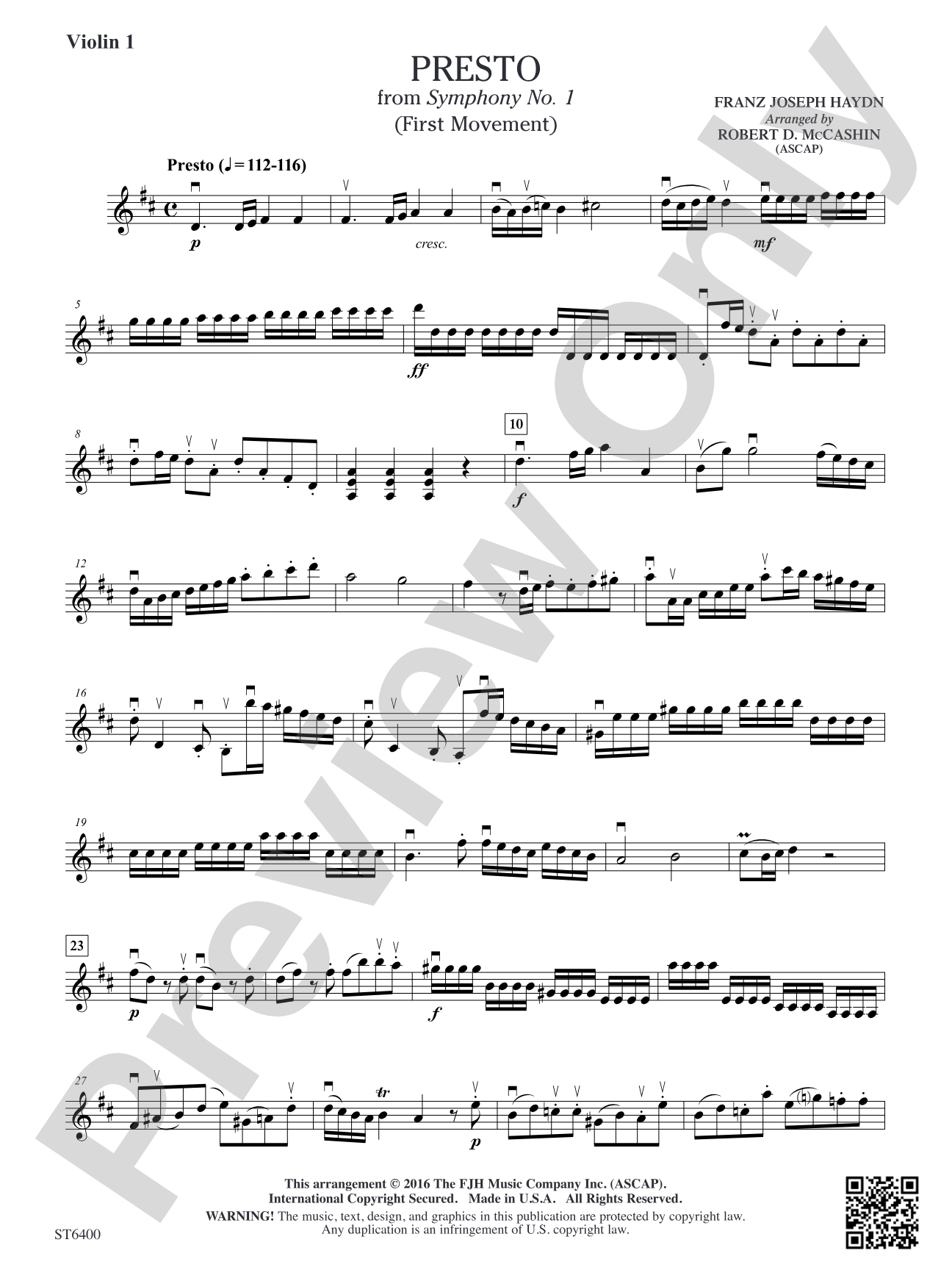

Presto from Symphony No. 1 (First Movement): Violin 1
First Movement
By Franz Joseph Haydn / arr. Robert D. McCashin
Grade: 4
Item: 98-PC-DST6400_VN1
$7.00
Pickup currently not available
Description
The opening movement of Haydn's first symphony demonstrates his substantial range of invention, organization of thought, musical ideas, and inventive compositional prowess. The movement is full of rhythmic and harmonic surprises. This creative work is masterfully captured in this arrangement and makes a fantastic closer for any performance!


Presto from Symphony No. 1 (First Movement): Violin 1 isn't in MakeMusic Cloud just yet...but it could be. Let us know you'd like to see it, and you'll help shape what comes next. In the meantime, start a free trial and dive into thousands of interactive titles your students can play along with today.
Request This Title
Tell us you want it.
Start Your Free Trial
Explore everything that's ready to play right now.
Sample Audio
1
Audio File
--:--
0:00
0:00
Sample Video
No sample videos found.
Additional Details
Series:
FJH String Orchestra
Publisher:
The FJH Music Company, Inc.
SKU:
98-PC-DST6400_VN1
More about this title
About the Composer: Franz Joseph Haydn
Franz Joseph Haydn (1732-1809) shaped the Classical symphony from its earliest forms into a vehicle for profound musical development and wit. Serving for nearly 30 years as Kapellmeister to the Esterházy court in Hungary, he composed 104 symphonies that chart the evolution of orchestral thinking across the late 18th century. His first symphonies, written in the 1750s, already show the architectural clarity and inventive motivic development that would define his legacy.
Haydn's approach to composition emphasized surprise and structural logic in equal measure. He built symphonies from simple, memorable ideas that he would fragment, recombine, and transform across multiple movements. His influence on both Mozart and Beethoven was direct and decisive; younger composers looked to Haydn's symphonies as the model for how to write with elegance, intelligence, and endless resource.
Why we love this
This arrangement captures everything that makes Haydn's early symphonic writing so contagious: economical material, unexpected harmonic turns, and an irresistible forward momentum. Programming a Haydn masterwork as a concert closer signals sophistication to adjudicators and audiences alike, and this version gives string orchestras at Grade 4 the chance to deliver a polished, professionally conceived performance without requiring the resources of a full orchestra.
What to expect
Brisk and ingenious, with an almost conversational quality. Haydn launches a simple, memorable idea and immediately toys with it, shifting harmonic ground and inverting rhythmic expectations. The movement crackles with forward motion and intellectual playfulness, never lingering long enough to become predictable. There's elegance here, not bombast.
Who it's for
String orchestras at the intermediate-advanced level who are ready to tackle a major composer's authentic voice without excessive technical difficulty. This arrangement suits programs building confidence in stylistic period playing and orchestral balance, while allowing sufficient rehearsal time for other repertoire.
How to get the most out of it
- Shape the opening phrase with a clear point of arrival on beat 3 of measure 3; the rhythmic surprise that follows lands harder when the first gesture has weight and purpose.
- Track the harmonic rhythm carefully in the middle section. Haydn moves faster through harmonic areas than many composers at this level, and precision here prevents the line from feeling aimless.
- Balance the first violin figuration against the supporting voices. This piece works only when the accompaniment is genuinely rhythmically alive, not merely filling in between melody notes.
- Conduct this movement with a clear, confident pulse. Haydn's rhythmic surprises need a steady reference point to register with impact; ambiguous time-keeping makes the writing feel tentative instead of playful.
How to use it
This works brilliantly as a concert finale, where its energy and intelligence send audiences out energized. It pairs naturally with Baroque or other Classical-era works in the same program, or it can anchor a repertoire set demonstrating orchestral mastery across centuries.
Skills your students will build
- Executing quick dynamic shifts and articulation contrasts within a single phrase
- Balancing rhythmic independence among voices while maintaining forward ensemble momentum
- Reading and performing Classical-era harmonic syntax and harmonic rhythm
- Responding to orchestration that privileges upper strings while keeping lower voices rhythmically engaged
- Sustaining character and focus through repeated or transformed motivic material