
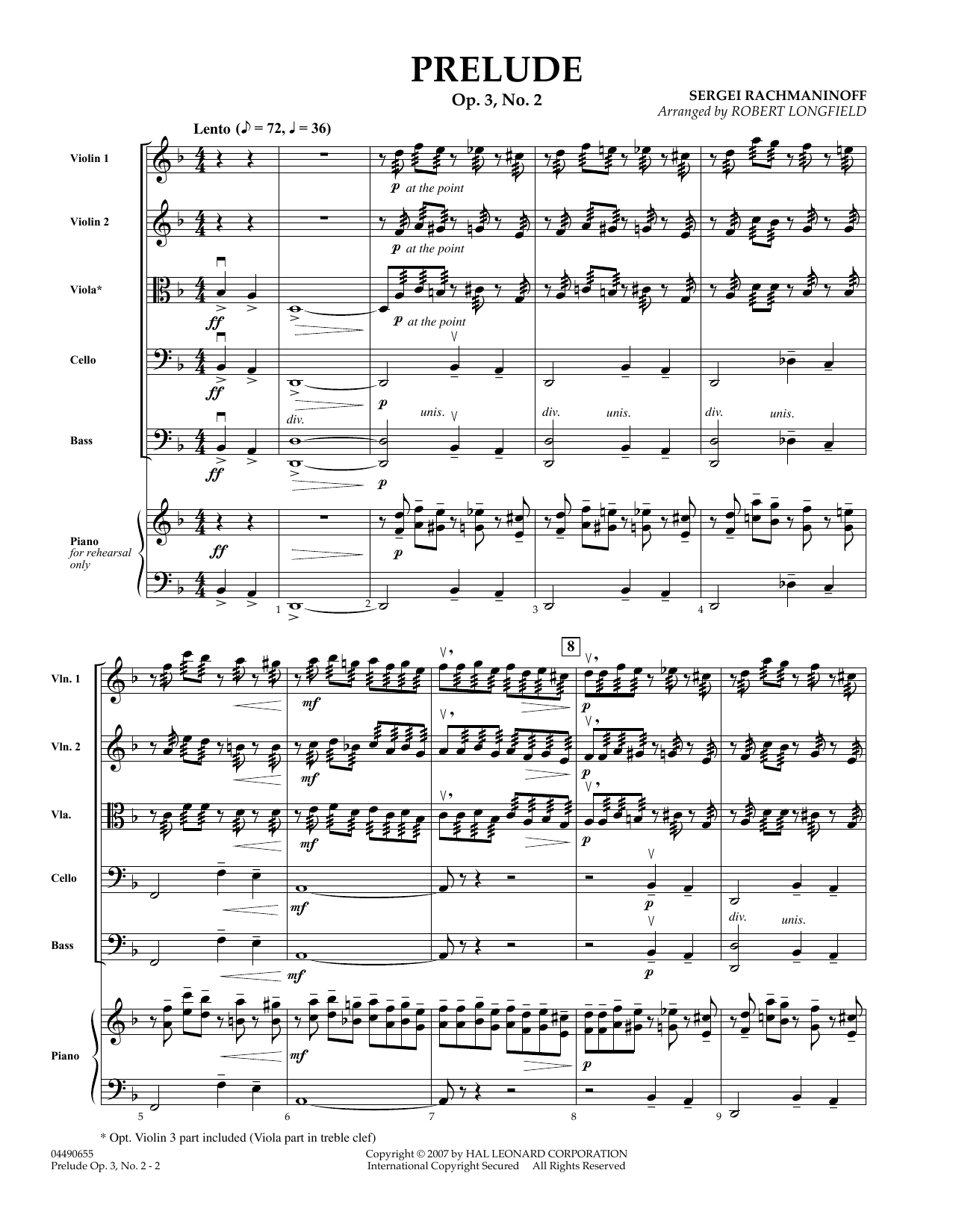

Prelude Op.3, No. 2: String Orchestra Conductor Score & Parts
As performed by Sergei Rachmaninoff / Arranged by Robert Longfield
Grade: 3-4
Item: 35-PK00320669
$50.00
Pickup currently not available
Buy Extra Parts (Digital PDF Download)
| Product | Price | Quantity |
|---|---|---|
| Prelude Op.3, No. 2 - Full Score | $6.00 | |
| Prelude Op.3, No. 2 - Violin 1 | $7.00 | |
| Prelude Op.3, No. 2 - Violin 2 | $7.00 | |
| Prelude Op.3, No. 2 - Violin 3 (Viola T.C.) | $7.00 | |
| Prelude Op.3, No. 2 - Viola | $7.00 | |
| Prelude Op.3, No. 2 - Cello | $7.00 | |
| Prelude Op.3, No. 2 - String Bass | $7.00 | |
| Prelude Op.3, No. 2 - Piano | $7.00 |
Parts Added to Cart!
Description
The engaging theme from this piano classic is instantly recognizable and your students will love its dark, forboding quality. Chromatic triads against a prominent bass line are trademarks of Rachmaninoff and his distinctive, late Romantic style.
Dur: 4:00


Prelude Op.3, No. 2: String Orchestra Conductor Score & Parts isn't in MakeMusic Cloud just yet...but it could be. Let us know you'd like to see it, and you'll help shape what comes next. In the meantime, start a free trial and dive into thousands of interactive titles your students can play along with today.
Request This Title
Tell us you want it.
Start Your Free Trial
Explore everything that's ready to play right now.
Sample Audio
No sample audio found.
Sample Video
No sample videos found.
Additional Details
Publisher:
Hal Leonard
SKU:
35-PK00320669
More about this title
About the Artist: Sergei Rachmaninoff
Sergei Rachmaninoff (1873-1943) was a Russian composer, pianist, and conductor whose dramatic harmonic language and sweeping melodic lines defined late Romantic music. His piano works, particularly the Preludes and Concertos, established him as a master of emotional depth and technical virtuosity; audiences recognized his music immediately for its richness and unmistakable character.
Rachmaninoff's influence on music education extends far beyond the concert hall. His accessible yet sophisticated compositional voice makes his works ideal for student ensembles seeking to explore chromatic harmony, motivic development, and the expressive possibilities of stringed instruments without excessive technical demands.
Why we love this
This arrangement captures the Prelude's hypnotic quality in a way that feels natural on strings rather than retrofitted. Longfield's orchestration respects Rachmaninoff's harmonic language while giving each section room to shape the familiar theme, making it an ideal choice when you want students to engage with a recognized masterwork that sounds immediately impressive in performance.
What to expect
A slow descent into shadow and introspection. The dark, chromatic harmonies feel weightier than the straightforward melodies students often encounter, while the prominent bass line anchors everything with gravitas. There's a brooding elegance here that rewards careful, committed playing.
Who it's for
Intermediate string orchestras ready to move beyond folk-song arrangements and simple classical themes. This score works well for ensembles with solid intonation and the ability to sustain long lines without losing focus, roughly Grade 3-4 level.
How to get the most out of it
- Balance the bass line as the foundational voice; it drives the harmonic progression and should be heard without overwhelming the upper parts.
- Attend to the chromatic voice leading in the harmonic background. Students often rush through chromatic passages; take time to ensure each voice moves deliberately.
- Shape the main theme with direction toward the highest notes, then allow the phrase to settle back. Avoid playing it as static or monotone.
- Use a recording as a reference for tempo and overall architecture, but encourage your section leaders to listen for Rachmaninoff's harmonic language rather than mimicking interpretation.
How to use it
Place this as a contrasting piece alongside brighter or more rhythmically active works. It works beautifully in a concert that explores different colors of the Romantic era, or as a moment of stillness between more energetic selections. The 4-minute duration fits easily into any program without disrupting pacing.
Skills your students will build
- Listening for and balancing chromatic voice leading across all four string sections
- Sustaining long, expressive melodic lines without relying on rhythmic motion
- Understanding harmonic function through late Romantic compositional language
- Coordinate ensemble sound across multiple independent lines moving simultaneously