Prelude No. 4 Sheet Music Preview

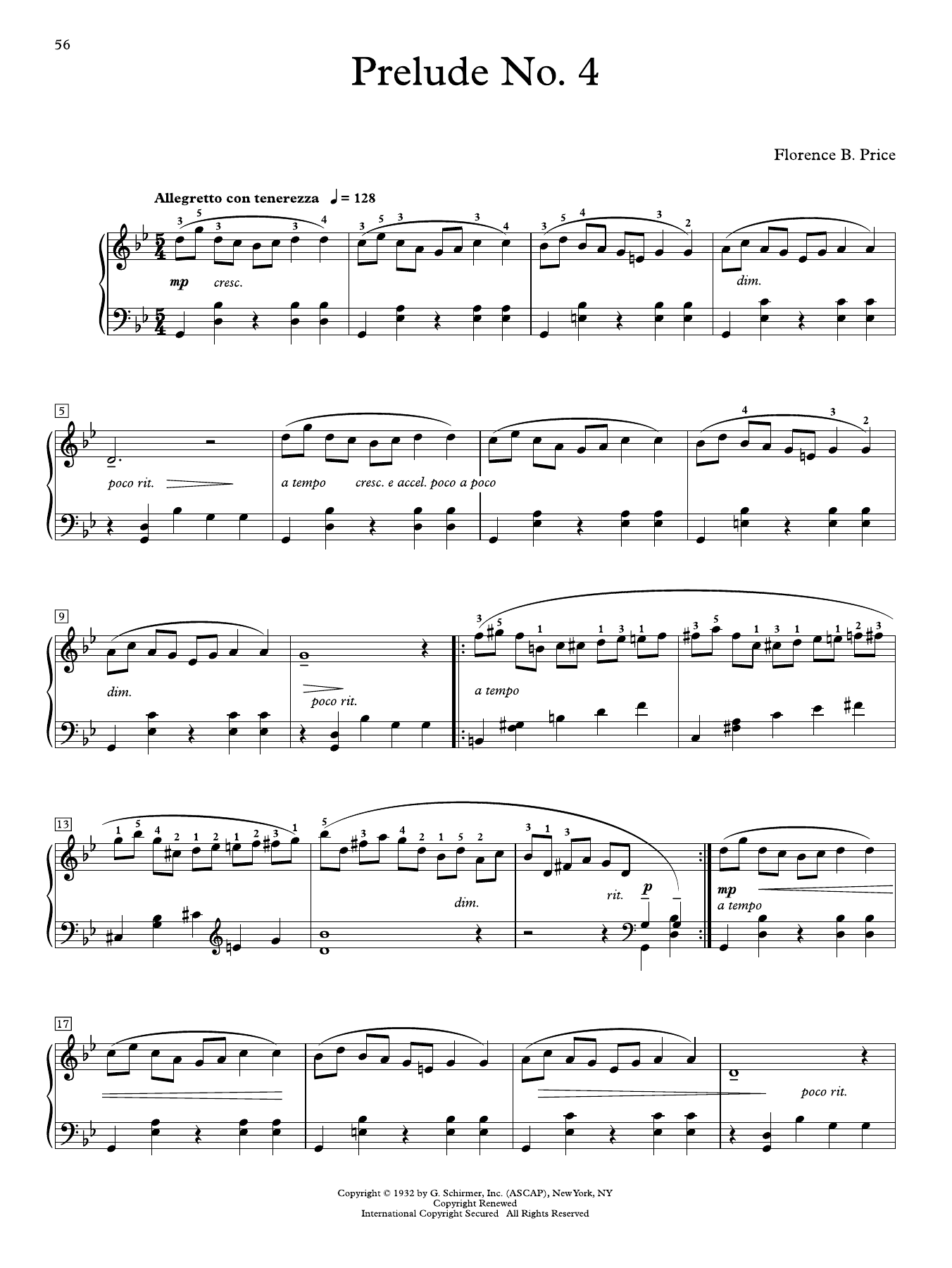
Prelude No. 4: Educational Piano

As performed by Florence Price

Item: 35-DS01838057

Digital Download
$4.99
Description

Discover MakeMusic Cloud: thousands of interactive titles your students can play along with today.

Sample Audio
No sample audio found.
Sample Video
Additional Details
Publisher: Hal Leonard
Page Count: 3
SKU: 35-DS01838057

More about this title

About the Artist: Florence Price

Florence Price (1887-1953) broke barriers as the first African American woman to have a symphony performed by a major American orchestra. Her compositional voice merged European classical forms with the harmonic language and rhythmic vitality of African American musical traditions, creating work that was both intellectually rigorous and deeply rooted in her cultural identity.

Price's piano works occupy a vital place in her catalog. Her preludes, in particular, demonstrate her gift for distilling complex harmonic ideas into compact, teachable forms that never sacrifice artistic substance. They remain essential repertoire for students encountering classical music by women composers and for pianists seeking American voices beyond the usual canon.

Why we love this

This prelude offers students an authentic entry point into twentieth-century harmony without abandoning the structural clarity of the classical prelude form. Price's voice is immediately distinctive yet accessible, making this an excellent choice when you want to expand your students' sense of what classical piano writing can be.

What to expect

Introspective and elegantly crafted, this prelude unfolds with quiet sophistication. The harmonic palette creates moments of gentle surprise while maintaining an overall sense of coherence and forward motion, giving the listener a feeling of discovering something carefully considered rather than sprawling.

Who it's for

Intermediate to early advanced pianists ready to engage with twentieth-century composition and seeking repertoire that connects classical form to new harmonic language. It works especially well for students exploring American composers or preparing recital programs that center underrepresented voices in the canon.

How to get the most out of it

  • Listen closely for Price's harmonic movement beneath the surface figuration; the progression often tells a different story than the melody suggests, and bringing that awareness to your touch will deepen the piece's character.
  • Pay particular attention to any tempo markings and dynamic shifts between sections. Price's architectural choices are precise, and respecting them reveals the form's elegance.
  • Consider the pedagogical balance between technical facility and interpretive depth. The notation is clear, but the emotional weight asks for mature phrasing even from intermediate players.

How to use it

Pair this with other American preludes or short character pieces to frame a thematic program exploring distinctly American voices in classical music. It also serves beautifully as a recital opener, where its three-page length and self-contained form set a contemplative tone without demanding excessive concert time.

Skills your students will build

  • Interpreting twentieth-century harmonic language while maintaining phrase coherence
  • Balancing technical accuracy with expressive intention in compact forms
  • Understanding how classical structures accommodate non-traditional harmonic progressions
  • Building cultural and historical awareness of American classical composition

You May Also Like