
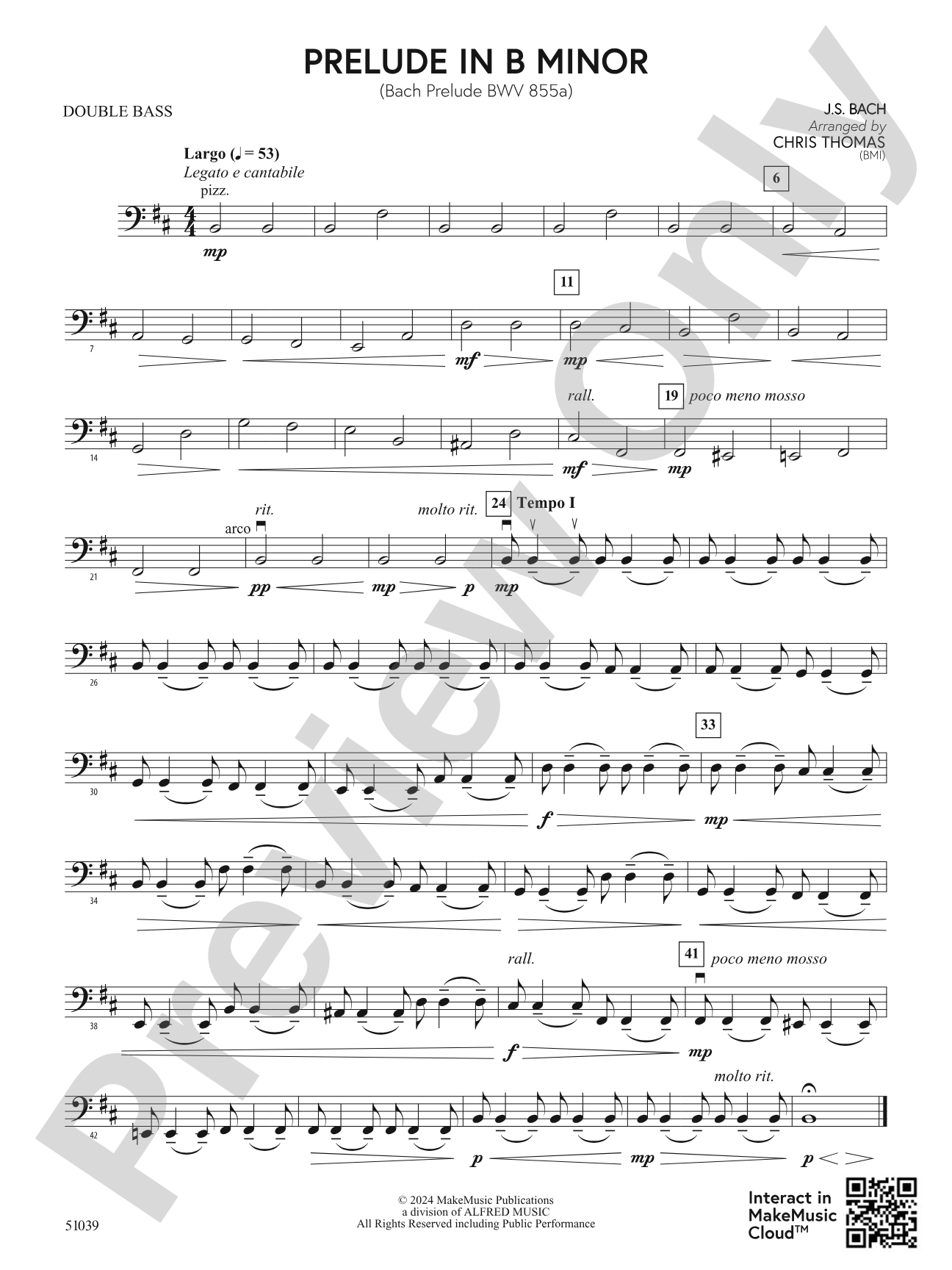

Prelude in B Minor: String Bass
(BWV 855a)
By J.S. Bach / arr. Chris Thomas
Grade: 3
Item: 00-PC-0019242_SB
$3.00
Pickup currently not available
Description
Embark on a musical journey like no other as you immerse yourself in this hauntingly beautiful arrangement of Bach's Prelude in B Minor (originally in E Minor). With every note, the stunning orchestration of Chris Thomas draws the listener into a world of deep emotion and intricate artistry, where darkness and beauty merge into a luminous musical experience. (3:45)


Don't just read it, hear it, play along with it, and watch your students grow with it. In MakeMusic Cloud, Prelude in B Minor: String Bass comes alive with professional accompaniment, adjustable tempo, and built-in practice tools that turn solo practice into real progress.
Open in the Player
Jump straight in and assign it today.
Start Your Free Trial
Open this title and explore the full library in minutes.
Sample Audio
1
Audio File
--:--
0:00
0:00
Sample Video
Additional Details
Series:
MakeMusic Symphony Strings
Publisher:
MakeMusic Publications
SKU:
00-PC-0019242_SB
More about this title
About the Composer: J.S. Bach
Johann Sebastian Bach (1685-1750) stands at the foundation of Western classical music. His systematic exploration of harmony, counterpoint, and form across every genre established principles that composers still follow today. For music educators, Bach's work offers an incomparable resource: pieces that teach through their construction rather than around it.
Bach's keyboard works, particularly his well-tempered compositions, have long served as both performance repertoire and pedagogical models. This prelude exemplifies why his music endures in rehearsal rooms and concert halls: it balances technical clarity with emotional depth, rewarding both careful study and expressive interpretation.
Why we love this
Chris Thomas's orchestration makes Bach's keyboard writing sing across a string section without sacrificing the original's harmonic integrity. The arrangement lands at Grade 3 but asks musicians to articulate Bach's voice-leading clearly, turning a familiar work into a vehicle for genuine musical growth. It's substantial enough to hold a concert slot while remaining accessible enough that your ensemble can focus on phrasing and ensemble blend rather than wrestling with complexity.
What to expect
Introspective and deliberate, this prelude unfolds with the inevitability of Bach's harmonic language. The arrangement honors the keyboard original's contemplative quality while giving strings the space to resonate; there's a sense of formal beauty in the unfolding, not rushing. Minor-key gravity pulls through the work without becoming heavy.
Who it's for
String orchestra directors working with Grade 3 ensembles who want to program Bach with musical legitimacy and without oversimplification. Students ready to handle polyphonic awareness and expressive control will find this rewarding; it asks them to listen critically to their own part within a larger fabric.
How to get the most out of it
- Shape each line independently within the texture. The inner voices carry harmonic weight, so balance the parts so listeners hear the counterpoint move, not just the top melody.
- Sustain tone quality across the full three minutes forty-five seconds. Younger string players often tighten or lose resonance in longer pieces; work for consistent vowel and bow pressure throughout.
- Lean slightly into the darker, introspective character of B minor without dragging tempo. The minor key suggests melancholy, but Bach's harmonic momentum still propels the music forward.
- Rehearse tutti sections with attention to entrance clarity. When all voices enter together, ensure articulation and dynamic placement align so the texture sounds unified, not ragged.
How to use it
This works excellently as the anchor of a Bach or Baroque-focused concert, or as a contrasting quieter moment in a mixed program. Pair it with a lighter contemporary work or a faster baroque piece to show range. It's also substantial enough for a solo spot on a festival or competition program.
Skills your students will build
- Sustaining tone and dynamic shape across longer melodic phrases
- Balancing independent voice lines while maintaining harmonic unity
- Articulating baroque counterpoint through bowing clarity
- Listening to and responding to harmonic tension and resolution
- Developing expressive control in a minor key without rushing or dragging