
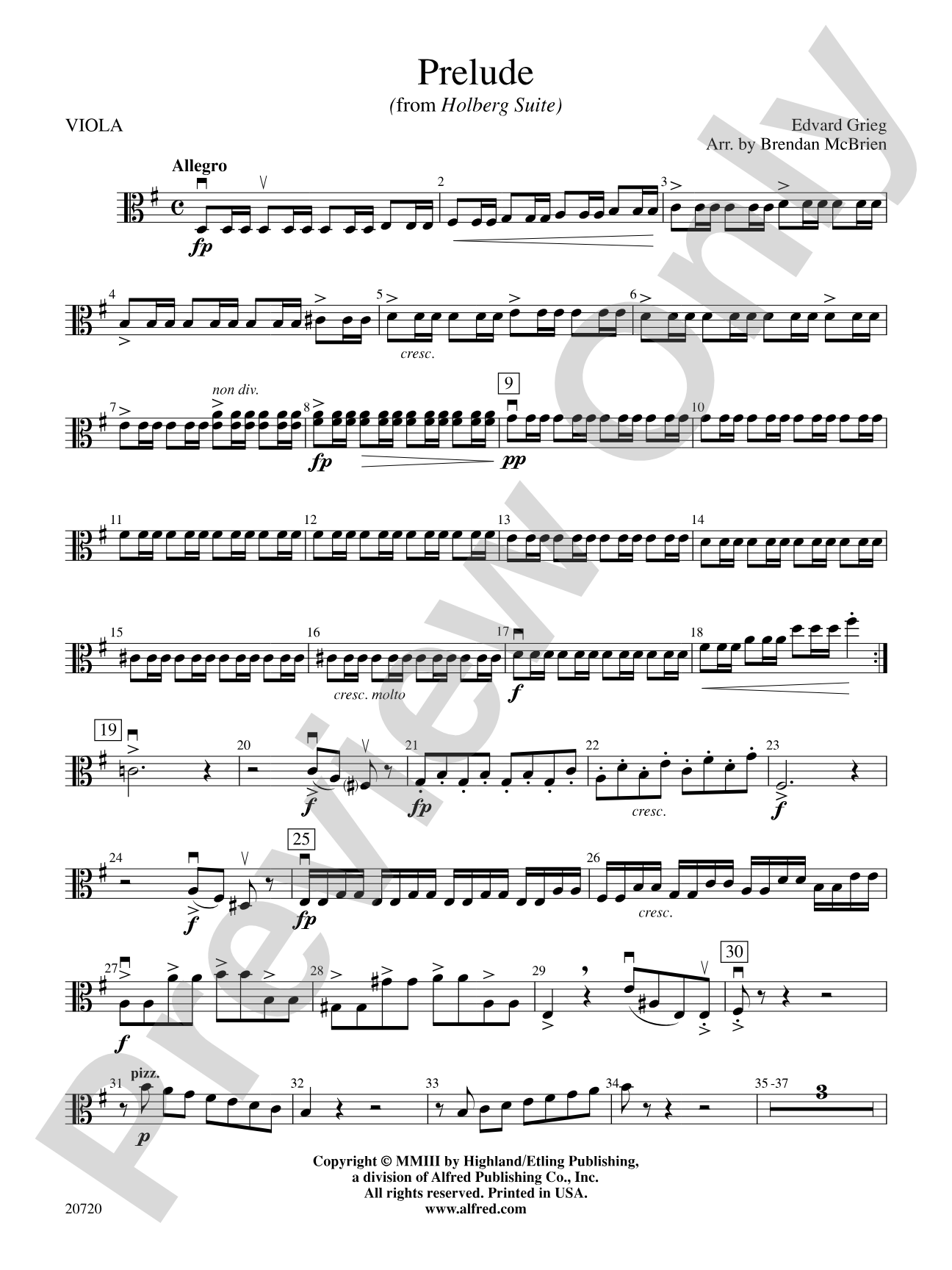

Prelude (from Holberg Suite): Viola
By Edvard Grieg / arr. Brendan McBrien
Grade: 3
Item: 00-PC-0000452_VA1
$5.99
Pickup currently not available
Description
Edvard Grieg's Holberg Suite, Op. 40 was composed in 1884 to celebrate the bicentenary of the birth of noted Norwegian playwright and satirist Ludwig Holberg. Composed in the Baroque dance-suite style of Holberg's time, Holberg Suite stands today as one of the earliest examples of neo-classicism in the Romantic Era and has become a beloved standard in the string orchestra repertoire. This title is available in MakeMusic Cloud.


Don't just read it, hear it, play along with it, and watch your students grow with it. In MakeMusic Cloud, Prelude (from Holberg Suite): Viola comes alive with professional accompaniment, adjustable tempo, and built-in practice tools that turn solo practice into real progress.
Open in the Player
Jump straight in and assign it today.
Start Your Free Trial
Open this title and explore the full library in minutes.
Sample Audio
1
Audio File
--:--
0:00
0:00
Sample Video
Additional Details
Series:
Highland/Etling String Orchestra
Publisher:
Alfred Music
Page Count:
114
SKU:
00-PC-0000452_VA1
More about this title
About the Composer: Edvard Grieg
Edvard Grieg (1843-1907) was Norway's most celebrated composer and a defining voice of Romantic nationalism. He drew deeply from Norwegian folk music, dance rhythms, and landscape to create works that brought his country's musical identity to the world stage. His gift for melody and harmonic color made him one of the most performed composers of his era, and his music remains central to string orchestra and piano repertoires today.
Why we love this
This arrangement opens doors to an undisputed masterwork at a grade level where access to genuine art music feels rare. Brendan McBrien has calibrated the writing so that Grade 3 orchestras can deliver the Baroque poise and lyrical warmth that made Holberg Suite essential repertoire, without sacrificing either the students' sense of accomplishment or the music's integrity. It's a piece that sounds far more sophisticated than the technical demands suggest, giving young string players immediate evidence that they can handle real repertoire.
What to expect
Prelude unfolds with the grace of a Baroque gavotte wrapped in Romantic warmth. There's formality in its phrasing and restraint in its orchestration, yet underneath runs a lyrical tenderness that's unmistakably Grieg. The piece invites the listener into a dignified, elegant world that feels both timeless and deeply personal.
Who it's for
Grade 3 string orchestras eager to program genuine classical masterworks without overreaching technically. Solo string players and advanced middle school or early high school orchestras will find this rewarding both as contest material and as a gateway to understanding how Grieg reimagined Baroque forms for the Romantic ear.
How to get the most out of it
- Shape the phrases with gentle crescendo and decrescendo, even when Grieg's notation is minimal. The melodic line wants to breathe like a Baroque dance, not sit flat.
- Balance the accompaniment voices carefully in the strings. Inner parts should support rather than compete; this clarity makes the harmonic sophistication audible to the audience.
- Maintain a steady, unhurried tempo. Prelude works best when it feels unhurried and stately, allowing the harmonic movement to emerge naturally rather than rushing through.
- Tune the section thoroughly around the sustained harmonies. Intonation issues become immediately obvious over long notes, so build ensemble listening into every rehearsal.
How to use it
Open a concert with this piece to establish a sense of refinement and set an artistic tone for what follows. It pairs naturally with lighter Baroque-inspired works or with other Grieg arrangements, and works equally well as an opening number at a festival or contest. Its moderate length and clear formal structure make it an ideal choice for programs where you need something substantial yet not overwhelming.
Skills your students will build
- Baroque phrase architecture and dance-form conventions
- Intonation control over sustained harmonic progressions
- Balance between principal melodic lines and accompanimental voices
- Expressive phrasing without relying on tempo changes
- Rhythmic precision in Baroque-influenced metric patterns