
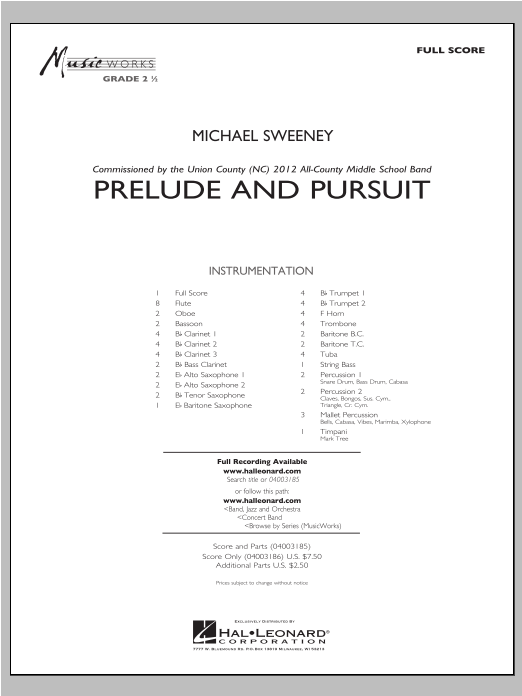

Prelude And Pursuit: Concert Band Conductor Score & Parts
By Michael Sweeney
Grade: 2.5
Item: 35-PK00245446
$60.00
Pickup currently not available
Buy Extra Parts (Digital PDF Download)
Parts Added to Cart!
Description
John Barnes Chance composed his landmark work for band, "Incantation and Dance", in 1960 while in residence at the high school in Greensboro, North Carolina. Commissioned by the Union County (NC) Honor Band, "Prelude and Pursuit" pays tribute to this important composition and its North Carolina connection. A haunting chant-like theme played by the clarinets sets the tone for the slow section. Similar to Chance's work, the fast section begins with percussion instruments introducing thematic elements later picked up and developed by the winds. Intensifying rhythmic elements, as well as carefully controlled random playing effects, contribute to an overall sense of excitement and anticipation. Themes are woven throughout various sections of the band before the opening chant motif makes a brief dramatic appearance near the end. A great teaching tool for young players, "Prelude and Pursuit" also provides a rewarding performance experience. Dur: 4:50


Prelude And Pursuit: Concert Band Conductor Score & Parts isn't in MakeMusic Cloud just yet...but it could be. Let us know you'd like to see it, and you'll help shape what comes next. In the meantime, start a free trial and dive into thousands of interactive titles your students can play along with today.
Request This Title
Tell us you want it.
Start Your Free Trial
Explore everything that's ready to play right now.
Sample Audio
No sample audio found.
Sample Video
No sample videos found.
Additional Details
Publisher:
Hal Leonard
SKU:
35-PK00245446
More about this title
About the Composer: Michael Sweeney
Michael Sweeney is a prolific composer and arranger whose works for concert band have become staples in music education. His compositions span multiple grade levels and demonstrate a keen understanding of how to write idiomatically for young musicians while maintaining artistic substance.
Why we love this
Sweeney has crafted a piece that honors an acknowledged masterwork without simply imitating it. The structural arc from introspective opening to kinetic finale gives your band something genuinely satisfying to build toward, and the controlled use of extended techniques keeps the excitement grounded in musicality rather than spectacle.
What to expect
The piece begins with something liturgical and meditative, almost hushed. When energy arrives, it builds through layered rhythmic momentum and instrumental colors rather than simple dynamics, creating a sense of ritual intensifying into celebration before circling back to where it started.
Who it's for
This work fits squarely in the Grade 2.5 repertoire but serves multiple purposes: developing bands looking for structured programming material, ensembles studying contemporary compositional techniques, and any conductor seeking a 4:50 opener or closer with real substance.
How to get the most out of it
- Shape the opening clarinet chant with careful attention to breath points and phrase contour; this is the emotional anchor the entire piece returns to.
- Balance the random playing effects in the fast section so they enhance rather than obscure the underlying thematic development. These are compositional choices, not permission to play loosely.
- Use the percussion introduction to the fast section as a rehearsal focal point. Once your battery locks the rhythmic foundation, the winds will find their footing more easily.
- Prepare players for the dramatic restatement of the opening motif near the end by rehearsing the transition carefully. The impact depends on contrast and control, not volume.
How to use it
Consider pairing this with other pieces that explore contrast and return. It works especially well as a concert opener, where the quiet opening settles an audience and the arc gives you a strong platform for what follows. The four-fifty duration also makes it ideal for a balanced concert flow without requiring longer concert staples.
Skills your students will build
- Sustaining long melodic lines with control and expression
- Reading and executing rhythmic precision in mixed meters and changing time signatures
- Balancing transparent ensemble texture during soft, chant-like passages
- Coordinating rapid rhythmic figures across multiple instrumental sections
- Executing extended techniques (controlled random playing) with intentionality
- Understanding formal structure through theme and variation