
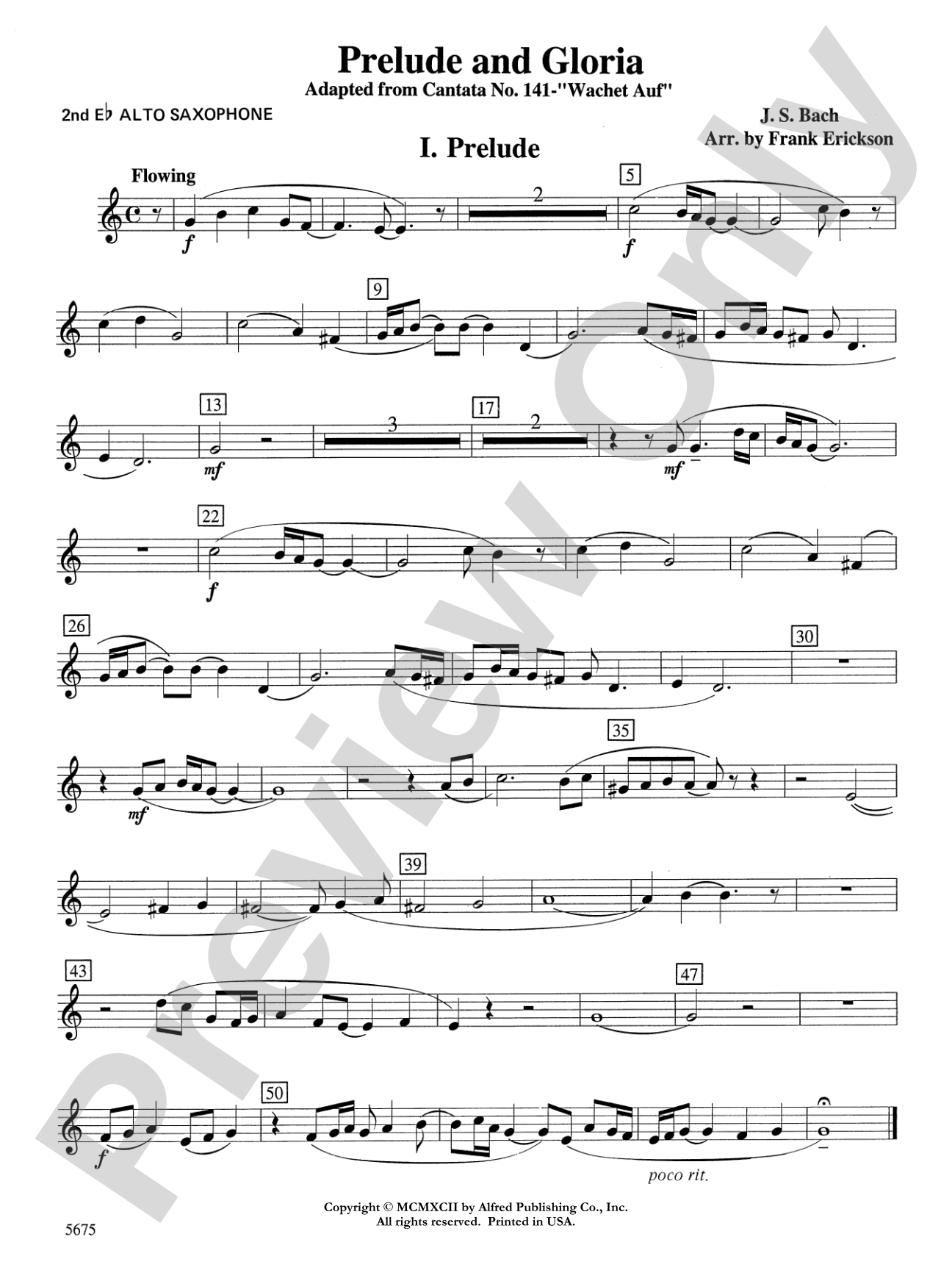

Prelude and Gloria (Adapted from Cantata No. 141 -- "Wachet Auf"): 2nd E-flat Alto Saxophone
By Johann Sebastian Bach / arr. Frank Erickson
Grade: 3 (Medium)
Item: 00-PC-0001908_AX2
$5.99
Pickup currently not available
Description
The melody, 'Wachet Auf' ('Sleepers, Wake') was not composed by Bach, but was used by him in three of the seven movements of his Cantata No. 141. This arrangement features adaptations of the third and last movements of the Cantata. An introduction has been added, as well as a finale for the Gloria, for a more cohesive presentation. Contrasting movements offer fantastic opportunities to focus on contrapuntal and chorale playing. (Grade 3---Medium) This title is available in MakeMusic Cloud.


Don't just read it, hear it, play along with it, and watch your students grow with it. In MakeMusic Cloud, Prelude and Gloria (Adapted from Cantata No. 141 -- "Wachet Auf"): 2nd E-flat Alto Saxophone comes alive with professional accompaniment, adjustable tempo, and built-in practice tools that turn solo practice into real progress.
Open in the Player
Jump straight in and assign it today.
Start Your Free Trial
Open this title and explore the full library in minutes.
Sample Audio
1
Audio File
--:--
0:00
0:00
Sample Video
No sample videos found.
Additional Details
Series:
Alfred Concert Band
Publisher:
Alfred Music
Page Count:
264
SKU:
00-PC-0001908_AX2
More about this title
About the Composer: Johann Sebastian Bach
Johann Sebastian Bach (1685-1750) was a German composer and organist whose mastery of counterpoint and harmonic language fundamentally shaped Western music. His output spanned nearly every genre of his era except opera, from sacred cantatas and passions to instrumental works for keyboard and ensemble. Bach's compositional techniques, particularly his command of fugue and chorale treatment, remain the foundation of music theory pedagogy today.
Why we love this
Frank Erickson's arrangement strips away nothing essential from Bach's original counterpoint while making it brilliantly accessible to a Grade 3 band. The structural decisions here are instructive: pairing the Prelude with the Gloria creates dramatic shape, and Erickson's added introduction and finale give students a complete musical arc to perform rather than a fragment. You'll find this works equally well in a festival setting or a concert program where you want to anchor the evening with something substantial.
What to expect
The Prelude opens with understated dignity, building gradually through layered instrumental voices that echo Renaissance polyphony. When the Gloria arrives, the energy lifts; there's brightness and declaration without losing the Baroque language. Throughout, the piece sustains a reverent but never heavy character, balancing Bach's structural rigor with the warmth of familiar melody.
Who it's for
Band directors programming a concert that demands musical substance without excessive complexity. Grade 3 ensembles with solid fundamentals in rhythm and note reading but still developing independence in part playing will thrive on this arrangement.
How to get the most out of it
- Balance the inner voices carefully during the contrapuntal passages. Many students fixate on melody and bass; remind your ensemble that the alto and tenor lines are not accompaniment but integral threads in the fabric.
- The transition from Prelude to Gloria rewards clear conducting and ensemble attention. Mark that moment in rehearsal as a crucial phrase boundary, not just a tempo or key change.
- Shape the chorale passages with a singing tone that respects Bach's harmonic rhythm. Avoid making it mechanical; each chord should breathe and connect to the next.
- Use the score's contrasting textures as a teaching opportunity. Isolate the imitative sections and have students trace the melodic line as it passes between sections.
How to use it
Program this as a concert opener or as the centerpiece of a second half designed around Baroque and early music. It pairs naturally with other arranged masterworks or with original concert band compositions that share similar contrapuntal thinking. The piece is also sturdy enough for festival performance, where its musical maturity will distinguish your ensemble.
Skills your students will build
- Reading and sustaining independent melodic lines in contrapuntal texture
- Recognizing and balancing inner voice importance in four-part harmonic writing
- Understanding chorale style and how to voice block chords with musical shape
- Tracking thematic material as it moves between instrumental sections
- Responding to clear structural contrasts (Prelude vs. Gloria) and style shifts within a single piece