Prelude and Fugue in D minor: Piccolo Sheet Music Preview

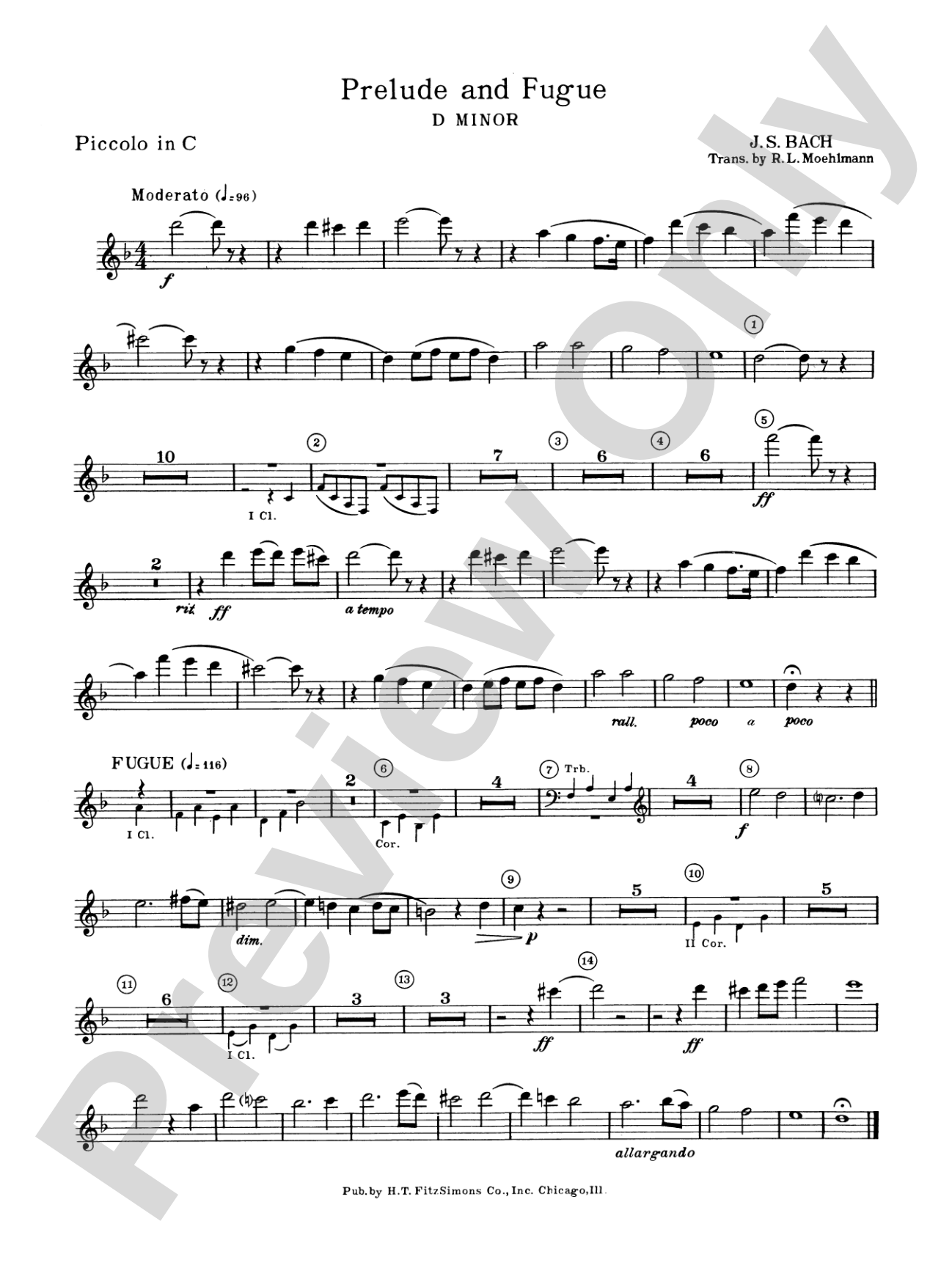
Prelude and Fugue in D minor: Piccolo

By Johann Sebastian Bach / arr. R. L. Moehlmann

Grade: 4 (Medium Difficult)

Item: 00-PC-0001644_P1

Digital Download
$3.00
Description

Don't just read it, hear it, play along with it, and watch your students grow with it. In MakeMusic Cloud, Prelude and Fugue in D minor: Piccolo comes alive with professional accompaniment, adjustable tempo, and built-in practice tools that turn solo practice into real progress.

Sample Audio
No sample audio found.
Sample Video
Additional Details
Series: Alfred Concert Band
Publisher: Alfred Music
Page Count: 78
SKU: 00-PC-0001644_P1

More about this title

About the Composer: Johann Sebastian Bach

Johann Sebastian Bach (1685-1750) stands as one of history's most systematic and prolific composers, crafting works across every major genre except opera. His mastery of counterpoint, harmonic innovation, and structural architecture established techniques that would influence centuries of composers. For music educators, Bach represents the gold standard of musical craftsmanship: his works reward deep study and reveal new layers with each rehearsal.

Bach's keyboard works, including his Preludes and Fugues, were originally conceived as teaching pieces and compositional models. They encapsulate his philosophy that music should be both intellectually rigorous and spiritually moving. When arranged for modern ensembles, these works maintain their pedagogical power while introducing students to the scaffolding of Western musical thought.

Why we love this

Moehlmann's arrangement captures the intricate polyphonic writing that makes Bach essential listening without sacrificing the brilliance of the original counterpoint. A Grade 4 concert band can deliver a performance that feels genuinely substantial and musically mature, offering your students encounter with architectural mastery rather than simplified melodic adaptation. This piece carries real weight in a festival program.

What to expect

The Prelude unfolds with contemplative grandeur, its harmonic language both ancient and strangely modern in its emotional directness. The Fugue that follows builds methodically from its initial subject, weaving strands of melody into increasingly elaborate textures until voices cascade in rich abundance. There is order and inevitability in this music, a sense that every note was placed exactly where it belongs.

Who it's for

Concert bands at the Grade 4 level ready to tackle substantial literature with contrapuntal complexity. This works for groups preparing festival entries or seeking repertoire that challenges musicianship without requiring extreme technical facility. Directors seeking to broaden student exposure to art music beyond standard band composers will find this arrangement an accessible gateway.

How to get the most out of it

  • Treat each voice line as a melody line in its own right; inner parts carry thematic material that demands as much attention as the primary voice. Sectional rehearsals focused on individual instrumental families help musicians understand their role in the polyphonic texture.
  • The Prelude's harmonic rhythm moves differently than modern tonal music; let the ensemble feel the underlying pulse without rushing through suspension points. These moments of rest and resolution are compositional destinations, not obstacles.
  • Balance and blend shift constantly as voices move between instruments. Frequent full-ensemble run-throughs with attention to relative dynamic levels ensure transparency without sacrificing unified sound.
  • The Fugue's subject enters in different keys and registers; clearly mark these expositions in rehearsal so students recognize the architecture unfolding rather than hearing disconnected phrases.

How to use it

This work functions as a centerpiece that elevates an entire concert when programmed strategically. Consider pairing it with one contrasting work of lighter character to provide relief, or position it as the culminating piece of your program when audience attention is deepest. The 78-page score indicates substantial length, so verify duration before scheduling alongside other selections.

Skills your students will build

  • Reading and performing independent polyphonic voice lines within an ensemble context
  • Understanding baroque harmonic language and suspension resolution
  • Balancing dynamic levels among multiple melodic strands
  • Recognizing fugal structure and subject entries across instrument families
  • Performing with historical awareness and stylistic sensitivity to baroque articulation and phrasing

You May Also Like