Prelude and Fugue in D Minor Sheet Music Preview

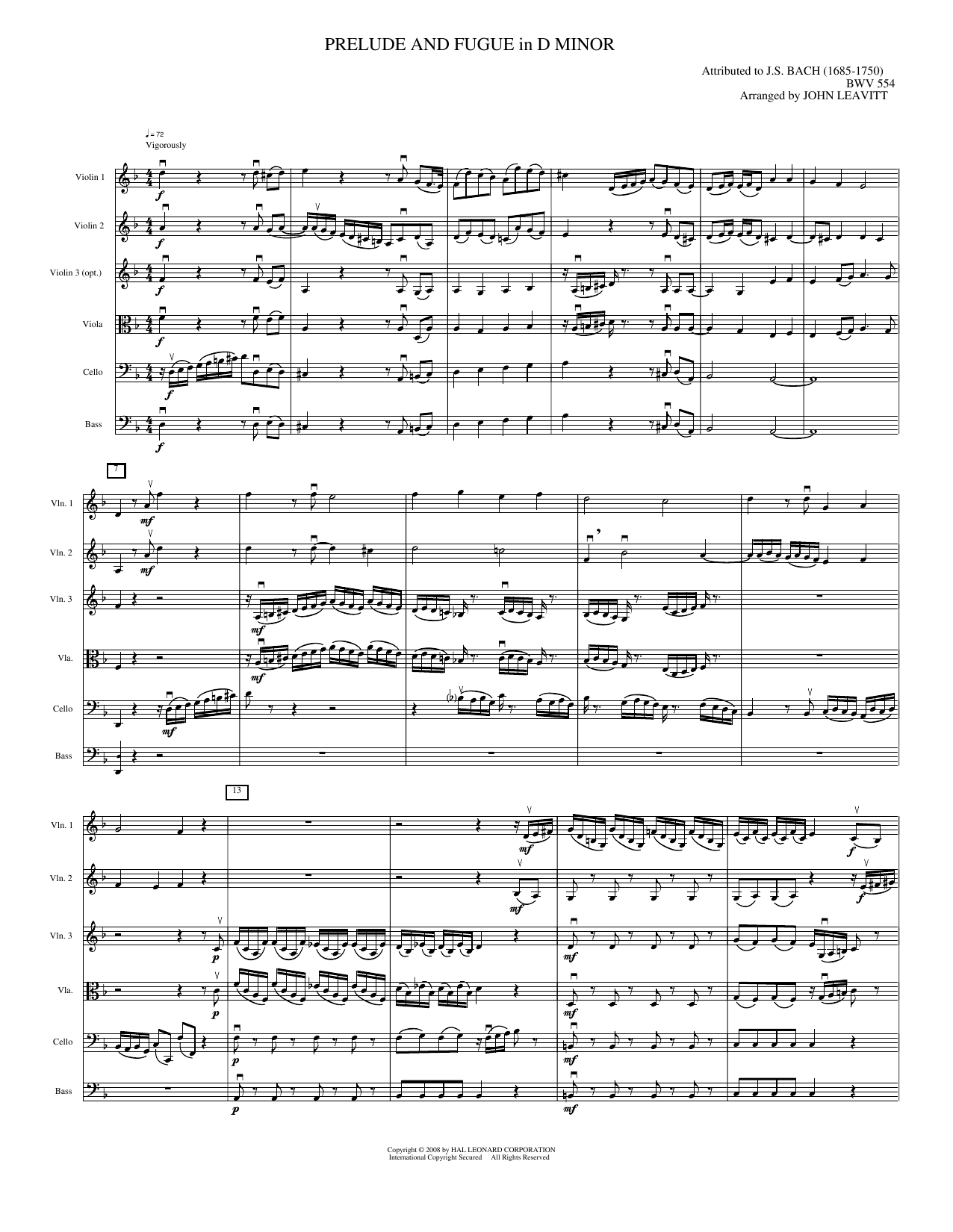
Prelude and Fugue in D Minor: String Orchestra Conductor Score & Parts

By Johann Sebastian Bach / Arranged by John Leavitt

Grade: 3-4

Item: 35-PK00426657

Digital Download
$45.00

Buy Extra Parts (Digital PDF Download)

Product Price Quantity
Prelude and Fugue in D Minor - Full Score $45.00

Parts Added to Cart!

Description
Prelude and Fugue in D Minor

Prelude and Fugue in D Minor: String Orchestra Conductor Score & Parts isn't in MakeMusic Cloud just yet...but it could be. Let us know you'd like to see it, and you'll help shape what comes next. In the meantime, start a free trial and dive into thousands of interactive titles your students can play along with today.

Sample Audio
No sample audio found.
Sample Video
Additional Details
Publisher: Hal Leonard
SKU: 35-PK00426657

More about this title

About the Composer: Johann Sebastian Bach

Johann Sebastian Bach (1685-1750) was a master of counterpoint and structural innovation whose works remain foundational to music education. His output spanned every genre of his era except opera, and his harmonic language influenced centuries of composers who followed.

Why we love this

John Leavitt's arrangement captures the architectural brilliance of Bach's original without overcomplicating string writing. The Prelude's reflective character and the Fugue's contrapuntal logic give young players the experience of playing substantive baroque music rather than simplifications that strip away the source's integrity.

What to expect

Introspective and deliberate, the Prelude unfolds with a contemplative gravity before yielding to the intellectual momentum of the Fugue. The piece carries the architectural precision characteristic of Bach's keyboard works, adapted here for the warmth and sustain of strings.

Who it's for

String orchestras at the intermediate level seeking authentic baroque repertoire that respects the source material while remaining performable by developing players. Directors wanting their ensembles to experience Bach's harmonic language and contrapuntal writing without requiring advanced technical facility.

How to get the most out of it

  • Shape the Prelude's arpeggiated figures as though they're breathing phrases rather than static accompaniment; resist the urge to make them rhythmically rigid.
  • In the Fugue, identify which section carries the subject at any given moment and ensure that voice projects clearly while maintaining ensemble balance.
  • Take time during sectionals to hear how the fugal entries stack; students grasp the form much faster when they understand their own line's relationship to others.
  • Let the harmonic rhythm guide tempo decisions rather than external metronome settings. Bach's voice leading often suggests natural expressive fluctuation.

How to use it

Position this as an opening work on a concert featuring other baroque selections, or use it as a centerpiece in a program exploring fugal form across different periods. It works particularly well alongside later arrangements of Bach or as an introduction to contrapuntal writing for ensembles beginning serious study of musical structure.

Skills your students will build

  • Voice independence in contrapuntal texture
  • Recognition and execution of fugal form
  • Baroque articulation and phrasing conventions
  • Harmonic listening and balance in four-part writing
  • Sustaining legato tone while maintaining rhythmic integrity

You May Also Like