
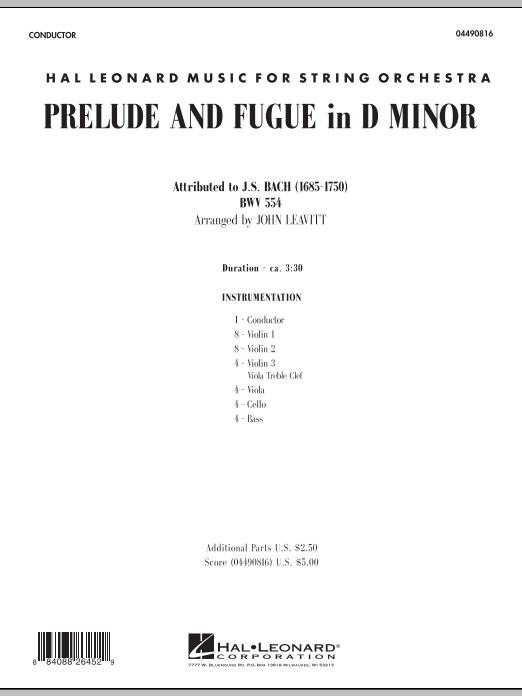

Prelude and Fugue in D Minor: String Orchestra Conductor Score & Parts
By Johann Sebastian Bach / Arranged by John Leavitt
Grade: 3
Item: 35-PK00117402
$45.00
Pickup currently not available
Buy Extra Parts (Digital PDF Download)
Parts Added to Cart!
Description
Taken from one of Bach's keyboard collections, this adaptation for strings by John Leavitt becomes an exquisite movement for performance. Independence of line, rhythmic connection between sections, and strong melodic structure will also give students meaningful insight into the genius of J.S. Bach. Dur: 3:30


Prelude and Fugue in D Minor: String Orchestra Conductor Score & Parts isn't in MakeMusic Cloud just yet...but it could be. Let us know you'd like to see it, and you'll help shape what comes next. In the meantime, start a free trial and dive into thousands of interactive titles your students can play along with today.
Request This Title
Tell us you want it.
Start Your Free Trial
Explore everything that's ready to play right now.
Sample Audio
No sample audio found.
Sample Video
No sample videos found.
Additional Details
Publisher:
Hal Leonard
SKU:
35-PK00117402
More about this title
About the Composer: Johann Sebastian Bach
Johann Sebastian Bach (1685-1750) stands as the foundational master of Western music theory and compositional technique. His work across keyboard, vocal, and instrumental genres established harmonic and counterpoint practices that musicians still study today, making him essential to any serious music education program.
Bach's ability to weave independent melodic lines into seamless musical architecture transforms what could be academic exercise into profound artistic statement. For students, his works offer unparalleled opportunity to understand how structure serves expression rather than constraining it.
Why we love this
Leavitt's orchestration respects Bach's contrapuntal genius while giving string players genuine voice independence that reveals itself through performance rather than theoretical study. The three-and-a-half-minute duration fits perfectly into mixed programs, and the Grade 3 level makes this accessible without sacrificing the intellectual rigor that makes Bach rewarding to teach.
What to expect
Austere at first, then architecturally revealing. The prelude establishes harmonic language through careful voice leading, while the fugue unfolds like a logical argument, each entry adding weight and clarity rather than confusion. The piece carries formal elegance without coldness; Bach's D minor key gives it reflective depth.
Who it's for
String orchestras at the intermediate level who are ready to engage with genuine contrapuntal writing. Directors introducing students to Bach's music beyond simple chorale arrangements will find this adaptation both pedagogically sound and genuinely performable.
How to get the most out of it
- Bring out the subject line in each section distinctly; the prelude's opening melodic gesture should remain recognizable even as accompanying voices gain texture.
- Balance inner voices carefully during the fugal entries. Younger orchestras often spotlight the first violin at the expense of the viola and cello lines that drive the harmonic progression.
- Shape phrases across the bar line rather than stopping at obvious punctuation marks. The architecture of Bach's melody depends on forward momentum.
- Use the recorded accompaniment to lock ensemble entries in the fugue's exposition, particularly where entries overlap or occur in unexpected register.
How to use it
Consider pairing this with other Baroque string works to create a coherent concert section, or position it as a concert opener that establishes sophisticated repertoire standards early. It also serves as excellent teaching tool during the study of fugal form, allowing students to hear theory actively at work.
Skills your students will build
- Recognition and balance of fugal subject entries across different voice parts
- Sustaining independent melodic lines while maintaining ensemble cohesion
- Understanding harmonic progression through voice leading rather than chord symbols
- Phrasing across bar lines in formal structures
- Stylistic awareness of Baroque articulation and ornamentation