
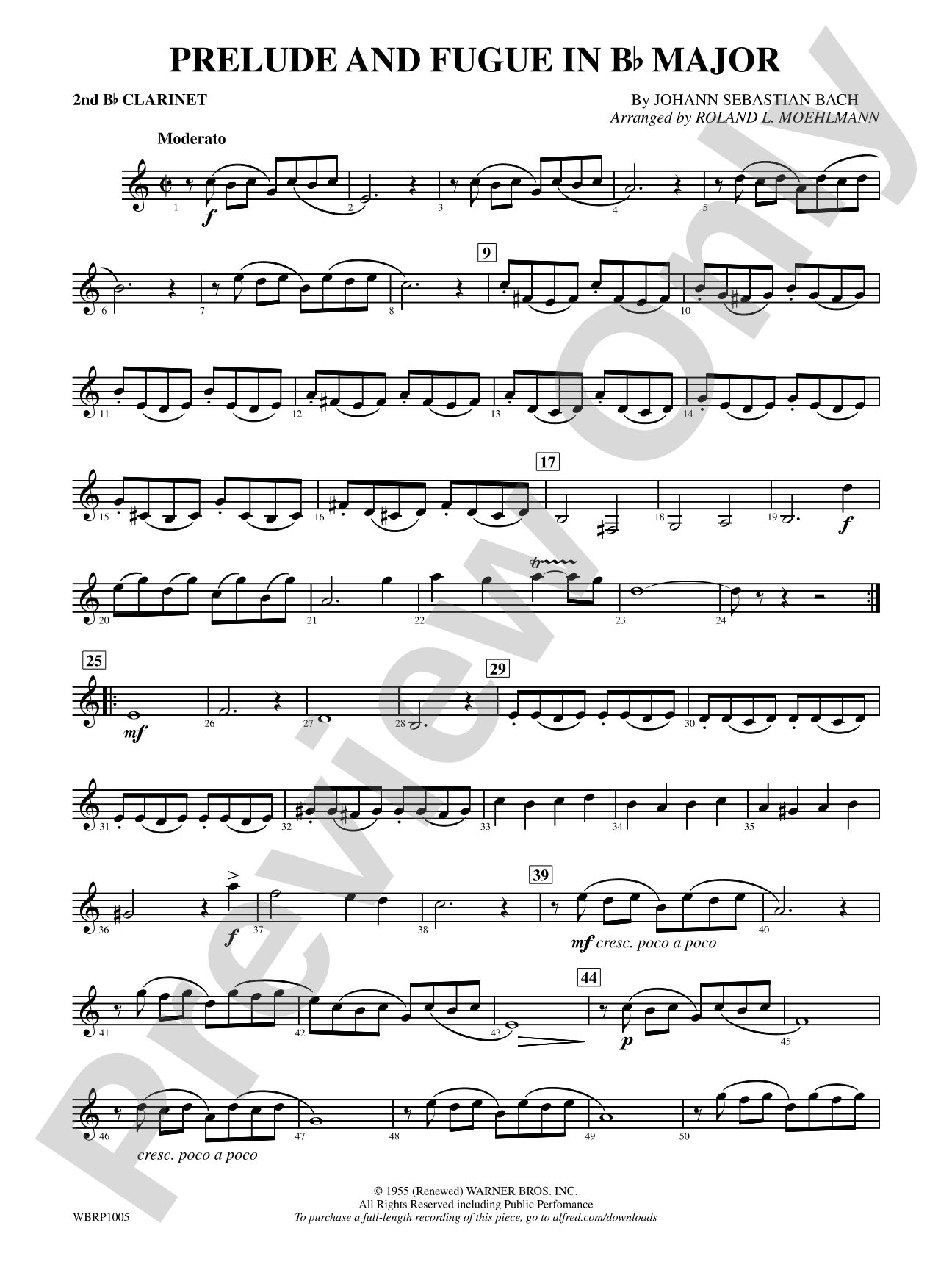

Prelude and Fugue in B-Flat Major: 2nd B-flat Clarinet
By Johann Sebastian Bach / arr. Roland L. Moehlmann
Grade: 3 (Medium Easy)
Item: 00-PC-0002605_C2
$3.00
Pickup currently not available
Description
The Roland E. Moehlmann arrangement of Johann Sebastian Bach's "Prelude and Fugue in B-flat Major" was originally scored in 1955 and remains on contest and festival lists. The fluid prelude establishes the melody and then it is amended musically with fascinating intricacy. Clarity of the composer's intent is certain in this time-honored arrangement. Classic repertoire for your concert band. Freshly re-engraved, this is must in every serious band music library! This title is available in MakeMusic Cloud.


Don't just read it, hear it, play along with it, and watch your students grow with it. In MakeMusic Cloud, Prelude and Fugue in B-Flat Major: 2nd B-flat Clarinet comes alive with professional accompaniment, adjustable tempo, and built-in practice tools that turn solo practice into real progress.
Open in the Player
Jump straight in and assign it today.
Start Your Free Trial
Open this title and explore the full library in minutes.
Sample Audio
1
Audio File
--:--
0:00
0:00
Sample Video
Additional Details
Series:
Belwin Classic Band
Publisher:
Alfred Music
Page Count:
182
SKU:
00-PC-0002605_C2
More about this title
About the Composer: Johann Sebastian Bach
Johann Sebastian Bach (1685-1750) stands as one of history's most influential composers, reshaping what was musically possible during the Baroque era. His mastery of counterpoint, harmonic invention, and structural clarity set the standard for centuries of composers who followed. Bach's works span sacred and secular forms, from intricate fugues to cantatas and concertos, all unified by his relentless pursuit of musical logic and emotional depth.
For band directors, Bach represents the gold standard of musical architecture. His ability to weave multiple melodic lines into coherent wholes provides students with models of clarity and intent that elevate any program. When a Bach work appears on a festival or contest list, audiences recognize immediately that serious musicianship is at hand.
Why we love this
Roland Moehlmann's 1955 arrangement unlocks Bach's architectural brilliance for concert band without sacrificing the integrity of the original voice leading. The prelude-fugue pairing gives your group a complete statement: contemplative opening followed by intellectual rigor and forward momentum. This is the kind of repertoire that reminds audiences (and students) why the concert band medium matters.
What to expect
The prelude unfolds with measured elegance, its fluid lines suggesting both contemplation and forward motion. Once the fugue takes hold, the music locks into intellectual precision; multiple lines weave in and out, each one essential to the whole, creating a sense of inevitability and architectural balance.
Who it's for
This arrangement serves Grade 3 bands ready to engage with Baroque counterpoint in a concert band context. Directors seeking quality literature for contests, festivals, or concerts will find a work with proven longevity and educational substance.
How to get the most out of it
- Attend carefully to the implied harmonic motion in the prelude. Even though Bach's melodies soar, the underlying progressions drive the piece forward; keep them audible rather than buried beneath scoring.
- Balance the fugal entrances so that each voice line remains distinct without any one section overwhelming the others. This demands sectional clarity and dynamic restraint.
- Establish a steady, unhurried tempo for the prelude that allows the fluid passage work to breathe; rushing flattens the contemplative character.
- Use the printed parts to identify which sections carry thematic material at any given moment. This shared awareness helps musicians hear their role within the larger contrapuntal design.
How to use it
Program this as the centerpiece of a concert that honors classical form and structure, or place it on a contest program where its contrapuntal clarity will stand out among more contemporary works. The work's moderate length and Grade 3 accessibility make it an ideal choice for mid-season programming when your ensemble has built ensemble strength and sectional independence.
Skills your students will build
- Tracking individual voice lines within contrapuntal texture
- Maintaining steady tempo through harmonic progression rather than phrase accent
- Balancing multiple simultaneous melodic lines
- Understanding fugal form and thematic transformation
- Achieving clarity of articulation in passage work