
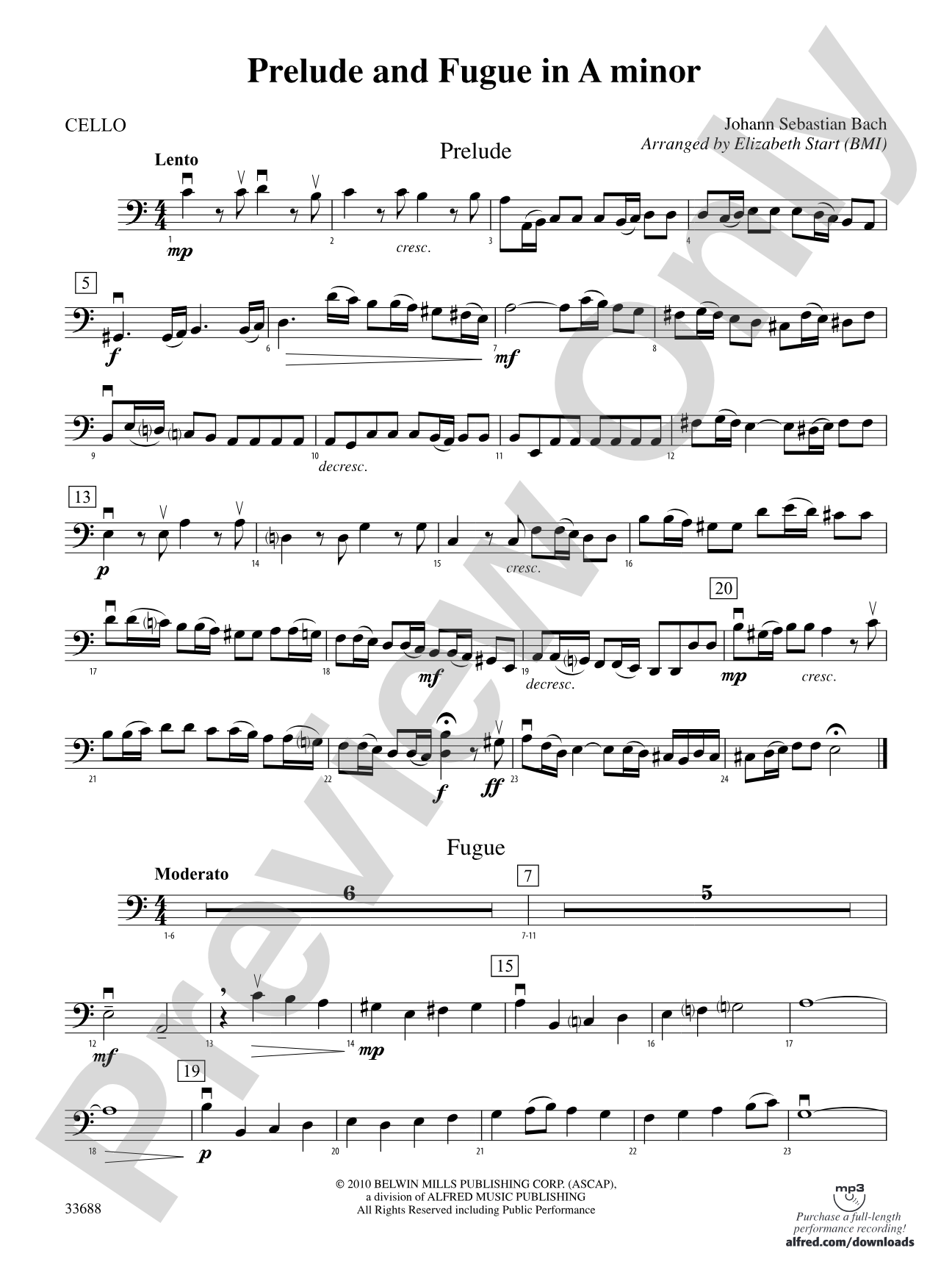

Prelude and Fugue in A Minor: Cello
By Johann Sebastian Bach / arr. Elizabeth Start
Grade: 3.5
Item: 00-PC-0014477_VC1
$5.99
Pickup currently not available
Description
From Book I of Bach's The Well-Tempered Klavier, this lively reworking of the "Prelude and Fugue in B-flat minor, No. 22" provides students the wonderful experience of playing Baroque counterpoint in a minor key. Though rhythms are not complex, counting skills will be honed. The piece remains mainly in first position, yet also includes melodic augmented seconds. In the five-part fugue, the double basses have their own independent line, so let them shine.


Don't just read it, hear it, play along with it, and watch your students grow with it. In MakeMusic Cloud, Prelude and Fugue in A Minor: Cello comes alive with professional accompaniment, adjustable tempo, and built-in practice tools that turn solo practice into real progress.
Open in the Player
Jump straight in and assign it today.
Start Your Free Trial
Open this title and explore the full library in minutes.
Sample Audio
1
Audio File
--:--
0:00
0:00
Sample Video
No sample videos found.
Additional Details
Series:
Belwin Concert String Orchestra
Publisher:
Alfred Music
Page Count:
124
SKU:
00-PC-0014477_VC1
More about this title
About the Composer: Johann Sebastian Bach
Johann Sebastian Bach (1685–1750) stands as one of history's most influential composers, a master of counterpoint whose works form the foundation of Western music theory and practice. His systematic exploration of harmonic language and fugal technique established principles that musicians still study and teach today. The Well-Tempered Klavier, composed across two books, demonstrates Bach's genius for combining technical rigor with musical depth; it remains essential repertoire for understanding how composers think about key relationships, voice leading, and structural architecture.
Why we love this
This arrangement gives your orchestra authentic access to Bach's counterpoint without requiring the technical command or interpretive maturity typically needed for string arrangements at this level. Elizabeth Start's scoring honors the original while allowing young musicians to experience the satisfaction of playing interdependent lines that lock together in real time. The minor key adds dramatic color to a work students know from keyboard study, and the independent bass line gives your lower strings genuine musical responsibility rather than just rhythmic support.
What to expect
The prelude flows with lively forward motion, its sixteenth-note figuration creating a sense of gentle urgency that feels almost improvisatory despite its careful construction. The fugue opens with quiet authority, gradually gathering voices as the subject passes through the ensemble; by its conclusion, the interweaving lines create a complex, satisfying polyphonic texture that rewards both player and listener with the clarity of well-balanced counterpoint.
Who it's for
This work suits Grade 3.5 string orchestras ready to engage with counterpoint and independent voice writing across the full ensemble. Orchestras preparing for concert festivals or competitions will find a piece that demonstrates musical sophistication and technical control without overwhelming young players. Teachers seeking to build students' literacy in Baroque style and harmonic thinking through active performance will find this arrangement particularly valuable.
How to get the most out of it
- Balance the four-part fugal writing by rehearsing voice pairs separately (violins with violas, cellos with basses) so each line maintains clarity even when all parts enter together.
- Approach the prelude's flowing sixteenth-note passages as vocal lines rather than technical exercises; shape each phrase with a gentle arc and let the harmonic rhythm beneath guide your tempo flexibility.
- In the fugue, give the double basses confidence before full rehearsal. Their line is genuinely compositional, not accompanimental; they anchor the harmonic foundation and deserve space to lock in securely.
- Pay close attention to the augmented seconds in the melodic writing. These intervals are characteristic of the minor key and create a distinctly Baroque color; resist the urge to smooth them out or shrink them.
How to use it
Place this work in a concert program that explores Baroque instrumental writing, perhaps pairing it with a single-movement contemporary piece in a contrasting key or mode to highlight how Bach's harmonic language shaped later composers. The piece works equally well as a contest selection or as a centerpiece for a concert exploring "Masterworks Reimagined for Young Ensembles." Its moderate length makes it an ideal closer for a program or a strong anchor point that demonstrates your orchestra's musicianship and precision.
Skills your students will build
- Reading and performing independent voice lines in four-part and five-part fugal texture
- Counting in mixed meters and syncopated rhythms within a Baroque harmonic framework
- Recognizing and playing augmented seconds and other intervallic features of minor-key counterpoint
- Maintaining ensemble balance while each instrument carries genuine melodic material
- Understanding harmonic progression and functional bass lines through active performance